
SUPERVISED EDUCATION
Reading Pens for Special-Needs and One-to-One Programs
Educators and therapists use reading pens as supervised learning tools: clear tactile buttons, large tips for less precise pointing, earphone support for focused one-to-one work, durable housings and fixed or expandable audio. Configuration options cover prompt behavior, volume and button mapping; suitability for any learner is decided by the responsible professional.
Why These Characteristics
What institutional buyers specify
Large tips
Large-tip models (B2, L5, T2, Y6) are more forgiving of imprecise pointing by young or less dexterous learners.
Tactile, clear buttons
Distinct button counts and layouts support learners who benefit from simple, consistent controls.
Earphone support
Earphone jacks across the recommended range enable focused, individual listening in shared settings.
Defined volume behavior
Maximum-volume limits and prompt sounds are configured to the program, not left at retail defaults.
Firmware configuration
Button mapping, prompts, auto power-off and fixed audio sets can be defined for the program.
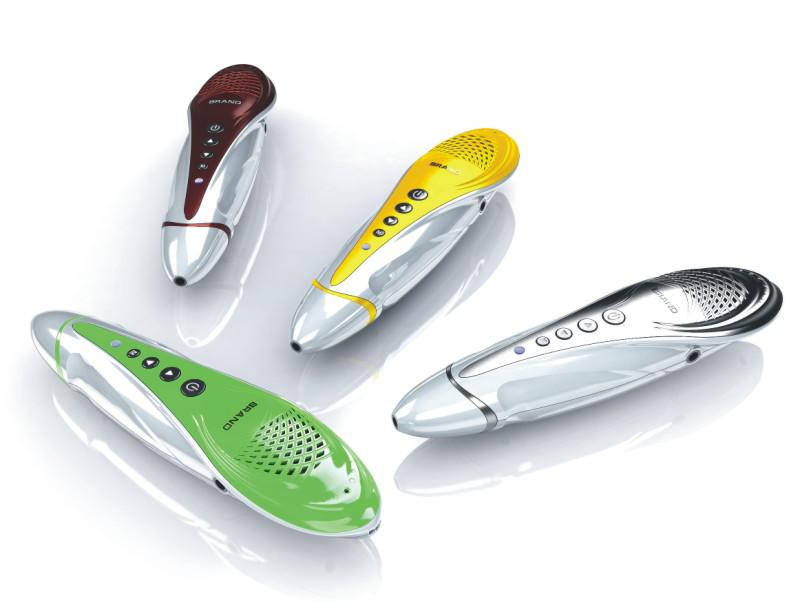
Candidate Models
Starting points for professional evaluation



Important Boundary
A learning tool, not a therapeutic claim
Reading pens are electronic educational products. We do not claim that any model treats, diagnoses or remediates a condition. Institutions and professionals evaluate suitability themselves, and we support that evaluation with accurate specifications, samples and configurable firmware behavior rather than medical-style promises.
Questions
Special-needs program questions
Which model suits learners with limited dexterity?
Large-tip models such as B2 and L5 are the usual starting points; the professional evaluator should confirm with samples, since needs vary by learner.
Can the audio set be fixed and simple?
Yes. Preloaded fixed audio sets, button mapping and prompt behavior can be configured; the soldered-NAND F8 is the most locked option where content simplicity is required.
Can learners use headphones?
All four candidate models include earphone jacks for individual listening in classrooms and therapy rooms.
Do you provide efficacy evidence for specific conditions?
No. We make no therapeutic claims; we provide accurate hardware specifications, compliance documents and evaluation samples to the responsible professionals.
Can the pen interface be simplified for learners with additional needs?
Yes. Firmware can be configured with simplified controls, larger tactile buttons, adjusted volume curves and predictable content paths; tell us the intended learning setting and we align the configuration during sampling.
Order evaluation samples with exact specifications
Describe the supervised use, button and audio requirements and the evaluator's checklist. The response names candidate models and sample terms.