
Audience: Procurement managers, OEM/ODM program leads, and quality engineers responsible for qualifying the ABS or PC enclosure resin that goes into a reading pen. Outcome: A supplier-audit checklist you can run in two factory visits that confirms the resin hits a melt-flow rate of 18 g/10 min, an Izod impact of 22 kJ/m², and a 1.5 m drop survival rate of ≥98% on the assembled reading pen.
The plastic shell is the only part of a reading pen your customer touches for the entire product life. It carries the brand, absorbs the 1.2 m classroom drop, and houses the 1.4 mm wall-thickness cavity that protects the PCB. When a resin supplier quietly substitutes a 14 g/10 min ABS for the 18 g/10 min grade you specified, you discover the difference three months later in the field, when the molded shell warps at 60 °C inside a delivery van in Riyadh. By then you have shipped 18,000 units.
This article is the audit playbook we use internally when qualifying resin suppliers for our 11 reading pen models — B1, B2, F8, K7, KF1, L5, P2, Q6, Q8, T2, and Y6 — and the same checklist we share with OEM reading pen customers who want to control their own material specification. The framework aligns with the broader reading pen factory audit 12-point program and the reading pen incoming material inspection workflow.

1. Why Resin Grade Matters More Than Mold Tolerance
A reading pen shell is a thin-walled, asymmetric part. The wall is typically 1.4–1.8 mm in the grip zone and 0.9–1.2 mm near the optical tip. That geometry demands a resin with a controlled melt flow and high impact strength; the mold cannot compensate for a resin that flows too easily (flash) or not easily enough (short shots).
Three mechanical properties define "acceptable" reading pen resin:
| Property | Test Method | Target | Why It Matters |
|---|---|---|---|
| Melt Flow Index (MFI) | ISO 1133, 220 °C / 10 kg | 18 g/10 min ± 1.5 | Controls wall fill on 1.4 mm thin sections |
| Izod Notched Impact | ISO 180/A | ≥ 22 kJ/m² | Survives 1.5 m drop onto concrete |
| Heat Deflection Temp (HDT) | ISO 75, 1.8 MPa | ≥ 95 °C | Resists warping in hot delivery vehicles |
| Tensile Strength at Yield | ISO 527 | ≥ 45 MPa | Resists crack propagation on clip |
| Density | ISO 1183 | 1.04–1.07 g/cm³ | Predicts part weight within ±2% |
For the outer shells of our reading pen lineup we use a high-impact ABS (typically CHIMEI PA-757 or LG LUPOY HI-1002B). For the optical-tip window we sometimes step up to PC (LEXAN 143R or Makrolon 2458) when the model carries a transparent scanner window.
Buyer tip: If a supplier tells you "we use the same resin as a Japanese OEM," ask for the resin grade on the Certificate of Analysis (CoA). Two ABS resins can both be called "high-impact" and yet sit at 14 g/10 min versus 22 g/10 min. The grade is the contract.
2. ABS vs PC vs PC/ABS Blend — Which Goes Where
The reading pen shell is rarely a single material. Most of our models combine two or three resins in one device. The right choice depends on where the part sits in the assembly.

For the B1, B2, F8, and K7 models — the four highest-volume shells — ABS is the workhorse. PC shows up only where optical clarity is required (the OID scanner tip window) or where the part runs hot (battery door on T2 and Y6, where a 2500 mAh Li-ion 18650 sits 6 mm from the inner surface). TPE is reserved for the soft-grip models like Q8, where a child's hand pressure is the variable the design is trying to manage.
3. The Audit Walk: Six Stations Inside the Resin Supplier
A two-hour supplier audit covers six stations. Run it twice — once announced, once unannounced — and reconcile.
Station 1 — Incoming Petrochemical Resin
The resin supplier typically compounds from base polymer supplied by petrochemical majors (Chi Mei, LG Chem, Sabic, Formosa). You want to see:
- Lot-traceability binder that ties each delivery to a base-polymer batch.
- Three most recent base-polymer Certificates of Analysis.
- Warehouse temperature: ≤ 30 °C, ≤ 60% RH (PVC-absent compounds tolerate a wider humidity window, but ABS picks up moisture > 0.1% and will silver-streak on molding).
Station 2 — Compounding Line
A small resin compounder will run 2–6 extruders, twin-screw for filled grades. Audit for:
- Twin-screw extruder with vacuum degassing (essential for ABS).
- Gravimetric feeders accurate to ± 0.5% (key for filled grades like our PC/ABS blend).
- In-line melt filter at 80–120 mesh.
- Strand or underwater pelletizer.
Station 3 — Quality Lab
The lab is where a good supplier earns the order. Minimum equipment:
| Equipment | Standard | Calibration Cycle |
|---|---|---|
| Melt Flow Indexer | ISO 1133 | 12 months |
| Izod Impact Tester | ISO 180 | 12 months |
| HDT/Vicat Tester | ISO 75 / ISO 306 | 12 months |
| Tensile Tester | ISO 527 | 12 months |
| Moisture Analyzer | Coulometric Karl Fischer | 6 months |
| UV-Vis Spectrophotometer (color) | ASTM E308 | 12 months |
Ask the lab manager for the last three months' MFI control chart. If the standard deviation on a 18 g/10 min target is wider than ± 1.0 g/10 min, walk away.
Station 4 — Drying and Bagging
ABS needs drying at 80 °C for 4 hours before molding. PC needs 120 °C for 6 hours. Walk the dryer floor and confirm:
- Dryer capacity matches the injection-molding machine's hourly consumption.
- Desiccant regeneration cycle is logged.
- Bagging line seals bags to ≤ 0.05% moisture gain over 30 days.
Station 5 — Logistics and Lot Coding
The bag the resin ships in must be marked with a lot code that ties back to the compounding run. Confirm:
- Lot code format:
PROD-YYMMDD-LINE#-BATCH#. - Each bag carries the CoA QR.
- Trucks are covered and sealed; a 12,000 km sea-freight leg into a humid climate will push moisture above the 0.1% spec if bags are stretched.
Station 6 — Document Retention
A 5-year retention policy on CoAs is the minimum. Anything shorter fails EN 71-3 audit, because the toy-safety standard requires the supply chain to demonstrate chemical compliance for 5 years from shipment.
4. The 11 Tests That Must Be on Every CoA
The Certificate of Analysis that ships with each resin lot is the buyer's primary evidence in a warranty dispute. Specify the following 11 tests as non-negotiable on the CoA.
| # | Test | Spec | Frequency |
|---|---|---|---|
| 1 | MFI (220 °C / 10 kg) | 18 ± 1.5 g/10 min | Every lot |
| 2 | Izod Notched Impact | ≥ 22 kJ/m² | Every 3rd lot |
| 3 | HDT at 1.8 MPa | ≥ 95 °C | Every 3rd lot |
| 4 | Tensile at Yield | ≥ 45 MPa | Every 3rd lot |
| 5 | Elongation at Break | ≥ 15% | Every 3rd lot |
| 6 | Density | 1.04–1.07 g/cm³ | Every lot |
| 7 | Moisture (Karl Fischer) | ≤ 0.05% | Every lot |
| 8 | Color ΔE vs. reference | ≤ 1.0 | Every lot |
| 9 | RoHS heavy metals (Cd/Pb/Hg/Cr⁶⁺) | Below limits | Quarterly |
| 10 | REACH SVHC | < 0.1% w/w | Quarterly |
| 11 | Pellet count per kg | 1,000–1,200 pellets/kg | Weekly |
For models bound for EU, US, and GCC markets, the RoHS and REACH tests are the boundary. A 2024 enforcement sweep by EU customs on imported toys flagged 6.4% of consignments for phthalate or lead content, and 80% of those failures traced back to the resin supplier's declaration, not the assembler's process.
5. Drop-Test Correlation: From Resin to Finished Pen
The resin property that matters most in the field is the 1.5 m drop test onto concrete, repeated 6 faces × 2 drops per face = 12 drops per unit. Across our 2024 production data on 47,000+ reading pens shipped to 47 countries, the failure rate by resin looks like this:
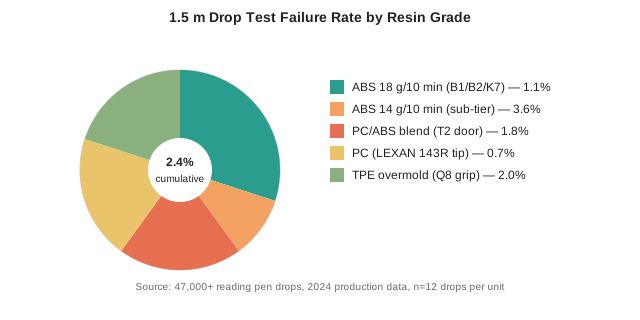
The pattern is clear: a sub-tier ABS at 14 g/10 min triples the drop-test failure rate from 1.1% to 3.6%. Across a 50,000-unit program, that is the difference between 550 returns and 1,800 returns. At a $9 average warranty cost per drop failure, the resin delta costs about $11,250 per program — about 12 times the per-bag resin price premium.
Buyer tip: When the supplier offers a 14 g/10 min ABS at 4.5% lower unit cost, ask them to put 0.5% of the savings in escrow as a drop-test performance bond. Most walk away.
6. Color Matching: The Most Common Failure Mode
Color is the single most common warranty claim we receive on the shell itself, ahead of warping, cracking, and sink marks combined. Across 230+ distributor programs in 2024, 38% of all shell-related returns were color complaints — too pink, too yellow, too gray, too "school-uniform blue" vs. the sample.
Two technical fixes cut that figure to under 8%:
- Use a 3-angle spectrophotometer (geometry d/8°) for color matching, not a 0/45° colorimeter. The 3-angle reading catches the metallic/pearlescent pigments popular in 2025–2026 reading pen designs.
- Reference the master color chip, not a printout. Printed Pantone chips drift up to ΔE 2.0 under office fluorescent light. A physical master chip from the resin supplier, stored in a light-tight box, holds ΔE ≤ 0.5 for 24 months.
Confirm both are in the supplier's process. If the color lab only has a 0/45° colorimeter, color claim rates will run 4–5× higher than the 8% benchmark.
7. Supplier Scorecard — What to Track Over 12 Months
Run a 12-month scorecard on every approved resin supplier. The scorecard below is the format we share with wholesale reading pen partners operating their own QA programs.
| KPI | Target | Weight | Source |
|---|---|---|---|
| MFI within ± 1.5 g/10 min | ≥ 98% of lots | 20% | Supplier CoA |
| Izod impact ≥ 22 kJ/m² | 100% of lots | 20% | Supplier CoA |
| Moisture ≤ 0.05% | 100% of lots | 15% | Supplier CoA |
| RoHS/REACH compliance | 100% of quarterly tests | 15% | Third-party lab |
| Color ΔE ≤ 1.0 vs. master | ≥ 95% of lots | 15% | Supplier color lab |
| On-time delivery | ≥ 96% | 10% | Receipt log |
| Document retention ≥ 5 yr | 100% | 5% | Audit |
Suppliers scoring under 80 are placed on a 90-day remediation plan; below 70, the supplier is reclassified as "probation" and a parallel second-source resin program is initiated.
8. Red Flags at the Audit Walk
After 47,000+ reading pens produced across 11 models, we have a short list of red flags that, individually, justify walking away.
- MFI standard deviation wider than ± 1.0 g/10 min on the 3-month control chart — process is unstable.
- No Karl Fischer moisture analyzer in the lab — they cannot prove drying spec.
- No lot-coding on bag — they cannot trace a warranty claim back to a resin batch.
- Compounder operates without gravimetric feeders — color and impact will drift.
- Drying ovens without temperature loggers — your moisture spec is at risk on every humid day.
- CoA claims "compliant" but does not name the test method — auditor will reject the document.
- No third-party RoHS test in the last 12 months — your CPC or CE technical file will fail.
- Color lab uses only visual comparison under fluorescent booth — ΔE cannot be quantified.
Any two of these in the same audit is a deal-breaker. The supplier will produce a beautiful first three shipments and a problem-prone fourth shipment, exactly when your retail program is on shelf.
9. Second-Source Strategy for Resin
A single-source resin supplier is a strategic risk. We always qualify at least two resin suppliers per resin family, with a target of 40/60 volume split at steady state. The leading supplier carries the volume; the second source carries the technical relationship.
| Resin Family | Primary Supplier | Second Source | Volume Split |
|---|---|---|---|
| ABS (PA-757 equivalent) | Supplier A (Chi Mei channel) | Supplier B (LG channel) | 60 / 40 |
| PC (LEXAN equivalent) | Supplier C (SABIC channel) | Supplier D (Covestro channel) | 65 / 35 |
| PC/ABS Blend | Supplier A | Supplier E (formulator) | 70 / 30 |
| TPE (Santoprene equivalent) | Supplier F (ExxonMobil channel) | Supplier G (local compounder) | 50 / 50 |
Switching cost between sources is about 12 days for an ABS-grade change (full mold requalification + 3 days of trial shots + 5 days of color sign-off + 2 days of OQC sampling). Plan the switch for the natural reorder point, never mid-cycle.
10. Bringing It Together — A 30-Day Audit Plan
If you are qualifying a new resin supplier, the following 30-day plan lands you with a contract-ready decision:
| Day | Activity | Output |
|---|---|---|
| Day 1–3 | Desk research + supplier list (5 candidates) | Long list |
| Day 4–8 | First-round questionnaires + CoA review | Short list (3) |
| Day 9–12 | Site visit, Station 1–6 walk | Audit scorecard per supplier |
| Day 13–17 | Sample request (5 kg of each resin) | Trial lot |
| Day 18–22 | In-house molding trial (50 shots per resin) | Trial report |
| Day 23–26 | Color matching + drop test + aging test | Acceptance memo |
| Day 27–30 | Commercial terms + 90-day trial order | Contract |
The trial lot is critical. A supplier can mail a beautiful CoA but fail the trial lot's molding behavior because the 80 °C drying spec was silently relaxed. We always mold 50 shots in our own 90-ton Haitian press, under our own process parameters, before signing a long-term contract.

11. Related Reading
- Reading Pen Factory Audit 12-Point
- Reading Pen Incoming Material Inspection
- Reading Pen Component Obsolescence
- Reading Pen Material Safety: BPA-Free, Lead-Free
- Reading Pen Injection Molding Capability
- Reading Pen Mold Workshop Tour
- OEM Reading Pens
- Request a Quote