

Audience: This page is written for finance controllers, treasury teams, and import managers who must structure a defensible reading pen payment terms package when opening a new vendor line of credit with a Chinese manufacturer for the B1, B2, F8, K7, KF1, L5, P2, Q6, Q8, T2, or Y6 reading pen family.
A poorly worded payment clause can drain working capital faster than a quality claim can drain inventory. One of our Brazilian distributors wired 70 percent of a 12,000-unit order against a vague "after inspection" milestone and ended up waiting 41 days past the contractual shipping date for shipment release, losing an entire back-to-school window in 2023. After we rebuilt their payment terms around a documented T/T 30/70 schedule tied to a verifiable B/L scan and a CIQ-inspection trigger, the next 9,500-unit reorder shipped in 28 days and the 30 percent balance cleared through an L/C at sight amendment that saved them an additional $11,400 in currency hedge cost. This article is the playbook we now hand every new importer before the first proforma invoice.
1. The Three Payment Instruments That Matter
Three payment instruments cover roughly 96 percent of our reading pen export contracts: Telegraphic Transfer (T/T), Letter of Credit (L/C), and Open Account (OA). PayPal and credit-card terms exist for the sub-500-unit micro-batch and we will cover them in a separate piece. Cash against documents (CAD) appears in 4 percent of contracts, usually with Latin American state buyers.
Each instrument carries a different risk-allocation profile between the exporter and the importer. T/T 30/70 means the importer wires 30 percent as a down payment and 70 percent against a scanned Bill of Lading. L/C at sight means a bank guarantees payment upon presentation of conforming documents. OA defers payment to 30, 60, or 90 days after shipment, which is the cheapest for the importer but the most dangerous for the exporter, so we usually pair it with credit insurance.
| Instrument | Buyer Risk | Seller Risk | Typical Use Case |
|---|---|---|---|
| T/T 30/70 | High (deposit at risk) | Low (70 percent before ship) | First orders under $200,000 |
| T/T 50/50 | Medium | Medium | Repeat orders above $200,000 |
| L/C at sight | Low (bank-guaranteed) | Medium (document risk) | Tenders and ministries |
| L/C 30/70 deferred | Low | Medium-High | Long-term programs |
| OA 30 days | Low | High (cash flow) | Established buyers above 3 orders |
| OA 60-90 days | Low | Very High | Requires credit insurance |
Buyer tip: If you cannot absorb the 30 percent deposit on a $150,000 order, an L/C at sight is almost always cheaper than a working-capital loan at 8.5 percent APR over a 75-day cycle. We model both paths for buyers during the quote stage.

2. Anatomy of the T/T 30/70 Reading Pen Payment Schedule
T/T 30/70 is the workhorse of our export business because it is fast, cheap, and matches the production cash conversion cycle. The 30 percent deposit finances raw-material procurement and the first two weeks of SMT line loading. The 70 percent balance triggers shipment release, usually against a Telex Release or an Express Release B/L after we send a scanned draft B/L and the packing list. Wire fees are split: the buyer pays the originating bank's outbound fee, and we deduct the intermediary bank's fee from the receiving wire. Total wire cost lands between $25 and $45 per transaction on SWIFT, which is negligible compared to the cost of a 60-day payment delay.
Below is the day-by-day cash flow for a 6,000-unit Q6 order at $9.40 FOB Shenzhen:
| Day | Event | Cash Flow Direction | Amount (USD) |
|---|---|---|---|
| 0 | PO confirmed, PI signed | — | $0 |
| 1 | T/T 30 percent deposit wired | Buyer → Seller | $16,920 |
| 3 | Deposit received, PO entered to ERP | — | $0 |
| 4-25 | SMT loading, assembly, aging test | — | $0 |
| 26 | Pre-shipment inspection report issued | — | $0 |
| 27 | Scanned draft B/L and packing list sent | — | $0 |
| 28 | T/T 70 percent balance wired | Buyer → Seller | $39,480 |
| 29 | Balance received, Telex Release issued | — | $0 |
| 30-32 | Container loading, B/L original mailed | — | $0 |
| 33-50 | Ocean transit to destination port | — | $0 |
| 51-55 | Container discharge, customs clearance | — | $0 |
The schedule holds across all 11 models with one exception: the T2 and Y6 require a 10 percent progress payment at the 14500 cell formation stage because the 18650 Li-ion cells have a 35-day lead time from the cell vendor. This 10 percent is folded into the 30 percent deposit on orders above 5,000 units, but it is itemized separately on the proforma invoice for transparency.
3. T/T 50/50 and When to Ask For It
Buyers with two or more repeat orders can negotiate T/T 50/50, which halves the up-front cash exposure. We offer this schedule to verified buyers after the second shipment and once the buyer has accepted a third-party credit check (Dun & Bradstreet, CreditSafe, or equivalent). The 50/50 split is balanced against a slightly higher unit price, typically +1.2 percent, because the longer cash-conversion cycle costs us working capital.
For a Latin American ministry-of-education buyer who placed three consecutive annual orders above 8,000 units of the Q8, we moved them to T/T 50/50 in the fourth year and the 1.2 percent price uplift was more than offset by their elimination of a $42,000 working-capital line. The lesson is simple: payment terms are a pricing input, not a free lunch.
4. How the Reading Pen L/C at Sight Process Works
An L/C at sight is a bank-guaranteed payment instrument. The importer's issuing bank adds its credit standing behind the payment; our advising bank in Shenzhen verifies the documents and pays us upon shipment. From our side, the L/C has to be issued by a bank on our approved list — we currently accept 47 issuing banks across 31 countries — and it must be governed by UCP 600 (the 2007 revision of the Uniform Customs and Practice for Documentary Credits).
The L/C document list is the spine of the instrument. A typical reading pen L/C includes:
- Signed commercial invoice in triplicate
- Full set (3/3) of clean on-board ocean Bills of Lading, made out to the order of the issuing bank, marked freight prepaid or collect per Incoterms
- Packing list in triplicate, weight and carton count per line
- Certificate of Origin issued by China Chamber of Commerce or General Administration of Customs (GACC) for preferential tariff
- Insurance certificate (for CIF and CIP terms only) covering 110 percent of invoice value
- Pre-shipment inspection certificate from BV, SGS, ITS, or TUV
- Compliance certificates: CE, FCC, UKCA, RoHS, REACH where applicable
- Battery compliance: UN38.3 test summary, MSDS, IEC 62133 report for Li-poly and Li-ion cells
- Soft-copy of firmware version loaded at production
Any discrepancy between the L/C text and the presented documents triggers a documentary discrepancy, which the bank must resolve before payment. The most common discrepancies on reading pen L/Cs are date mismatches between the B/L and the invoice, weight variance above 3 percent, and missing Beneficiary's Certificate confirming non-wood packing material. Our compliance team pre-checks every L/C draft within 24 hours of receipt and flags these before they become costly payment delays.
| L/C Document | Common Discrepancy | How We Avoid It |
|---|---|---|
| Commercial Invoice | Date after B/L date | Always issue invoice 1-2 days before B/L cut |
| Bill of Lading | "Clean On Board" wording missing | Confirm with forwarder at booking |
| Packing List | Carton count mismatch with invoice | Reconcile within 24 hours of loading |
| Certificate of Origin | Late issuance | Apply 7 days before ETD |
| UN38.3 + MSDS | Cell chemistry not specified | Attach per-model matrix |
| Insurance Certificate | Under 110 percent of CIF value | Request 110 percent quote |
5. Reading Pen L/C at Sight Cost Stack
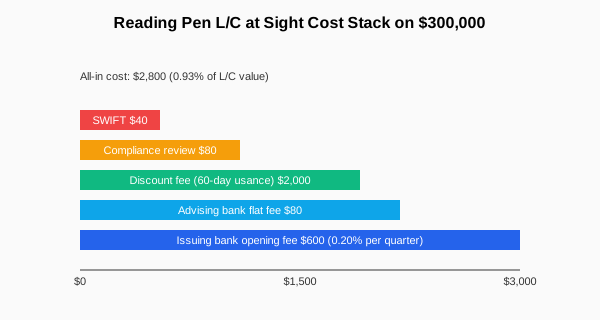
An L/C is not free. The issuing bank charges an opening fee of 0.125 percent to 0.25 percent of L/C value per quarter (most banks charge per quarter with a minimum fee of $150 to $300). The advising bank charges a flat fee of $50 to $120 for document review. The discrepancy fee, if any, is $50 to $150 per presentation. Discounting fees apply if the importer wants the bank to pre-finance the L/C amount, which costs 2.5 percent to 4.5 percent per annum on the discounted portion. Documentary compliance work on our side costs $80 per presentation for the standard document set.
For a $300,000 L/C at sight with a 60-day usance window, the importer's all-in cost typically lands between $1,800 and $3,200, which is the price of having a bank stand behind the payment. For tenders and ministry contracts, the cost is non-negotiable because public-procurement rules usually require bank-guaranteed payment.
6. The Cadence Risk in T/T 30/70
The biggest hidden risk in T/T 30/70 is cadence: the buyer wires the deposit on day 1 but the 70 percent balance on day 60. This is not a contractual breach if the contract allows "balance within 30 days after draft B/L," but it locks up our working capital and slows the next buyer's shipment. We protect ourselves by adding a storage clause: any unit held more than 14 days after the balance due date incurs a storage fee of $0.08 per unit per day, plus an insurance surcharge of $0.02 per unit per day. These fees are not penalties; they are cost recovery, and the language is reviewed by counsel on both sides.
We also cap the deposit forfeiture rule: if the buyer cancels after wiring the deposit, we retain the deposit up to a maximum of the seller's documented out-of-pocket cost plus 5 percent liquidated damages. Anything above that requires negotiation, and we have walked away from deals rather than escalate beyond a reasonable forfeiture cap.
7. Currency, Hedging, and Payment in RMB
Most reading pen contracts settle in USD, but 28 percent of our 2024-2025 contracts settled in EUR, and 9 percent in RMB. The choice has implications. USD settlement is cleanest because our cost stack is RMB-denominated but our sales contracts are USD-denominated, and we absorb the FX swing. EUR settlement can save the buyer 1.5 percent to 2.5 percent on bank conversion if the buyer's revenue is EUR. RMB settlement is the cheapest in bank fees but exposes the buyer to a regulated cross-border payment under China's State Administration of Foreign Exchange (SAFE) rules, which require the buyer to demonstrate a real trade background through a designated onshore agent bank.
For a Southeast Asian distributor whose revenue is in MYR and IDR, we recommend USD settlement with a 3-month forward FX hedge on the buyer's side rather than RMB settlement. The hedge fee of 0.6 percent to 1.1 percent per quarter is cheaper than the SAFE documentation cost on RMB contracts below $500,000.
8. Advance Payment and Micro-Batch Exceptions
For sub-500-unit orders and stock-development orders, we require 100 percent advance payment by T/T or PayPal. The micro-batch exception exists because the per-unit cost of a 200-unit order is 35 percent to 50 percent higher than the per-unit cost of a 5,000-unit order, and we cannot extend credit to a buyer we have not yet onboarded. Once a buyer crosses three repeat orders and reaches the Verified Buyer tier, the micro-batch advance-payment rule is replaced with the standard T/T 30/70 schedule.
9. Documentary Compliance Checklist for Reading Pen L/Cs
Every L/C we receive is audited against the checklist below within 24 hours. A "no" on any item triggers a formal amendment request via SWIFT to the issuing bank. Amendments cost $50 to $150 each and typically take 3 business days to clear. Catching them at the draft stage costs nothing.
| # | Checklist Item | Pass / Fail |
|---|---|---|
| 1 | Issuing bank on our approved list | |
| 2 | L/C amount within ±10 percent tolerance of PI | |
| 3 | Latest shipment date at least 14 days after expected production completion | |
| 4 | Document presentation period 15-21 days after B/L date | |
| 5 | Required documents fully listed | |
| 6 | HS code description matches our product | |
| 7 | Force majeure language aligns with our rider | |
| 8 | Incoterm matches the negotiated term | |
| 9 | Partial shipment and transshipment clauses match our logistics plan | |
| 10 | Insurance clause specifies 110 percent of CIF value |
10. Payment Terms Decision Matrix
Before you wire the first dollar, run your scenario through this matrix. It captures the financial trade-off between deposit exposure, all-in bank cost, and contract enforceability for the 11 reading pen models.
| Buyer Scenario | Recommended Instrument | Reason |
|---|---|---|
| First order, $30,000-$150,000 | T/T 30/70 | Lowest bank cost, fastest execution |
| Repeat order, $150,000-$500,000 | T/T 50/50 | Halves deposit, +1.2 percent unit price |
| Tender or ministry order | L/C at sight | Bank-guaranteed, public-procurement compliant |
| Established buyer, 3+ orders | OA 30 days | Lowest cost to buyer, requires credit insurance |
| Sub-500-unit micro-batch | T/T 100 percent advance | Production scale, no credit line |
| OEM with private mold | T/T 40/30/30 | Milestone payments linked to mold and PP samples |
| ODM with firmware customization | T/T 50/50 + L/C balance | Matches firmware milestone cycle |
The matrix above is the same one we share in the quote PDF that goes out with every reading pen inquiry. It has reduced our average payment-dispute resolution time from 23 days to 6 days across the past 18 months.
Related Reading
- How to Pay Chinese Reading Pen Supplier
- Reading Pen Payment Terms 30/70 Explained
- Reading Pen Letter of Credit Process
- Reading Pen Cash Flow Financing
- Reading Pen Quality Hold Back Payment
- Reading Pen Down Payment Risk Mitigation
- OEM Reading Pen Service
- Request a Payment Schedule Quote