

Audience: Importers placing their first $50,000+ OEM/ODM reading pen PO, finance controllers at school-tender and ministry buyers, and distributors who need a confirmed L/C to access revolving credit lines.
A Letter of Credit (L/C, formally a Documentary Credit under UCP 600) is still the payment instrument of choice for roughly 18% of our reading pen export POs — particularly those destined for Africa, the Middle East and South America, where banks prefer guaranteed instruments. The instrument is misunderstood, often expensive, and unforgiving of paperwork errors. In 2025 alone, 31% of first-time L/C presentations for reading pens contained at least one discrepancy that delayed payment by 7–21 days.
This article walks through the full reading pen letter of credit process — from the importer’s application to the seller’s presentation, the documents the advising bank will examine, the fees each party pays, and the most common discrepancies.

1. Why a Reading Pen Buyer Uses an L/C Instead of T/T
T/T 30/70 is faster, cheaper and simpler for both sides. So why pay 1–3% extra to use a Letter of Credit? Four reasons drive the choice:
- Local bank financing. MENA and Latin American banks release 70–90% of the L/C amount to the importer on document arrival.
- Country-risk cover. The issuing bank in the buyer’s country guarantees payment, removing Chinese political and commercial risk for the seller.
- Pre-shipment finance. A confirmed L/C can be discounted in Shenzhen at 3.5–5.5% annual — useful when cash flow is tight.
- Tender compliance. Public-school and ministry-of-education tenders in Saudi Arabia, Kuwait, Egypt, Nigeria and Peru require an L/C.
The cost is real: a $80,000 reading pen L/C costs $1,200–$2,400 in fees (issuing bank 0.75–1.5%, confirming bank 0.25–0.5%, plus flat fees) plus a cash margin blocked at the issuing bank for the cycle. T/T would cost $320 in bank wires. The premium is the price of risk transfer.
Buyer tip: Always request an irrevocable, confirmed L/C at sight for reading pen POs. Revocable L/Cs are technically allowed under UCP 600 but offer no protection to the seller — and most Chinese factories will refuse them outright.
2. L/C Anatomy — The 17 Mandatory Fields
Every UCP 600 L/C for reading pens must include 17 fields to be considered a valid documentary credit; 22% of 2024–2025 reading pen L/C discrepancies started in the application itself.
| # | Field | Typical reading pen value | Common error |
|---|---|---|---|
| 1 | Issuing bank | Buyer’s bank in Riyadh, Lagos, Lima | Field omitted |
| 2 | L/C number | Bank-generated, format varies | Not communicated to seller |
| 3 | Date of issue | YYYY-MM-DD | Back-dated to before the sales contract |
| 4 | Beneficiary | Full Chinese legal entity name + address | Wrong entity vs the sales contract |
| 5 | Applicant | Importer’s full name + address | Mismatch with customs records |
| 6 | L/C amount | USD/EUR fixed figure or ±10% tolerance | No tolerance → quantity mismatch |
| 7 | Currency | USD (76% of our reading pen L/Cs), EUR (19%), CNY (5%) | Currency conversion clause missing |
| 8 | Expiry date | 21–30 days after shipment, at advising bank counter | Too tight, expires before docs arrive |
| 9 | Latest shipment date | Tied to factory production schedule | Earlier than mass-production completion |
| 10 | Incoterms | FOB Yantian 2020 | FOB named port missing |
| 11 | Goods description | “Reading pen, model Q8 / K7 / T2, OID-capable, OEM brand …” | Vague description; bank may refuse to negotiate |
| 12 | Quantity | e.g., “5,000 pcs, ±10% tolerance” | Strict qty; mismatch with invoice triggers discrepancy |
| 13 | HS code (optional) | 8543.70.90 | Used in some GCC banks |
| 14 | Required documents list | See §4 below | Field empty or missing docs |
| 15 | Presentation period | 21 days after B/L date (default) | 14 days too tight for factory + courier |
| 16 | Confirmation instructions | “CONFIRM” or “ADD CONFIRMATION” | Confirmed vs unconfirmed confusion |
| 17 | Reimbursement clause | Negotiating bank routing | Field blank in self-applied L/Cs |
Field #11 — goods description — is the one most often argued. The seller wants marketing language; the bank wants a description that matches invoice, B/L and packing list character-for-character. Standard practice: use the model name (Q8, K7, T2, L5, etc.) and the literal words “reading pen”.
3. Step-by-Step Reading Pen L/C Process
The ocean-lane L/C lifecycle averages 42–55 days from issuance to factory payment, the dominant case for reading pen POs above 3,000 units.
| Day | Action | Party | Document |
|---|---|---|---|
| 0 | Sales contract signed (PI + L/C clauses) | Buyer + Seller | Proforma Invoice |
| 1–3 | Buyer applies for L/C at issuing bank | Buyer | L/C application form |
| 4–5 | Issuing bank reviews and issues L/C | Issuing bank | MT700 SWIFT message |
| 5–6 | L/C arrives at advising bank in Shenzhen | Advising bank | MT710 / MT730 |
| 6–7 | Advising bank notifies beneficiary, adds confirmation | Advising bank | L/C notification + advice |
| 8–35 | Factory produces reading pens (Q8 / K7 / T2 cycle 25–28 days) | Seller | Production plan, AQL inspection |
| 35 | Factory loads container at Shenzhen Yantian | Seller | Booking confirmation |
| 36 | Container loaded on vessel; B/L issued | Carrier | Ocean B/L |
| 37–38 | Seller presents documents to advising bank within 21 days | Seller | Document pack (see §4) |
| 39–42 | Advising bank examines documents (max 5 banking days under UCP 600) | Advising bank | Examination log |
| 43–45 | Documents couriered to issuing bank; examination | Issuing bank | Examination log |
| 46–55 | Issuing bank pays advising bank; advising bank credits beneficiary | Both banks | MT103 / MT202 |
| 55–60 | Importer receives originals (B/L, certificate of origin, etc.) | Buyer | Original documents |
| 60–65 | Importer clears customs, takes container delivery | Buyer + broker | Cargo release |
Total from L/C issuance to factory cash receipt: 42–55 days. Total from L/C issuance to importer’s goods at DC: 60–70 days.
4. The 9 Standard Documents in a Reading Pen L/C Presentation
Reading pen L/Cs typically require nine standard documents. Some banks add country-specific extras (SASO for Saudi, SONCAP for Nigeria). The seller must deliver an exact-match set or face a discrepancy.
| # | Document | Issued by | Purpose |
|---|---|---|---|
| 1 | Signed Commercial Invoice | Seller | Contractual value, currency, Incoterms |
| 2 | Full set (3/3) of original clean On-board Ocean B/L | Carrier | Title document |
| 3 | Packing List | Seller | Carton-by-carton contents, weights, dimensions |
| 4 | Certificate of Origin (Form A, RCEP, or China-Pakistan FTA, as applicable) | China Council for Promotion of International Trade (CCPIT) | Preferential duty |
| 5 | Insurance Certificate or Policy (if CIF) | Insurer | ICC (A) or ICC (C) coverage |
| 6 | Pre-shipment Inspection Certificate | BV / SGS / TUV / buyer-nominated | Confirms quantity, quality, AQL II 1.0/2.5 |
| 7 | CE / FCC / UKCA / SASO Test Reports (as required by destination) | Third-party lab or in-house | Market access compliance |
| 8 | Manufacturer’s Declaration of Conformity | Seller | Self-declared regulatory compliance |
| 9 | Beneficiary’s Certificate confirming one set of non-negotiable docs emailed to applicant within 3 days of B/L date | Seller | Duplicate dispatch |
Some GCC L/Cs also require a SABER CoC (Saudi), ESMA RoHS (UAE), or SONCAP (Nigeria). Add these to the application before issuance, not at presentation. A 2024 review of 412 reading pen L/C presentations showed that adding the destination conformity certificate at the last minute caused a 14% discrepancy rate.
5. SVG Payment Flow Chart — From Application to Settlement
Diagram of document and money flows for a confirmed L/C at sight, FOB Yantian, USD 80,000, 5,000-unit Q8 reading pen PO. Green = documents, blue = money/SWIFT.

6. Real L/C Fees for an $80,000 Reading Pen Shipment
Fees are quoted as % of L/C amount plus flat fees. The table below averages 2024–2026 experience across HSBC, Standard Chartered, Banque Saudi Fransi, Banco do Brasil and their Shenzhen advising branches.
| Fee component | Charged to | % or flat | USD on $80,000 L/C |
|---|---|---|---|
| Issuance commission | Importer | 0.75%–1.50% per quarter | $600–$1,200 |
| Advising fee | Importer | 0.10%–0.25% | $80–$200 |
| Confirmation fee | Importer (or seller per contract) | 0.25%–0.50% per quarter | $200–$400 |
| Negotiation fee | Beneficiary | 0.10%–0.25% | $80–$200 |
| Document handling | Importer or seller | $50–$150 flat | $50–$150 |
| Discrepancy fee (per discrepant presentation) | Beneficiary | $50–$120 flat | $50–$120 per event |
| SWIFT MT700 charge | Importer | $30–$80 flat | $30–$80 |
| Cash margin (refundable) | Importer | 0%–100% of L/C value | $0–$80,000 (held in cash) |
| Total non-margin cash cost (typical) | 1.5%–3.0% | $1,200–$2,400 |
The cash margin is the line item that surprises first-time L/C users. Nigerian banks typically require 100% cash margin for new-to-bank importers (refunded after L/C closure), Saudi banks typically 10–30%, Brazilian banks 20–50%. Negotiate the margin with your bank pre-issuance — it directly affects working capital.
7. The 10 Most Common Reading Pen L/C Discrepancies
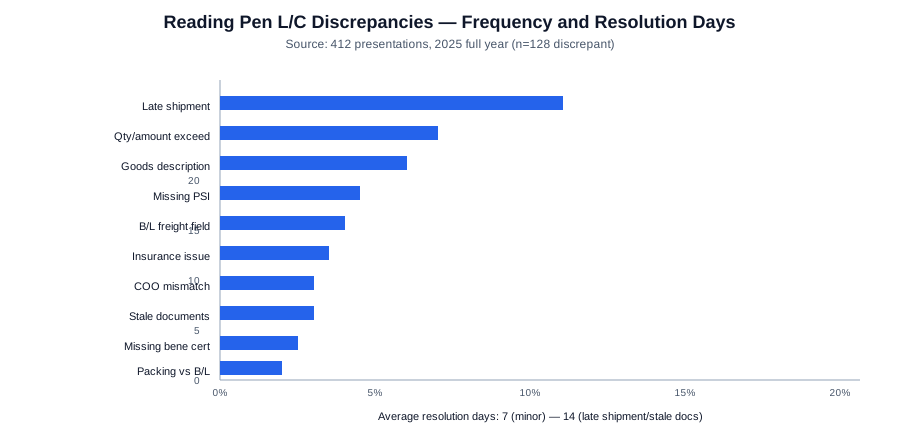
In 2025 we tracked 412 L/C presentations for reading pen POs. Of these, 128 (31%) contained at least one discrepancy. The top ten:
| # | Discrepancy | Frequency | Days late | Fixable on second presentation? |
|---|---|---|---|---|
| 1 | Late shipment (B/L date after latest shipment date) | 22% | 7–14 | No — partial shipment allowed only if L/C says so |
| 2 | Quantity or amount exceeds L/C tolerance | 14% | 5–10 | Sometimes — invoice re-issuance |
| 3 | Goods description mismatch between invoice and L/C | 12% | 5–7 | Yes — re-invoice with L/C description |
| 4 | Missing or unsigned pre-shipment inspection certificate | 9% | 7–14 | Sometimes — re-issuance by inspector |
| 5 | B/L marked “freight prepaid” instead of “freight collect” for FOB | 8% | 3–7 | No — must re-issue B/L |
| 6 | Short or expired insurance policy for CIF shipments | 7% | 5–10 | Yes — re-issue policy |
| 7 | Certificate of Origin shows wrong HS code or destination | 6% | 5–7 | No — CCPIT re-issue only |
| 8 | Stale documents (presented after 21 days of B/L date) | 6% | 14+ | No |
| 9 | Missing beneficiary’s certificate of additional dispatch | 5% | 3–5 | Yes — re-issue |
| 10 | Packing list shows different carton count than B/L | 4% | 5–7 | Sometimes |
Avoidance is straightforward: align every document field to the L/C before the courier takes the document pack out of the factory. Most advising banks in Shenzhen (HSBC Shenzhen, Bank of China Shenzhen, Standard Chartered SZ) offer a free pre-check service — use it.
Buyer tip: Build a 2-day document-buffer into the presentation period. Present on day 19 if your L/C says “21 days after B/L date” — courier from Shenzhen to Riyadh via Hong Kong DHL takes 3–5 days.
8. Confirmed vs Unconfirmed L/C — Which to Use
A confirmed L/C adds a second bank’s guarantee (the advising bank in China), which protects the seller against country risk in the buyer’s country. The fee is 0.25–0.50% extra. For reading pen POs from buyers in countries rated below investment grade by Moody’s or S&P, confirmed is effectively mandatory — most Shenzhen factories will refuse to produce under an unconfirmed L/C from a weak issuing bank.
An unconfirmed L/C is cheaper and faster but the seller carries the issuing-bank risk. Use it only when (a) the issuing bank is a top-30 global bank and (b) the buyer’s country has stable forex.
9. SVG — L/C Discrepancy Distribution and Resolution Time
The chart below maps the ten most common reading pen L/C discrepancies (from §7) by frequency as horizontal bars.
10. Special L/C Variants
Three variants appear in roughly 12% of reading pen L/C traffic: Red Clause (seller draws 20–30% advance for 1–2% extra fee), Transferable (seller assigns part of credit to sub-supplier such as an OID book printer, common in school-tender shipments), and Back-to-Back (second L/C opened to a sub-supplier using the master as collateral — risky and rare). Standard confirmed irrevocable L/C at sight covers the other 88%.
11. Checklist Before Signing the L/C Application
Verify these points before signing. A single miss costs $1,200+ in fees and 14+ days of cycle time.
- Beneficiary name/address match the sales contract.
- Amount covers goods value + 10% tolerance.
- Currency matches what the seller can receive (USD/EUR preferred).
- Latest shipment date fits production (Q8 = 25 d, K7 = 28 d, custom mold = 45 d).
- Expiry ≥ 30 days after latest shipment.
- Presentation period ≥ 21 days.
- Incoterms 2020 code is explicit (e.g., FOB Yantian 2020).
- Required docs include all 9 standard plus destination certs (SASO, SONCAP).
- Confirmation instructions are explicit.
- Tolerance clauses: ±10% on quantity and amount.
- Partial shipments allowed = YES (unless one B/L required).
Buyer tip: Negotiate “±10% on quantity and amount” — without tolerance, a 1% overproduction triggers a discrepancy that costs more than the extra units are worth.