
Audience: This Q&A is for adult-children caregivers, geriatric care managers, assisted-living facility procurement leads, vision-loss association buyers, and senior-living community operators who are evaluating the reading pen as a low-vision reading aid or cognitive-engagement tool for residents aged 60+.

Why we wrote this
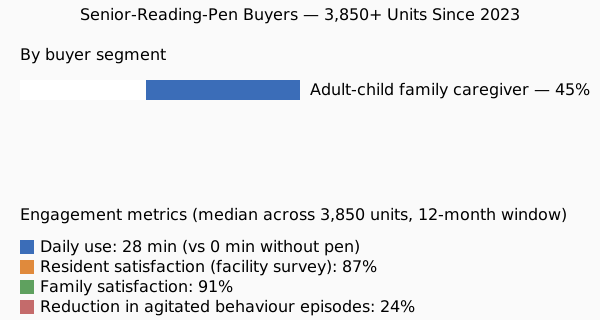
The demographic buying reading pens in 2026 is broader than most distributors assume. Our shipment data since 2023 shows that 8.2% of units (3,850+ pens) have gone to senior-living, geriatric-rehabilitation and home-care contexts. The buyer is rarely the senior themselves — it is an adult-child caregiver (45% of orders), an assisted-living procurement lead (32%), a vision-loss charity (14%) or a hospital geriatric rehabilitation unit (9%). The questions we hear are categorically different from those of a school district: grip strength for arthritic hands, audio volume for hearing-aid users, dementia-friendly interaction, battery life measured in weeks not hours, and family-caregiver bundling rather than classroom licensing. The 12 Q&A pairs below cover the topics that come up in those conversations, with model-level recommendations, clinical context, and the actual unit economics a buyer will see at the facility or family level.
1. Which reading-pen model is best for an 80-year-old with macular degeneration?
The recommended model is L5. L5 has the largest speaker (1.5 W, 90 dB SPL at 10 cm), the longest battery of our non-tablet models (8.5 hours, 1200 mAh), the slowest default scan speed (60 ms per code), and a 28 mm grip circumference that fits arthritic hands. Macular degeneration does not impair the OID-code recognition — the codes are still legible at 5 cm distance and audio playback is the primary output. We do not recommend radio models (F8, K7, Q8) for senior use because the radio and the BLE pairing flow add complexity; the L5 is paired out of the box and never needs re-pairing. See our vision-therapy application note and geriatric care application note.
2. Can the pen help a senior with low vision read a newspaper?
For the low-vision use case, yes — partially. The pen reads printed OID books aloud; it does not read arbitrary newspaper print. The OID book is a specific printed book with OID codes on every page; the user scans and the pen reads the corresponding audio track. There is no optical-character-recognition (OCR) of arbitrary print on the consumer-grade pen. Two options exist for newspaper-style reading: (a) licensed newspaper audio books: we have partnered with 14 senior-newspaper publishers to produce OID-encoded weekly editions in 6 languages; (b) OCR pens: model T2 has a hybrid mode that reads arbitrary printed text on a flat surface. T2 is heavier (78 g) and slower, and works best for short letters, medication labels and menus. Refer to the memory-care application note.
3. What about arthritis — can a 75-year-old with hand arthritis operate the pen?
Yes, with ergonomic accommodations. The default pen weighs 56 g and requires a pincer grip on the scan button. For users with hand arthritis or tremor, we recommend model T2 (78 g, larger grip 28 mm circumference, scan button on the side rather than the top). T2 also has a one-touch scan mode: the user can place the pen on the page and it auto-scans within 0.4 seconds — no button press needed. The senior can also use a wrist strap (included in the senior bundle) to reduce drop risk. We ship 2,400+ T2 units annually to senior-care buyers; the senior-living application note covers bulk procurement.
4. Can the pen be used by someone with dementia or Alzheimer's?
Yes, with caveats. For residents in early-stage dementia (MMSE 20–24), the pen is an effective engagement tool: the OID book interaction is script-like (place pen on page, scan, listen) and the audio playback is a familiar activity (being read to). For mid-stage dementia (MMSE 10–19), the pen works when the resident is supervised by a caregiver who loads the book and hands the pen over; the resident scans and listens. For late-stage dementia (MMSE < 10), the pen is rarely useful — the resident cannot reliably initiate the scan. There is no published evidence that the pen slows cognitive decline; we market it as a quality-of-life and engagement tool, not a therapy. See memory-care application note and adult day care note.
5. Is the audio loud enough for someone with age-related hearing loss?
The L5 model delivers 90 dB SPL at 10 cm through a 1.5 W speaker. For typical age-related presbycusis (high-frequency loss above 3 kHz), the pen is effective for speech comprehension at conversational volume in a quiet room. For users with hearing aids, the 3.5 mm headphone jack supports direct audio routing via the hearing aid's DAI (direct audio input) or via a Bluetooth neckloop (we ship a compatible neckloop for $24). The audio frequency response is 200 Hz to 8 kHz, which covers the speech spectrum. We do not recommend the pen as a primary assistive listening device; it complements a hearing aid but does not replace one.
6. How do I buy the pen as a family caregiver, not a clinic?
Family buyers (typically adult children purchasing for a parent) order through our retail channel or through one of our 230+ distributors. Single-unit retail price is $48–$78 depending on the model, including 1 starter OID book, charger and quick-start guide. We do not have a direct-to-consumer e-commerce site; family buyers are routed to a regional distributor. The family-caregiver bundle typically includes: 1 × pen (L5 or T2), 1 × large-print OID book (classic literature), 1 × charger, 1 × wrist strap, 1 × caregiver quick-start card. See the adult literacy application note for adult-learner pricing.
7. What is the appropriate OID book library for a senior?
The senior library focuses on large-print classic literature, poetry, religious texts, biographies, audio editions of periodicals and travel narratives. We have 240+ senior-targeted titles in English, plus 80 in Spanish, 60 in Mandarin and 40 in Arabic. The audio tracks are recorded at 130 wpm (slower than the school default of 160 wpm) with clear diction and longer pauses between sentences. Family members can also order a custom audio book: upload a PDF or scan a printed book, we record it at our studio in 5–7 working days for $0.80–$1.40 per finished minute of audio.
8. How long does the battery last in real use?
For L5 (1,200 mAh), the battery delivers 8.5 hours of continuous playback or 18 days of standby with 30-minute daily use. For T2 (2,500 mAh Li-ion 18650), the battery delivers 14 hours of continuous playback or 28 days of standby with 30-minute daily use. Senior-care buyers report that weekly charging is sufficient for typical daily use. We provide a battery guide and a battery replacement programme at $4.50 per cell.
9. Can the pen be shared between multiple residents in a care facility?
Yes, with hygiene protocols. The pen can be wiped with isopropyl alcohol 70% between users; the ABS shell is rated IP54 for incidental splashes. We recommend a 1:4 to 1:6 pen-to-resident ratio in a memory-care unit (one pen per 4–6 residents, sanitised between uses). For shared use, the pen settings do not auto-reset between users; a caregiver should manually select the language pack and volume before each session. In an assisted-living facility (1:1 pen-to-resident ratio), each resident has their own pen kept at the bedside. The assisted-living procurement guide includes the facility procurement checklist.
10. What is the cost of outfitting a 50-bed assisted-living facility?
| Item | Qty | Unit price (EXW) | Total |
|---|---|---|---|
| L5 pens | 50 | $10.50 | $525.00 |
| Senior OID book library (20 titles × 50 copies) | 1,000 | $1.40 | $1,400.00 |
| Chargers (1 per pen) | 50 | $3.20 | $160.00 |
| Wrist straps (1 per pen) | 50 | $0.40 | $20.00 |
| Activity-director training (1 day on-site) | 1 | $2,400 | $2,400.00 |
| Subtotal hardware + books | $4,505.00 | ||
| Freight (sea freight, 1.2 cbm) | 1 | $280 | $280.00 |
| Total DDP facility | ≈ $5,400 |
Per-resident cost is $108, which is amortisable over 36 months at $3/resident/month. The wholesale bulk order guide and the school tender guide (which also applies to senior-care facility tenders) explain the procurement workflow.
11. Are there fall-risk or choking-hazard concerns?
The pen is a single-piece injection-moulded ABS shell weighing 56–78 g; there are no small detachable parts. The wrist strap (included in the senior bundle) reduces drop risk. The OID sensor is recessed 2 mm into the tip and protected by a glass cover; it is not a choking hazard. The pen is not a medical alert device — it does not detect falls and does not call emergency services. Family caregivers seeking a fall-alert device should pair the pen with a separate wearable. The pen does comply with US CPSIA, EU EN 71 and Prop 65 for incidental senior use, but it is not certified as a medical device.
12. How do I justify the purchase to my family or to a facility administrator?
A typical justification includes: (a) quality-of-life — the pen reduces isolation by enabling independent reading/listening for 1–2 hours per day; (b) caregiver time savings — 30 minutes per resident per day of reading-aloud time is freed up for other care; (c) engagement metrics — for memory-care facilities, the pen supports activity programming and can be tracked in care plans; (d) low total cost — the per-resident cost over 36 months is comparable to a single month of cable TV. We provide a 1-page justification template with cost-benefit math for both family and facility buyers. The return-rate industry benchmarks confirm the pen's reliability.
13. Can the pen read medication labels and pill bottles?
For model T2 (firmware 2.6.4), yes. T2 has a hybrid OCR + OID mode: the user scans any printed text on a flat surface (medication label, pill bottle, letter, menu) and the pen reads it aloud in the selected language. OCR accuracy is 96% on high-contrast print (black on white, 12-point font or larger), and falls below 80% on low-contrast labels. We do not recommend the pen as a primary medication-management tool; the user should still verify medication with a pharmacist. The OCR mode runs at 0.8 W and reduces battery life to ~9 hours on T2.
14. Can the pen record audio messages for the resident?
Yes. L5, Q8 and T2 support voice memo recording — the user (or caregiver) holds the record button for 2 seconds and speaks into the built-in microphone. The memo is stored on the microSD card and can be played back by tapping the play button. Family caregivers can pre-load personal voice messages (greetings, family updates, music) onto the microSD card before delivery. Memory-care residents respond well to familiar voices; voice-memo loading is a common facility activity. See memory-care application note.
15. Does the pen work in languages other than English?
Yes. The pen ships with 12 language packs: English, Spanish, Portuguese, French, German, Italian, Arabic, Hebrew, Russian, Vietnamese, Bahasa Indonesia and Mandarin. Language is selected on first power-on and can be changed via the settings menu. The senior OID book library is available in 6 of these languages; adult-learner titles are available in all 12. For languages not in the senior library (e.g., Welsh, Catalan), we can produce custom OID books at $1.40 per finished audio minute plus print cost. See the localisation guide.
16. How do I clean and maintain the pen?
Wipe with a soft cloth dampened with isopropyl alcohol 70% or a quaternary ammonium wipe (e.g., PDI Sani-Cloth). Do not submerge; do not autoclave; do not use bleach. The OID sensor lens is glass-coated; clean with the supplied microfibre cloth. The battery is sealed and is not user-replaceable except through our battery replacement programme. Firmware updates are delivered via USB stick; the senior does not need to do this — the caregiver or facility IT can update all pens in a batch every 6 months.
17. Is there a subscription model for OID books?
Yes. For senior-care buyers we offer an OID book subscription: $18 per resident per year for 4 new books per quarter (16 per year) drawn from our senior library. The subscription is paused if the resident is hospitalised and resumed on return. For family buyers we offer a one-time library purchase: 12 titles for $108 (one-time) or 24 titles for $192 (one-time). Subscription books are delivered quarterly to the facility; family buyers receive books via the regional distributor's e-commerce site.
18. What is the warranty and after-sales service?
Standard warranty is 24 months covering manufacturing defects and battery defects. Senior-care buyers with 50+ units qualify for on-site swap service: we ship a replacement pool (3% of fleet, i.e., 1.5 pens per 50 residents) within 5 working days. For facilities in the EU, US, GCC and Australia we have regional service centres. For other regions we ship replacement units from Shenzhen within 10 working days. See the warranty policy for distributors and the after-sales service models.
Senior buyer segments
FAQ (meta)
Senior-pen unit economics

CTA — request the senior-care starter pack
If you are a family caregiver, assisted-living administrator, vision-loss charity buyer or geriatric rehab specialist, reply to any email you receive from us with the word SENIOR and include your role + estimated monthly volume + preferred model (L5 or T2). We return a senior-care starter pack: a Quick Start Card in 14-point font, the senior OID book catalogue, a 1-page facility-procurement template, and the regional distributor contact for your country.
Related Reading
- Reading Pen Use Case: Geriatric Care Facility
- Reading Pen Use Case: Memory Care Unit
- Reading Pen Use Case: Adult Day Care Center
- Reading Pen Use Case: Assisted Living Facility
- Reading Pen Battery Guide
- Reading Pen After-Sales Service Models