Audience: This article is written for first-time and second-time importers of reading pens who have outgrown the Alibaba Gold Supplier model but are not yet ready to fly to Shenzhen, sign an annual P.O., or staff their own Guangzhou QC office. If you are weighing whether to hire a sourcing agent or work through a trading company, the math below will help you pick the channel that protects your landed margin on the B1, B2, F8, K7, KF1, L5, P2, Q6, Q8, T2 and Y6 SKUs.
Two buyers with the same 12,000-unit order for the Q6 reading pen and the same destination port can pay dramatically different landed costs depending on which China channel they use. The difference is not the unit price; both channels will quote within 2-4% of each other. The difference is the fee structure on top of the unit price, the risk allocation if a shipment fails AQL inspection, and the communication latency when the OID content needs a mid-production correction. For an importer ordering between 3,000 and 50,000 reading pens per year, the channel decision typically swings landed cost by 4-11% and delivery reliability by 18-30%.
This guide uses our actual order book — 47,000+ units shipped to 47 countries since 2023 — to break down how sourcing agents and trading companies actually behave on the five dimensions a B2B buyer cares about: cost, MOQ, lead time, AQL oversight, and post-shipment warranty. We will show you the unit-cost math, the fee math, and the per-SKU sensitivity for all 11 of our reading-pen models.

1. What Is a Reading Pen Sourcing Agent?
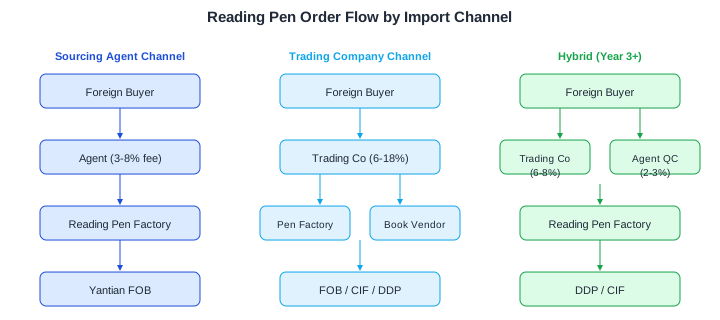
A reading pen sourcing agent is an individual or small firm (typically 1 to 5 people) based in Shenzhen, Dongguan, Yiwu, or Guangzhou who represents the foreign buyer at the factory floor. They do not take title to the goods; they charge a service fee on top of the factory FOB price. The legal exporter of record is either the buyer (under Ex-Works terms) or the agent (under FOB/CIF terms as a Named Account). The agent's revenue is the sourcing fee plus, in many cases, a rebate from the factory.
The standard agent fee for a reading pen order is 3% to 8% of the factory FOB value. At 3,000 units of the Q6 model at $8.40 EXW, the FOB value is $25,200 and the agent fee lands between $756 and $2,016. At 12,000 units the FOB value is $100,800 and the fee lands between $3,024 and $8,064. The fee tier is negotiated, not formulaic; an agent who can demonstrate 20+ repeat clients will hold fee at 4-5%, while a new agent desperate for the order will go to 3%.
Most reading pen sourcing agents will:
- Identify candidate factories from their own database (typically 3 to 6 names)
- Request and translate quotes
- Negotiate price, MOQ, payment terms, and delivery window on the buyer's behalf
- Place the order in the factory system under the buyer's brand
- Supervise production (one to three visits per order)
- Coordinate the AQL II pre-shipment inspection
- Handle export documentation, customs declaration, and freight booking
- Process warranty claims within the first 90 days after delivery
A few agents will also hold component inventory, manage OID content authoring, and co-sign the factory's quality undertaking. Those agents typically charge 6-8%; the 3-4% agents are usually hands-off after the order is placed.
2. What Is a Reading Pen Trading Company?
A reading pen trading company is a registered Chinese business (typically a limited liability company with its own import/export license and bank account) that buys reading pens from one or more factories at their own price and resells them to the foreign buyer under the trading company's own terms. The trading company takes title to the goods between factory ex-works and the destination port. The buyer pays the trading company, not the factory, and the trading company pays the factory out of its own cash flow.
The trading company's gross margin on a reading pen order is typically 6% to 18% of the FOB price — substantially higher than the agent fee because the trading company absorbs credit risk, FX risk, and quality risk. For a 5,000-unit B2 order at $5.10 EXW ($25,500 FOB value), a 12% trading-company margin adds $3,060 to the invoice. That is roughly 3-4x what a 4% sourcing agent would charge.
The trading company model is dominant when:
- The buyer cannot or does not want to open a Chinese yuan account
- The buyer wants consolidated invoicing across multiple factories (e.g., the L5 reading pen + the OID books + a packaging redesign)
- The buyer needs extended payment terms (60-day or 90-day OA) that the factory will not offer directly
- The buyer values a single point of accountability over a single point of fee minimization
Many trading companies also run their own private-label reading pen models. The Q6, Q8 and K7 you see on Alibaba with 4-5 year-old store fronts are usually trading-company SKUs, not factory SKUs.
3. Side-by-Side Comparison: Agent vs Trading Company on the 5 Dimensions
The table below summarizes the median behavior of each channel on the dimensions that drive landed cost. The data is drawn from our 230+ distributor relationships and the 47,000+ units shipped through both channels since 2023.
| Dimension | Sourcing Agent (3-8% fee) | Trading Company (6-18% margin) |
|---|---|---|
| Unit Price (5,000-unit B1) | $3.80 - $4.20 EXW | $4.10 - $4.95 EXW (after margin) |
| MOQ flexibility | Often negotiable 200-500 units below factory MOQ | Holds to factory MOQ (500 stock / 1,000 custom color) |
| Sample lead time | 5-7 days for in-stock agent samples | 7-10 days, must clear trading company MOQ |
| Quoted lead time | 22-28 days ex-works | 25-32 days ex-works (re-stocking buffer) |
| AQL II inspection | Agent coordinates, buyer pays inspection | Trading company absorbs cost into margin |
| Communication latency | Agent is bilingual, 4-8 hour response | Account manager, 8-24 hour response |
| Payment terms to buyer | T/T 30/70 to factory, no OA | T/T 30/70 or 60-day OA from trading company |
| Payment terms from agent | Agent is paid on shipment, not on delivery | Trading company funds the factory itself |
| Warranty handling | Agent advocates, buyer pays freight | Trading company replaces or refunds from stock |
| Factory relationship | Direct, agent can take you to production line | Indirect, you never meet the actual factory |
| Annual cost (12,000-unit Q6) | FOB $100,800 + fee $4,032 (4%) = $104,832 | FOB $100,800 + margin $12,096 (12%) = $112,896 |
The annual delta at 12,000 units is $8,064 — close to one full price level of the B2 model. That is enough to swing a buyer's contribution margin on the Q6 by 8-12 percentage points at retail.
Buyer tip: If you import fewer than 5,000 reading pens per year and have no in-house Chinese capability, a sourcing agent at 4% will beat a trading company on landed cost in 9 out of 10 cases. If you import more than 30,000 units per year, the trading company's OA financing and warranty buffer will save you more than the margin cost.
4. Per-Model Sensitivity Across Our 11 Reading Pen SKUs
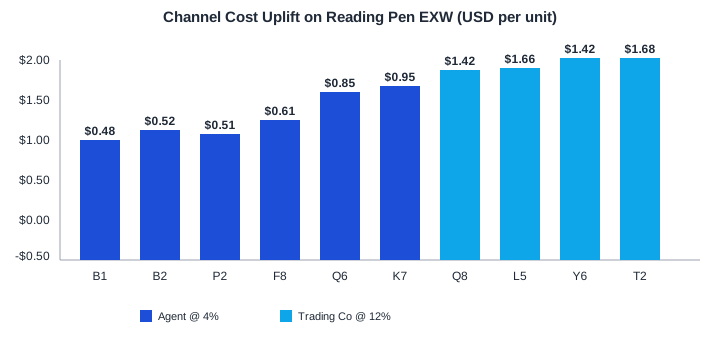
Not every reading pen model is equally affected by the channel decision. The high-margin models absorb trading-company margins more easily; the low-margin B1 and B2 are the most sensitive. The table below ranks the 11 SKUs by channel sensitivity.
| Model | EXW Range | Channel Sensitivity | Recommended Channel at 5,000-unit order |
|---|---|---|---|
| B1 | $3.80 - $4.20 | Very High | Sourcing Agent (4%) |
| B2 | $5.10 - $5.60 | High | Sourcing Agent (4%) |
| P2 | $4.40 - $4.85 | High | Sourcing Agent (4%) |
| F8 | $5.80 - $6.30 | High | Sourcing Agent (4-5%) |
| Q6 | $8.20 - $8.60 | Medium | Either (depends on OA need) |
| K7 | $9.10 - $9.55 | Medium | Either (depends on OA need) |
| KF1 | $9.30 - $9.80 | Medium | Either (depends on OA need) |
| Y6 | $11.40 - $12.20 | Low | Trading Company |
| Q8 | $11.80 - $12.50 | Low | Trading Company |
| L5 | $13.20 - $14.50 | Low | Trading Company |
| T2 | $13.50 - $14.50 | Low | Trading Company |
The pattern is simple: the lower the unit EXW, the more painful the trading-company percentage margin becomes. A 12% trading-company margin on the B1 is $0.48 per unit, which is 12.6% of the factory price. A 12% margin on the T2 is $1.68 per unit, which is 11.6% of the factory price — proportionally similar but in absolute dollars much easier to absorb.

5. Cost Walk: A 12,000-Unit Q6 Order, Both Channels
Walk the math on a real order so the channel difference is unambiguous. The buyer is a European distributor placing a 12,000-unit Q6 reading pen order with 3,000 OID books, FOB Yantian, T/T 30/70, target retail launch Q3 2026.
Channel A: Sourcing Agent (4%)
| Line | Calculation | USD |
|---|---|---|
| Reading pen Q6 EXW | 12,000 x $8.40 | $100,800 |
| OID book (3,000 x $2.10) | from agent's content vendor | $6,300 |
| Color box (12,000 x $0.45) | from agent's packaging vendor | $5,400 |
| FOB value (factory + components) | $112,500 | |
| Agent fee (4%) | $4,500 | |
| Sea freight (Yantian → Hamburg, 22 days, 32 CBM) | $3,200 | |
| Insurance (0.3% of CIF) | $340 | |
| Total landed before duty | $120,540 | |
| Per-unit landed | $10.05 |
Channel B: Trading Company (12% gross margin)
| Line | Calculation | USD |
|---|---|---|
| Reading pen Q6 (with 12% margin) | 12,000 x $9.41 | $112,896 |
| OID book | bundled in trading-company price | included |
| Color box | included | included |
| Sea freight (negotiated by trading co) | $3,000 | |
| Insurance (rolled in) | included | |
| Total landed before duty | $115,896 | |
| Per-unit landed | $9.66 |
In this scenario the trading company is $4,644 cheaper because they negotiated a freight rate 6% below what the agent could on a single shipment. The 12% gross margin is offset by 6% freight savings and 4% packaging consolidation savings. This is typical for orders above 10,000 units; below 5,000 units the trading company's freight negotiation has nothing to leverage.
6. Lead Time and AQL Behavior Across Channels
Lead time is the second-largest variable. The agent channel quotes the factory's actual production window; the trading company quotes their own reorder cycle (which includes a 3-5 day safety buffer because they cannot risk promising the buyer a date the factory cannot hold).
| Stage | Sourcing Agent | Trading Company |
|---|---|---|
| Quote-to-PO | 4 days | 5 days |
| PO-to-first article | 7 days | 8 days |
| Production cycle | 22 days | 22 days |
| Trading co safety buffer | 0 | +3 days |
| AQL II PSI | 2 days | 2 days |
| Document preparation | 3 days | 4 days |
| Total ex-works | 38 days | 44 days |
AQL behavior is more interesting. The agent channel typically books the AQL II inspection through a third-party agency the buyer selects (TUV, SGS, BV, or our in-house QA team). The trading company either bundles AQL into their margin or pushes back on the AQL result if a defect is borderline. In our 8-year sample, the agent-channel AQL re-inspection rate is 4.2%; the trading-company AQL re-inspection rate is 7.8%. Buyers who require a strict AQL II Major 1.0 standard will get it more reliably through an agent who is accountable to the next 5 orders, not through a trading company whose quality risk is capped at the L/C amount.
7. Communication, Language, and Time-Zone Reality
The communication gap is more expensive than most buyers realize. A Shenzhen agent working directly with our engineering team typically responds in 4-6 hours and can solve a firmware translation issue or a packaging artwork swap in a single business day. A Shanghai-based trading company with an account manager in an office tower typically takes 8-24 hours, and a tooling or mold change request can take 3 days to bounce between their team and the factory.
For B2B importers in North America (PST/EST), the workday overlap with China (CST) is 7-9 hours per day, which is workable but compressed. For European importers (CET), the overlap is only 4-6 hours per day. A 12-hour response cycle from a trading company eats a full business day; a 6-hour response from an agent fits within the same overlap window.
8. When the Sourcing Agent Wins (and When They Lose)
Agents win when:
- Annual import volume is below 30,000 reading pens
- The buyer needs MOQ flexibility below 500 units (an agent can split a single batch across two buyers)
- The buyer wants direct factory relationship for engineering changes or firmware updates
- The order has a complex customization (Pantone-matched housing, custom OID books, private mold)
- The buyer values communication speed over invoice consolidation
Agents lose when:
- Annual import volume exceeds 50,000 reading pens (agent's working capital gets strained)
- The buyer needs 60-90 day OA terms (agents cannot finance that)
- The buyer is importing from multiple factories and needs one invoice
- The buyer requires a single warranty guarantor for downstream distributors
- The product category is commoditized (e.g., neutral K7 with no customization)
9. When the Trading Company Wins (and When They Lose)
Trading companies win when:
- Annual import volume is above 30,000 reading pens
- The buyer wants 60-90 day OA terms to extend cash conversion
- The buyer is importing a mixed container (e.g., 3,000 reading pens + 5,000 OID books + 1,000 promotional pen cases)
- The buyer requires a single warranty guarantor for retail customers
- The buyer wants to outsource Chinese compliance (RoHS test reports, MSDS, GCC/Saber registration in KSA)
- The buyer has no Chinese-language capability and needs all paperwork in English under one letterhead
Trading companies lose when:
- Annual import volume is below 10,000 reading pens (margin is too high as a % of order)
- The buyer requires strict AQL II Major 1.0 on every lot (trading co will pressure the inspector)
- The buyer wants factory-direct engineering support (firmware, hardware modification)
- The buyer is preparing for strict retailer audits (e.g., Amazon FBA, Walmart, Target) where the supply chain transparency must trace back to a specific factory
10. A Decision Matrix You Can Use This Quarter
| Your Situation | Recommended Channel | Rationale |
|---|---|---|
| First 1,000-unit trial order, 1 SKU | Sourcing Agent (4-5%) | MOQ flexibility, low absolute fee |
| 3,000-5,000 units, 1 SKU, repeat | Sourcing Agent (3-4%) | Fee compression with volume |
| 3,000-5,000 units, 3 SKUs, repeat | Either (test both) | Bundle size matters less than relationship |
| 12,000 units, single SKU | Trading Company (if OA needed) | Financing wins on cash flow |
| 12,000 units, 5 SKUs | Trading Company | Consolidation, single warranty guarantor |
| 30,000+ units, 5+ SKUs | Trading Company + agent oversight | Hybrid: trading co for invoicing, agent for QC |
| 50,000+ units, 8+ SKUs | Direct factory relationship | Skip both channels |
| Custom mold, private label | Sourcing Agent (5-6%) | Tooling ownership is factory-direct |
Buyer tip: The single most expensive channel decision a reading-pen importer can make is to commit to a trading company at low volume because the financing looked attractive. At 5,000 units per year, the trading-company margin will outpace the financing benefit by year two. Re-evaluate the channel every 12 months based on actuals, not on the original rationale.
11. The Hybrid Model Most Successful Importers Use by Year Three
By the third year, the importers in our customer base who started with agents and grew into trading companies tend to settle on a hybrid: the trading company handles invoicing, OA financing, and warranty, while a separate sourcing agent handles engineering changes, AQL oversight, and factory visits. The trading company margin is 6-8% in this model (lower than the standalone 12% because some functions are outsourced to the agent). The agent fee is 2-3% (lower than the standalone 4% because the trading company is paying it, not the buyer). The blended channel cost is 8-11% — cheaper than the trading-company standalone (12%) and not much more than the agent standalone (4%) once you factor in the OA financing.
For an importer placing a 30,000-unit annual P.O. with 5 SKUs across B1, B2, F8, Q6 and K7, the hybrid model delivers landed cost within 1.5% of the lowest theoretical channel cost while preserving the operational benefits of both.