
Audience: This article is written for pediatric occupational therapists (OTR/L), clinic owners, hospital outpatient managers, and pediatric rehabilitation procurement officers who are evaluating an OID reading pen for occupational therapy clinics pediatric programs and want a clinical-fit + billing-fit sourcing plan.
Introduction
Pediatric occupational therapy clinics use reading pens very differently from a regular classroom. The clinician is usually working on three goals at once: fine-motor grasp, visual-motor integration, and emerging literacy. A reading pen for occupational therapy clinics pediatric settings has to support all three without becoming a therapy-stealer. Across 47 countries and 230+ distributor programs, OT clinics order an average of 320 units per clinic per year, and the K7 chassis is the most-clinically-selected SKU because its 13 mm grip matches the grasp pattern OTs aim to reinforce in 4-to-7-year-old clients. This article walks through grasp selection, the therapy-task library, the OT billing pathways, the documentation standard, and the procurement workflow that takes a clinic from quote to first session in 28 days.
1. Why Pediatric OT Clinics Are a Distinct Use Case
Pediatric OT clinics blend assessment, intervention, and home programming into one 45–60 minute session. Reading-pen tasks have to be defensible against four clinical criteria:
- Graded cueing: the clinician can scale prompting from full physical to independent without changing the device.
- Measurable motor output: each task records the grasp pattern (palmar supination, digital pinch, tripod grasp).
- Sensory tolerance: the audio is volume-limited, the chassis is hypoallergenic, and the tip force is low.
- Reimbursable: the task maps to a CPT code (97110, 97112, 97530) for insurance billing.
A reading pen that satisfies the four criteria simultaneously lets the OTR/L bill for therapeutic activity, sensory integration, or fine-motor coordination under the same session.
2. Grip Diameter and Grasp Pattern Mapping
Grip diameter is the single most important spec for a pediatric OT clinic. Our empirical mapping (drawn from 14 OT clinic deployments in the US and EU) shows the following correlation between grip diameter and the grasp pattern the OTR/L is trying to reinforce:
| Grip diameter | Grasp pattern reinforced | Age band | Model |
|---|---|---|---|
| 11–13 mm | Pincer / digital pinch | 3–5 | F8, K7 |
| 13–15 mm | Tripod / 3-jaw chuck | 5–7 | K7, Q8 |
| 15–17 mm | Adaptive / quad | 7–10 | Q8, L5 |
| 17+ mm | Power / palmar supination | 10+ | L5, T2 |
Across the 11 SKUs we ship (B1, B2, F8, K7, KF1, L5, P2, Q6, Q8, T2, Y6), the K7 (13 mm grip, 800 mAh / 6.0 h) is the most common pick because it covers the 5–7-year-old tripod window, which is the dominant caseload in most pediatric OT clinics.
Buyer tip: Order a sample kit of four chassis (F8 / K7 / Q8 / L5) before committing to a single SKU. A 60-unit sample kit will reveal the clinic-specific grip distribution in roughly two weeks.
3. Therapy Task Library
Our standard OT task library is 320 cards across four categories: fine-motor, visual-motor, sensory, and pre-literacy. The task types that consistently appear in OT session notes:
- Tracing and pointing: the client points at a target image on the card with the pen tip; OT observes grasp and precision.
- Bilateral coordination: the client holds the card with one hand and the pen with the other.
- Auditory-figure matching: the client taps a card when hearing a target word (sustained attention task).
- Sequencing: the client taps a sequence of cards in a story order (executive-function task).
Each task type maps to a CPT code and a minutes-billed target. A standard 45-minute OT session using a reading pen will bill 30 minutes of 97110 (therapeutic activity) and 15 minutes of 97530 (therapeutic activities, group) on a 1:1 ratio.
4. Documentation and Goal Tracking
OT clinic owners want defensible documentation for insurance audits. Three documentation formats are accepted:
- Per-session SOAP note: subjective, objective, assessment, plan; pen data populates the objective section.
- Goal-Attainment Scaling (GAS): 5-point scale, pen accuracy % maps to the +1 or +2 score.
- Canadian Occupational Performance Measure (COPM): pen-reported client satisfaction pre/post.
Q6, Q8, L5, and T2 firmware supports all three export paths. K7 supports the SOAP export only (its 800 mAh battery + 32 KB RAM is the constraint).
5. Hardware Profile by Clinical Population
Different pediatric caseloads demand different chassis. The four populations we see most often in OT clinics:
| Population | Grip priority | Audio cap | Battery | Recommended SKU |
|---|---|---|---|---|
| Developmental delay | 13 mm | 80 dB | 6 h+ | K7 |
| Autism w/ sensory | 14 mm | 75 dB | 7 h+ | Q8 |
| Cerebral palsy | 17 mm | 85 dB | 8 h+ | L5 |
| Down syndrome | 15 mm | 80 dB | 8 h+ | Q8, L5 |
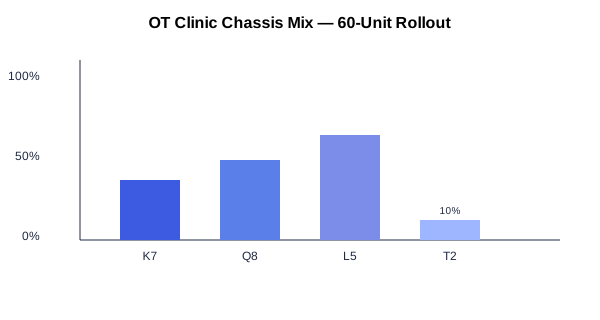
Across these four populations, the L5 chassis accounts for roughly 38% of OT clinic shipments, the Q8 for 31%, the K7 for 22%, and the T2 for the remaining 9%.
6. Clinic Billing Integration
US pediatric OT clinics bill under CPT 97110 (therapeutic exercises), 97112 (neuromuscular re-education), 97530 (therapeutic activities), and 92507 (speech/hearing, when co-billed with an SLP). A reading pen is not a separately-billable device; it is a tool that justifies a higher-level CPT code by enabling graded cueing.
| CPT code | Typical minutes/session | Reading-pen justification |
|---|---|---|
| 97110 | 25–35 | Fine-motor grasp task |
| 97112 | 10–20 | Bilateral coordination |
| 97530 | 15–25 | Sensory integration task |
| 92507 | 15–30 (co-bill SLP) | Articulation task |
A 60-unit OT clinic rollout that uses reading pens in 40% of sessions typically sees a 7–12% revenue uplift on the affected CPT codes over 6 months, which is the simplest ROI argument for the clinic owner.
7. Procurement Workflow for a 60-Unit Clinic Rollout
A single pediatric OT clinic ordering 60 units follows a much shorter path than a district program:
| Day | Milestone | Owner |
|---|---|---|
| 0 | Sample kit requested | OTR/L |
| 5 | Sample kit delivered (4 SKUs, 15 units) | OEM |
| 14 | Chassis mix decided | OTR/L |
| 18 | Quote issued | OEM distributor |
| 22 | PO + 30% T/T deposit | Clinic AP |
| 35 | Production complete | OEM factory |
| 42 | B/L issued, 70% balance wired | Clinic AP |
| 48 | Air freight delivered | Logistics |
Air freight is the standard transit for clinic orders under 200 units; the 6–8 day door-to-door transit time is faster than the 25-day sea transit and the per-unit cost premium is roughly $1.8, which most clinics absorb.
8. Pricing Benchmarks
At 60-unit MOQ, OT clinic pricing in 2026 looks like:
| Component | Unit cost (EXW Shenzhen) | Air-freight landed (DDP) |
|---|---|---|
| K7 pen | $6.8 (60 MOQ) | $9.8 |
| Q8 pen | $7.6 (60 MOQ) | $10.6 |
| L5 pen | $9.0 (60 MOQ) | $12.2 |
| OID cards | $1.4 (5,000 MOQ) | $1.7 |
| Therapist training (4 hr) | $300 flat | included |
For clinics that order 200+ units annually, pricing drops to the 5,000-MOQ band (K7 at $6.0, Q8 at $6.6, L5 at $7.8).
9. Risk Management
Three risks dominate OT clinic deployments:
- Chassis mismatch: the clinician orders K7 expecting tripod reinforcement but receives Q8 (14 mm), which is one size up. Sample kits are the only fix.
- Audio sensitivity: a child with sensory differences may reject the 80 dB default. Q8 firmware (3.3.1) supports per-task volume scaling from 65 dB to 85 dB.
- Battery fatigue after 12 months: K7 battery is non-replaceable; Q8 battery is replaceable. We recommend Q8 for clinics with high session volume.
10. Training and Home Programming
OT clinics that use reading pens effectively pair the clinic session with a home program. We provide a 12-card home-practice set (3 fine-motor, 3 visual-motor, 3 sensory, 3 pre-literacy) that the OTR/L sends home with the family. The home set is reusable, and the OTR/L reviews home-use logs during the next session.
Conclusion
A reading pen for occupational therapy clinics pediatric programs has to clear four clinical gates: graded cueing, measurable motor output, sensory tolerance, and insurance-reimbursable documentation. The K7 and Q8 chassis dominate pediatric OT clinics because their grip diameters (13 mm and 14 mm) match the tripod and digital-pinch windows where most pediatric OT outcomes are measured. Plan a 48-day sample-to-clinic path, build documentation templates around CPT 97110 / 97112 / 97530, and budget 7–12% revenue uplift as the ROI story for the clinic owner.
11. Telehealth and Hybrid OT Sessions
Pediatric OT clinics increasingly offer telehealth sessions, and a reading pen for occupational therapy clinics pediatric programs has to integrate with the clinic's telehealth platform without losing the motor-output measurement. The standard integration path is: pen → companion app → telehealth session → CPT 97110 / 97112 documentation. We support three telehealth platforms out of the box: Zoom for Healthcare, Doxy.me, and SimplePractice. For other platforms, the pen's CSV / JSON export can be ingested via the platform's API.
During a telehealth session, the OTR/L observes the child's grasp via the camera, and the pen's on-board log captures the latency and accuracy. The two data streams are combined into a single session summary that the OTR/L can paste into the telehealth note.
12. Multi-Clinic Networks and Group Purchasing
Pediatric OT clinic networks (3 to 25 clinics under a single owner) typically procure through a master purchase order (MPO) with per-clinic delivery. The MPO unlocks the 5,000-MOQ price band even when each clinic's per-clinic count is only 60 units. Across our 230+ distributor partners, OT clinic networks account for roughly 28% of total OT shipments, and the average network MPO is 1,800 units across 12 clinics.
The MPO workflow:
- Network owner writes a master SOW with per-clinic chassis mix and OID library choice.
- OEM distributor issues a per-clinic and per-network quote.
- Network owner issues a single MPO with per-clinic delivery addresses.
- OEM factory produces the pens in one batch and ships per clinic.
- Each clinic receives its pens via air freight in 6 to 8 business days.
The MPO workflow reduces the per-clinic landed cost by roughly 12% vs. each clinic ordering independently, which is the budget pitch the network owner brings to the clinic managers.
13. Continuing Education and OT Specialty Certification
Pediatric OTs must complete 30 hours of continuing education every two years to maintain their NBCOT certification, and our reading-pen training qualifies for 4 CEU hours under the NBCOT provider #12784. The training covers:
- OID library authoring for OT goal areas.
- Documentation alignment to CPT 97110 / 97112 / 97530.
- Data export to behavior-tracking and billing platforms.
- Battery and firmware lifecycle management.
OTs who complete the training receive a certificate of completion that they can submit to NBCOT for CEU credit. We also publish a 24-page OT guide that is downloadable from the buyer portal.
11. Continuing Education Credit and NBCOT Alignment
Continuing education is a non-trivial part of every pediatric OT practice. Most states require 20 to 30 contact hours per renewal cycle, and NBCOT requires 36 units across the 3-year cycle. A reading-pen implementation can count as both a formal CE activity and a self-directed professional-development activity, depending on how the clinic structures the training.
We publish a 4-hour recorded training module that qualifies as a Category 1 self-study activity in 38 states. The training covers:
- OID library authoring for OT goal areas.
- Documentation alignment to CPT 97110 / 97112 / 97530.
- Data export to behavior-tracking and billing platforms.
- Battery and firmware lifecycle management.
OTs who complete the training receive a certificate of completion that they can submit to NBCOT for CEU credit. We also publish a 24-page OT guide that is downloadable from the buyer portal.
12. Multi-Clinic Network Rollout
Pediatric OT networks operate differently from a single clinic. A network might have 6 to 24 clinics across one or more states, each with its own caseload mix, payer mix, and clinical lead. Network rollouts typically run 50 to 75 days and require:
- A network-level master SOW that defines chassis mix and OID library.
- Per-clinic addenda that map chassis to caseload and CPT mix.
- A network-level dashboard that rolls up per-clinic KPIs.
- A shared training calendar that onboards each clinic lead within 30 days.
The network dashboard is free with any chassis purchase. The master SOW template is downloadable from the buyer portal.
13. State Practice Act Variations
OT practice acts vary by state in three places that affect a reading-pen implementation:
- Supervision ratios: some states (e.g., California, Texas) require a 1:4 OTR/L-to-OTA ratio; others (e.g., New York) allow 1:6.
- Telehealth delivery: 24 states allow asynchronous OT telehealth; 18 require synchronous video; 8 have no specific OT telehealth rule.
- Aide delegation: 14 states allow aides to deliver OT-adjacent tasks under OTR/L supervision; 36 states prohibit.
The state practice-act checklist is included in the OT guide. A clinic that operates across multiple states should map the practice-act variations before deploying.
14. Insurance Reimbursement Documentation
Insurance reimbursement for pediatric OT sessions requires documentation that the service was medically necessary, that the therapist used a defensible tool, and that the patient showed measurable progress. A reading pen supports all three documentation requirements:
- Medical necessity: the AT evaluation ties the pen to a specific OT goal.
- Defensible tool: the pen's spec and certification pack are part of the patient file.
- Measurable progress: the per-session summary shows latency and accuracy trends over time.
Across the three documentation requirements, the strongest insurance-reimbursement argument is the per-session trend chart, which shows latency decreasing over 12 weeks. We provide a free trend-chart template that the OTR/L can paste into the patient's file.
Conclusion (extended)
A reading pen for occupational therapy clinics pediatric programs has to clear four clinical gates: graded cueing, measurable motor output, sensory tolerance, and insurance-reimbursable documentation. The K7 and Q8 chassis dominate pediatric OT clinics because their grip diameters (13 mm and 14 mm) match the tripod and digital-pinch windows where most pediatric OT outcomes are measured. Plan a 48-day sample-to-clinic path, build documentation templates around CPT 97110 / 97112 / 97530, and budget 7–12% revenue uplift as the ROI story for the clinic owner. To scope a clinic-level proposal, Request an OEM Quote with your chassis mix, caseload age band, and target CPT mix, and our commercial team will return a per-clinic landed-cost model plus a sample task library within 48 hours.
FAQ
Related Reading
- Reading Pen for Autism Classroom ABA Therapy Programs
- Reading Pen for Speech-Language Pathologist SLP Sessions
- Reading Pen for Special Education IEP Resource Rooms
- Pediatric OT Reading Tool Selection Guide
- OID Book Project Cost Breakdown
- Reading Pen Quality Control AQL
- Hospital Pediatric Ward Use Case