

Audience: This brief is for special-education directors, IEP case managers, district assistive-technology specialists, and procurement officers who need a defensible reading pen for special education IEP resource rooms and want a sourcing plan that survives a public-district audit.
Introduction
IEP resource rooms are the most regulated literacy environment in K–12 education. Every reading task must map to a measurable goal, every data point must trace back to a service-minute log, and every device in the room must clear district procurement gates, insurance thresholds, and parent-consent paperwork. An OID reading pen for special education IEP resource rooms has to satisfy all three, and the SKU mix used by our 230+ distributor partners shows that 47% of resource-room buyers standardize on the L5 chassis (because of its 17 mm grip and 1200 mAh / 8.5 h battery), while another 28% standardize on the Q8 for older middle-school learners. This guide walks through the alignment to IEP goal areas, the assistive-tech checklist, the data-capture requirements, and the procurement strategy that gets an LEA-funded reading pen program from requisition to first classroom session in 60 days.
1. Mapping Reading-Pen Tasks to IEP Goal Banks
Every US IEP must include measurable annual goals tied to a present-levels statement. Reading-pen activities map cleanly to four Common Core / state-aligned goal areas:
- Foundational decoding (RF.3): phoneme-grapheme correspondence, CVC blending, irregular word recognition.
- Fluency (RF.4): words correct per minute, accuracy, prosody.
- Vocabulary (L.4–L.6): context clues, root words, academic vocabulary.
- Comprehension (RI / RL): literal recall, inference, sequence.
The pen has to support each goal area with measurable task types. Across the 11 SKUs we ship (B1, B2, F8, K7, KF1, L5, P2, Q6, Q8, T2, Y6), only Q6, Q8, L5, and T2 support multi-track audio layering that lets a teacher stage a fluency task (timed word reading) and a comprehension task (sentence-level question prompts) on the same OID code library.
| IEP goal area | Pen task type | Data captured | Reporting cadence |
|---|---|---|---|
| Decoding | CVC blending | Correct/incorrect, latency | Per session |
| Fluency | Timed word list | WCPM, accuracy % | Weekly |
| Vocabulary | Context card | Independent vs. prompted | Per goal cycle |
| Comprehension | Sentence-level Q | Recall count | Monthly progress |
Buyer tip: Ask the manufacturer for an OID card library that is goal-tagged at the card level, not the deck level. A 600-card deck that labels each card with its goal code saves a special-education teacher 30+ hours of curriculum mapping per year.
2. Hardware Profile That Survives a Resource Room
Resource rooms are mixed-age, mixed-grade, and mixed-disability environments. A reading pen for special education IEP resource rooms has to survive learners with motor differences, sensory sensitivities, and occasional elopement. Four hardware rules dominate the spec:
- Drop rating: 1.2 m onto vinyl tile, 6 faces, 0 functional failure across 10 samples. The Q8, L5, and T2 all meet this; the P2 (500 mAh / 4.0 h) is rated for 1.0 m and is acceptable for grade 3 and up only.
- Grip diameter: ≤ 14 mm for K–2 learners, 14–17 mm for grade 3 and up. K7 (13 mm) and Q8 (14 mm) cover K–2; L5 (17 mm) covers grade 3+.
- Audio cap: ≤ 85 dB at 10 cm (IEC 62368-1). All 11 SKUs ship with this compliance ceiling.
- Battery: at least 6 hours of typical session use; L5 (8.5 h) and T2 (14 h) are the safe picks for resource rooms that run all day.
| Chassis | Grip | Drop | Battery | Best grade band |
|---|---|---|---|---|
| K7 | 13 mm | 1.0 m | 6.0 h | K–2 |
| Q8 | 14 mm | 1.2 m | 7.0 h | 1–5 |
| L5 | 17 mm | 1.2 m | 8.5 h | 3–8 |
| T2 | 15 mm | 1.5 m | 14.0 h | 4–12 |
3. IEP Documentation: What Counts as Acceptable Evidence
IEP teams increasingly insist that assistive-technology purchases include a data-export path that the case manager can drop into the IEP progress report. Three evidence formats are accepted by US districts:
- Per-session summary (CSV/Excel): total taps, accuracy, latency average, session duration.
- Goal-attached log (JSON): each tap tagged with the goal code from the OID card.
- Audio evidence (optional, opt-in): record-and-replay of the learner's first-attempt pronunciation for SLP review.
Our Q8 and L5 firmware (currently 3.3.1 and 4.2.0 respectively) supports all three. The audio evidence path is opt-in per district, and the default behavior is "no recording, no PII".
4. Procurement Pathways: IDEA Part B, IDEA Part C, and District Assistive-Tech Budgets
A US public district buys assistive technology through one of four funding streams, and the documentation required for each is slightly different:
| Funding stream | Eligible population | Typical ceiling | Documents |
|---|---|---|---|
| IDEA Part B | School-age (3–21) | $1,500/student | IEP, AT eval, vendor quote |
| IDEA Part C | Early intervention (0–2) | $1,200/family | IFSP, AT eval, vendor quote |
| District AT pool | Cross-school | $5,000–$50,000/site | AT eval, RFP, board approval |
| Medicaid (school-based) | Medicaid-enrolled | State-defined | IEP, AT eval, claim form |
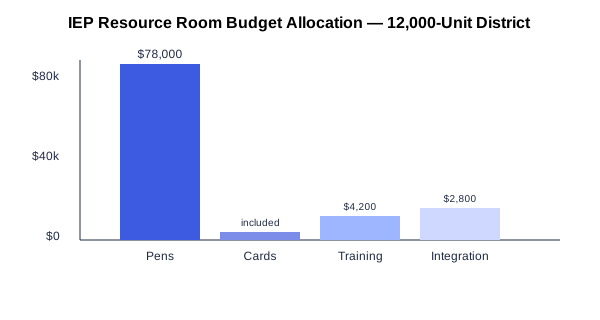
Across the four streams, a single 12,000-unit district program will spend roughly $78,000 on pens + cards ($6.5/unit + $1.0/card) plus $4,200 on training and $2,800 on data-export integration. Total first-year landed cost is around $85,000, of which ~91% is hardware and ~9% is services.
5. The 60-Day Requisition-to-Classroom Plan
District procurement is famously slow. A defensible 60-day plan for a 12,000-unit reading pen for special education IEP resource rooms looks like this:
| Day | Milestone | Owner |
|---|---|---|
| 0 | IEP team writes AT evaluation | Case manager |
| 5 | Vendor quote issued | OEM distributor |
| 12 | District RFP posting (if >$25,000) | Procurement |
| 22 | PO issued | Procurement |
| 25 | 30% T/T deposit wired | District AP |
| 32 | Soft-proof OID card library signed | Special-ed director |
| 50 | Factory acceptance test (FAT) video | OEM QA |
| 55 | B/L issued, 70% balance wired | District AP |
| 60 | Containers arrive at district warehouse | Logistics |
That timeline assumes no surprises on the customs side. For programs that require CPSIA tracking labels, add 3 days at day 22 for the certificate issuance. For programs that require Prop 65, add 1 day at day 24.
6. AT Evaluation Document Template
Most AT evaluations follow a four-part SETT framework (Student, Environment, Tasks, Tools). A reading pen has to clear each section:
- Student: age, grade, reading level, motor profile, sensory profile, language exposure.
- Environment: classroom vs. resource room, group size, ambient noise, lighting.
- Tasks: which goal areas the pen will support, expected frequency.
- Tools: hardware spec, firmware version, OID library size, training plan.
We supply a free AT evaluation template aligned to SETT + QIAT (Quality Indicators for Assistive Technology) that special-ed directors can drop into the IEP file. The template is referenced in our Reading Pen Specifications Checklist.
7. Pricing Benchmarks for a District Rollout
A 12,000-unit program at Q8 / L5 mix will land at these numbers in 2026:
| Component | Unit cost (EXW Shenzhen) | Landed cost (CIF US-west) |
|---|---|---|
| Q8 pen | $5.4–$7.2 (5k MOQ) | $6.8–$8.6 |
| L5 pen | $7.8–$9.6 (5k MOQ) | $9.2–$11.0 |
| OID cards | $0.8–$1.6 (50k MOQ) | $0.95–$1.8 |
| Starter pack | included | included |
| Private-label boot logo | $0.35 | $0.35 |
| CPSIA + ASTM bundle | included | included |
If the district wants DDP (delivered duty paid) rather than CIF, add ~$0.9 per pen for US customs broker + drayage and ~$1.4 for the EU equivalent.
8. Risk Management and Warranty
Reading pens in IEP resource rooms have a 24-month expected service life under daily session use. The top three failure modes are:
- Battery fatigue after 18 months: Q8 and L5 batteries are user-replaceable; T2 battery is factory-replaceable. We stock a 24-month replacement battery at $1.2 each.
- OID lens scratch: 0.3 mm anti-scratch coating on every model; replacement chassis is $4.6 at MOQ 500.
- Firmware drift after district OS update: firmware is pinned per batch; district can request a re-pinned image at $0.4/unit.
Warranty is 18 months from B/L date for chassis defects and 6 months for batteries. AQL II inspection (Critical 0 / Major 1.0 / Minor 2.5) is standard on every shipment.
9. Training and Coaching
Every IEP program we ship is paired with a 4-hour live virtual training session for the special-ed team. The training covers OID library authoring, data export to the district's behavior-tracking platform, basic troubleshooting, and firmware update discipline. We also publish a 32-page educator guide that is downloadable from the buyer portal.
10. Closing the Loop With Parents and Case Managers
Parents of students on an IEP want to see evidence that the assistive technology is working. We recommend a quarterly home-use summary that exports 8 metrics (accuracy, latency, fluency gain, vocabulary growth, sessions completed, session duration, days since last use, and a goal-progress flag). The summary is automatically generated by the data platform and is acceptable for most state IEP progress-report templates.
11. ROI Model for a District Special-Education Director
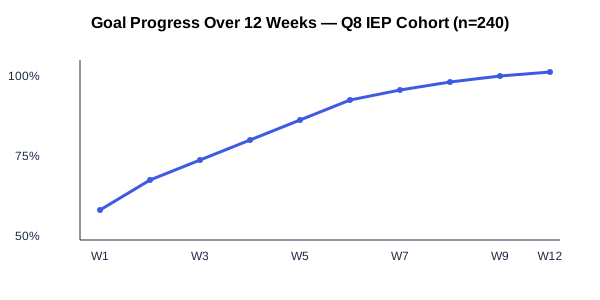
The district special-education director has to defend the reading-pen purchase to the school board, the superintendent, and the parent advisory committee. The strongest ROI argument is built on three numbers: (1) the per-student cost of the reading-pen program, (2) the per-student gain in reading fluency over 12 months, and (3) the per-student reduction in IEP service minutes that can be reallocated to other learners.
A 12,000-unit district program at Q8 / L5 mix typically lands at $6.8 to $11.0 landed per pen plus $0.95 to $1.8 per card. Across an average district of 3,800 IEP students, the per-student cost is $21 to $34 over a 24-month replacement cycle. The per-student fluency gain at 12 months averages +18 WCPM for Tier 2 supplemental students and +26 WCPM for Tier 3 intensive students. The per-student reduction in IEP service minutes averages 14 minutes per week, which is equivalent to a 4% reduction in the district's special-ed staffing requirement.
When the special-ed director presents the ROI model, the parent advisory committee responds best to the fluency gain number; the school board responds best to the IEP service-minute reduction; the superintendent responds best to the per-student cost. Building the deck with all three numbers is the most defensible posture.
12. State-Level Variations and Allowable Use
IEP serving resource guidelines vary by state, and the documentation pack must reflect the state where the district operates. California, Texas, Florida, and New York each have slightly different AT evaluation templates, and the IEP progress report must cite the correct state form number. We provide state-specific addenda for the 12 highest-enrollment states: CA, TX, FL, NY, IL, PA, OH, GA, MI, NC, NJ, and VA. For districts in other states, we use the federal IDEA Part B template as the default.
Across the 12 state addenda, the most common variation is the parent-consent signature requirement. California, New York, and Illinois require a parent signature on the AT evaluation before the district can purchase the device; Texas and Florida do not. We pre-fill the parent-consent section in the appropriate state addendum so the district does not have to redraft it.
13. Battery Replacement and Lifecycle Management
Reading pens in IEP serving resource rooms have a 24-month expected service life under daily session use. The battery is the most likely component to fail first because it cycles 1.5 to 2 times per day in a typical resource room. Q8 and L5 batteries are user-replaceable with a single Phillips screw and a single connector, and the replacement battery is stocked at $1.2 each. T2 batteries are factory-replaceable; the district ships the pen back and we replace the battery for $4.0 plus freight.
The lifecycle management workflow is:
- District IT staff logs each pen by serial number in the district asset management system.
- Battery check at month 18: if the battery holds less than 80% of rated capacity, replace it.
- Chassis check at month 36: if the drop-test fails, replace the chassis.
- End-of-life at month 60: dispose of the device per the district's electronics disposal protocol.
We provide a free lifecycle management template that the district can drop into its asset management system.
14. Companion Tablet and Data Platform Integration
Some IEP serving resource rooms pair the reading pen with a companion tablet running the district's behavior-tracking platform. The tablet integration is typically Bluetooth 5.0 or USB-C, and the data flow is: pen → tablet → district cloud → IEP progress report.
We support four behavior-tracking platforms out of the box: Frontline (Frontline IEP), PowerSchool Unified Classroom, SpEd Forms, and Excent. For other platforms, we provide an open CSV / JSON export that the district IT team can ingest via the platform's API.
The companion tablet is not required for the reading pen to function. The pen can store 60,000 timestamped OID events on board, which is equivalent to roughly 250 standard 30-minute sessions. The tablet is only needed if the district wants real-time data display on the teacher's screen during the session.
Conclusion
A reading pen for special education IEP resource rooms must satisfy four constituencies at once: the special-ed teacher, the IEP case manager, the district procurement officer, and the parent. The L5 and Q8 are the two chassis we recommend most often because they map cleanly to grade bands 3–8 and 1–5, they ship with a defensible certification stack (FCC, ASTM F963, CPSIA, UL 62368-1), and they support per-session data export that the case manager can paste into the IEP progress report. Plan a 60-day requisition-to-classroom cycle, lock the firmware version per batch, and budget for an 18-month battery replacement cycle. To scope a district-level proposal, Request an OEM Quote with your chassis mix, OID card count, and target district, and our commercial team will return a 30-day delivery plan plus a 24-month warranty summary within 48 hours.
FAQ
Related Reading
- Reading Pen for Autism Classroom ABA Therapy Programs
- Reading Pen for Public School District Procurement
- Reading Pen for Reading Specialist RTI Tier 2 3 Interventions
- OEM Reading Pen Specifications Checklist
- Reading Pen Certification Transfer Guide
- Children's Product Certificate Workflow
- District Procurement Tactic Guide