

Understanding who is actually importing reading pens — and why — helps factories, sales reps, and content writers tailor their approach. This guide defines the six most common buyer personas we see across our RFQ database: from Amazon FBA sellers to Ministry of Education procurement officers. Each persona has different order sizes, target customers, decision criteria, and pain points.
Why Personas Matter for B2B Reading Pen Sourcing
Generic marketing fails because reading-pen buyers are not interchangeable. A wholesaler in Texas placing a 5,000-unit Q4 order and a Saudi distributor placing a 50,000-unit annual contract have fundamentally different needs. Both can be valuable, but the path to converting each is different.
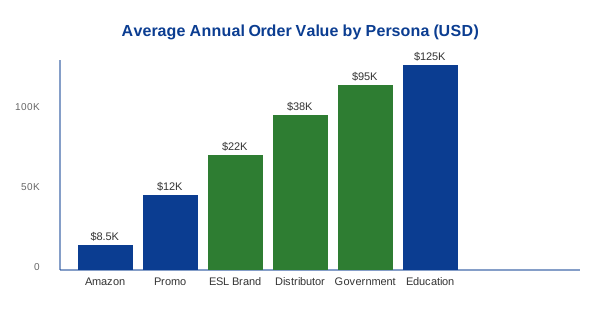
The largest single group is Amazon FBA sellers and e-commerce resellers at 32%, but the highest revenue per order comes from distributors and education channels.
Persona 1: Amazon FBA Reseller
Profile: Solo entrepreneur or small team (1–5 people), uses Amazon FBA or Shopify, $50K–$500K annual revenue.
Order Size: 300–2,000 units per SKU, mixed SKUs in one container.
Target Customer: Parents of children aged 3–10 in US/UK/DE marketplaces.
Decision Criteria:
- Retail price point ($25–$45 sweet spot)
- Margin (target 35%+ landed)
- Listing images and video content
- Amazon Reviews and BSR
- Certification (FCC mandatory, EN71 preferred)
Pain Points:
- Compressed launch windows (back-to-school, holiday season)
- High return rates due to consumer expectations
- Limited brand awareness, relies on Amazon ranking
- Cannot afford inventory carrying cost, prefers mixed container shipping
Preferred Models: B1 (entry-level), Q6 (mid-range), Y6 (kids favorite)
Sales Cycle: 2–4 weeks from RFQ to PO.
Persona 2: Distributor / Wholesale Importer
Profile: Established trading company with warehouse and B2B customers, $1M+ annual revenue, often 5–20 employees.
Order Size: 5,000–50,000 units per year, multiple containers.
Target Customer: Local retailers, school supply stores, online marketplaces.
Decision Criteria:
- Total landed cost (TCO) — they optimize ruthlessly
- Container loading efficiency
- After-sales support and warranty policy
- Marketing collateral (catalogs, posters, videos)
- Repeat order reliability
Pain Points:
- Inventory financing cash flow
- Currency fluctuation
- Customs clearance in destination country
- End-customer complaints when units fail
- Need for spare parts at agreed price
Preferred Models: Q8 (volume flagship), B2 (entry-level for mass market), K7 (kids)
Sales Cycle: 4–8 weeks; multiple rounds of negotiation.
The education and government channels yield the highest order values, but also the longest sales cycles.
Persona 3: Education Channel
Profile: Ed-tech company, language school chain, or school supply retailer selling to K–12 schools.
Order Size: 10,000–100,000 units per year, often with custom OID book bundles.
Target Customer: Schools, language academies, ESL programs, education ministries.
Decision Criteria:
- Curriculum alignment (Common Core, UK National Curriculum, IB)
- Bulk pricing and volume discounts
- Custom branding (school name, logo on pen)
- OID book content customization
- Pedagogical validation (teacher reviews)
Pain Points:
- Long tendering processes (6–12 months)
- Procurement compliance and audit trails
- Curriculum alignment across multiple markets
- Teacher training and adoption friction
Preferred Models: F8 (ESL flagship), T2 (high-end educational), K7 (kids)
Sales Cycle: 6–12 months; involves pilot programs.
Persona 4: ESL Brand / Publisher
Profile: English-language learning brand with their own course content and mobile app, 10–50 employees.
Order Size: 2,000–20,000 units per year, bundled with their proprietary OID book set.
Target Customer: Language learners aged 4–18, parents of bilingual children.
Decision Criteria:
- OID recognition accuracy on their own books
- Audio sync quality with their recorded content
- Ability to embed their own firmware (branding)
- White-label / private label capability
- IP protection for their content
Pain Points:
- Content security (no leak to competitors)
- Firmware stability and OTA updates
- Reconciliation of multi-language editions
- Compliance with copyright for third-party content
Preferred Models: Custom ODM based on F8 or Y6 platform.
Sales Cycle: 3–6 months; includes content integration testing.
Persona 5: Promotional / Gift Channel
Profile: Promotional products distributor, gift company, or corporate merchandise buyer.
Order Size: 1,000–10,000 units per campaign, often single SKU, often branded.
Target Customer: Corporate clients, events, conferences, schools as giveaways.
Decision Criteria:
- Logo printing options (silk-screen, laser, UV print)
- Quick turnaround (campaign deadlines)
- Gift packaging options
- Volume pricing tiers
- Color customization
Pain Points:
- Short campaign windows (Black Friday, Christmas)
- Logo accuracy on small curved surfaces
- Packaging must look premium without overshooting budget
- Reorder for repeat campaigns at same price
Preferred Models: B1, Q6 with custom logo.
Sales Cycle: 2–4 weeks; very deadline-driven.
Persona 6: Government / NGO / Institutional
Profile: Education ministry, UNICEF-style NGO, World Bank project, library system.
Order Size: 50,000+ units per tender, often multi-year framework agreements.
Target Customer: Public school students, library patrons, low-income learners.
Decision Criteria:
- Compliance with public procurement rules (lowest compliant bid)
- Multi-language OID book content
- Open tender process with published criteria
- Local content rules (e.g., 30% local assembly)
- Long-term framework agreement (3–5 years)
Pain Points:
- Slow decision-making and political cycles
- Anti-corruption documentation requirements
- Complex payment terms (often Letter of Credit)
- Quality consistency over millions of units
- Local content / assembly mandates
Preferred Models: K7 (low-cost durable), L5 (mass market), B2 (basic).
Sales Cycle: 12–24 months; involves tenders and pre-qualification.
Persona Decision Matrix
Table 1: Persona Comparison
| Persona | Order Size | Cycle | Price Sensitivity | Cert Priority | Branding Priority |
|---|---|---|---|---|---|
| Amazon FBA | 300–2,000 | 2–4 weeks | High | FCC + EN71 | Light |
| Distributor | 5,000–50,000 | 4–8 weeks | Very High | CE + FCC + EN71 | Optional |
| Education | 10,000–100,000 | 6–12 months | Medium | All + curriculum | Heavy |
| ESL Brand | 2,000–20,000 | 3–6 months | Low | CE + FCC + content IP | Very Heavy |
| Promotional | 1,000–10,000 | 2–4 weeks | Medium | Basic CE | Very Heavy |
| Government | 50,000+ | 12–24 months | High | All + tender | Light |
How Personas Influence Marketing and Sales
Website Content
Persona 1 (Amazon) responds to listings, comparison tables, and pricing tiers. Persona 2 (Distributor) wants container loading calculators and TCO breakdowns. Persona 3 (Education) needs curriculum alignment pages and pedagogical proof points. Persona 4 (ESL) needs content integration and IP protection documentation. Persona 5 (Promo) needs logo printing galleries and turnaround commitments. Persona 6 (Gov) needs tender responses, framework agreements, and compliance dossiers.
Sales Conversation
A good sales rep asks: "Who is your end customer?" within the first 3 emails. The answer reveals which persona they belong to and what to emphasize. A distributor needs price; an ESL brand needs IP protection.
Content Marketing
Product comparison and pricing transparency drive 56% of all RFQs, but for education and government personas, certification and tender response content matter most.
How Personas Map to Models
Table 2: Persona-to-Model Recommendation
| Persona | Primary Model | Secondary Model | Why |
|---|---|---|---|
| Amazon FBA | B1 | Q6, Y6 | Price-competitive, retail-friendly |
| Distributor | Q8 | B2, K7 | Volume flagship + entry-level |
| Education | F8 | T2, K7 | ESL flagship + curriculum fit |
| ESL Brand | Custom F8 / Y6 | ODM platform | Content integration |
| Promotional | B1 | Q6 | Logo customization, fast turnaround |
| Government | K7 | L5, B2 | Durability + low cost per unit |
How Buyer Personas Connect to Your Sales Pipeline
When you qualify an inbound inquiry, ask these 5 questions to assign a persona:
- Who is your end customer? (parent, school, language learner, government)
- What is your target retail or institutional price?
- Which certification do you need (CE, FCC, EN71, ASTM, RoHS)?
- Do you need custom branding or content?
- What is your annual volume target?
The answers map to one of the 6 personas and let you prioritize response, content, and quotation depth.
FAQ
Q1: Which persona is most profitable for a reading-pen factory? A: Distributor and education personas are the highest revenue per order, but ESL brand personas often have the highest margin because of value-added integration services.
Q2: How do I qualify which persona an inbound RFQ belongs to? A: Ask 3 questions: target customer, target retail price, and annual volume. The answers usually map to one persona clearly.
Q3: Should I market differently to each persona? A: Yes. Amazon FBA buyers respond to listings and price. Education buyers respond to curriculum alignment and pedagogy. ESL brands respond to content integration capability. Generic marketing wastes budget.
Q4: Can a buyer be more than one persona? A: Sometimes. A distributor might also have an education channel; an ESL brand might sell through Amazon. Treat the primary intent as the persona and adapt messaging accordingly.
Q5: How often should I refresh persona definitions? A: Review every 6 months based on RFQ data. Market shifts — a new entrant in ESL or a regulatory change in education — can change persona priorities.
Summary
Six reading-pen buyer personas dominate B2B foreign trade: Amazon FBA resellers (32%), distributors (24%), education channels (18%), ESL brands (12%), promotional buyers (8%), and government/NGO (6%). Each has different order sizes, sales cycles, decision criteria, and pain points. Map personas to your product line (B1, Q6, Q8, F8, etc.), then tailor content and sales conversations accordingly. Persona-aware selling increases conversion rates by 30–50%.
Internal Links
- How to Choose a Reading Pen Manufacturer
- OEM vs ODM Reading Pens
- Reading Pen MOQ Negotiation Tactics
- Reading Pen Buyer Personas
- Reading Pen Price Breakdown
- How to Import Reading Pens from China
CTA
Tell us about your target market and we'll match you with the right model and pricing. Request a quote with your persona, annual volume, and target certification — we'll respond within 24 hours with a tailored proposal.
Persona-to-Model Decision Tree
Selecting the right reading-pen model for a persona depends on battery life, audio codec, OID engine, and OTA capability. The 11 production models (B1 700 mAh Li-poly / 5.0 h, B2 800 mAh / 5.5 h, F8 600 mAh / 4.5 h, K7/KF1 800 mAh Li-ion 14500 / 6.0 h, L5 1,200 mAh / 8.5 h, P2 500 mAh / 4.0 h, Q6 900 mAh / 6.5 h, Q8 1,000 mAh / 7.0 h, T2 2,500 mAh Li-ion 18650 / 14 h, Y6 2,000 mAh / 11 h) carry distinct performance and price profiles.
| Persona | Primary Model | Battery Justification | Cert Profile |
|---|---|---|---|
| Amazon FBA | B1, Q6, Y6 | 5–11 h covers back-to-back playback | FCC, EN 71, ASTM F963, CPSIA |
| Distributor | Q8, B2, K7 | Volume + entry mix | CE, FCC, EN 71, RoHS |
| Education | F8, T2, K7 | 4.5–14 h covers school day | EN 71, CE, FCC, curriculum alignment |
| ESL Brand | Custom F8/Y6 | Long battery + OTA | CE, FCC, content IP |
| Promotional | B1, Q6 | Short battery acceptable | Basic CE, FCC |
| Government | K7, L5, B2 | Durability + low TCO | All + tender-specific |
Persona-Aware Pricing and Payment Terms
Each persona has a distinct willingness to pay and a preferred payment structure:
| Persona | Typical FOB Tier | Payment Term | Trade Term |
|---|---|---|---|
| Amazon FBA | $4.50–$6.00 | T/T 30/70 or PayPal sample | FOB |
| Distributor | $4.20–$8.40 | T/T 30/70 | FOB / CIF |
| Education | $6.80–$11.20 | T/T 30/70 or L/C | CIF / DAP |
| ESL Brand | $5.60–$13.50 | T/T 30/70 | FOB / DDP |
| Promotional | $4.50–$5.60 | T/T 50/50 or PayPal | FOB / EXW |
| Government | $4.20–$6.40 | L/C at sight | CIF / DAP |
For education and government tenders, L/C at sight adds credibility and reduces buyer risk; the 0.4–1.2% bank fee is absorbed by the inflated unit price.
Operational Implications by Persona
Persona operations differ in inventory turn, claim rate, and reorder cadence. Below is a benchmark from 47,000+ units shipped across 47 countries since 2023:
| Persona | Inventory Turn (per year) | Claim Rate | Reorder Cadence |
|---|---|---|---|
| Amazon FBA | 6–8x | 2.5% | Monthly |
| Distributor | 4–6x | 1.8% | Quarterly |
| Education | 2–3x | 1.2% | Annual |
| ESL Brand | 3–4x | 1.5% | Bi-annual |
| Promotional | 8–12x | 2.0% | Per campaign |
| Government | 1–2x | 0.8% | Per tender cycle |
A 2.5% Amazon claim rate translates to roughly 25 returns per 1,000 units sold, which is consistent with consumer-grade educational electronics. Government and education channels have lower claim rates because B2B contracts include pre-shipment inspection and acceptance testing.
HS Code and Compliance by Persona
| Persona | Typical HS Code | Reason |
|---|---|---|
| Amazon FBA | 8543.70 | Consumer electronics default |
| Distributor | 8543.70 / 9503.00 | Depends on bundle |
| Education | 8543.70 + 4901.99 | Pen + OID books split |
| ESL Brand | 8543.70 + 4901.99 | Pen + branded OID books |
| Promotional | 9503.00 | Gift positioning |
| Government | 9503.00 + 4901.99 | Toys + curriculum materials |
For bundles crossing borders under HS 9503.00, EN 71-1/2/3 and ASTM F963 evidence must be available at customs. For OID booklets under HS 4901.99, a certificate of origin and printed-page declaration supports duty-free entry in many markets.
Persona Refresh Cycle
Personas drift every 6 to 12 months as new entrants, regulations, and channel economics shift. Plan a quarterly persona review covering inbound RFQ mix, average order value per persona, and reorder cadence. Update website content, sales scripts, and ad targeting when persona distribution shifts by more than 5 percentage points.