

Audience: This report targets B2B reading pen buyers evaluating a China+1 sourcing strategy in 2026 — importers, brand owners, and OEM partners who currently source from Shenzhen, Dongguan, or Ningbo and are weighing Vietnam or Thailand as a final-assembly or sub-assembly destination. The data here is procurement-focused, not macro-economic commentary.
In 2026 the "China+1" reading pen sourcing conversation is no longer hypothetical. The reading pen category — 11 catalog SKUs (B1, B2, F8, K7, KF1, L5, P2, Q6, Q8, T2, Y6), 47,000+ cumulative shipments since 2023 across 47 countries and 230+ distributors — is now mature enough that two distinct ASEAN manufacturing patterns have emerged: Vietnamese final assembly for buyers targeting the US market, and Thai sub-assembly for buyers serving the EU and ASEAN itself. This news brief documents what those patterns look like in 2026, what they cost versus a pure-China FOB Shenzhen PO, and what the realistic 24-month outlook is.
1. Why ASEAN Reading Pen Manufacturing Matters in 2026
Three forces pushed reading pen buyers to evaluate Vietnam and Thailand in 2025 and 2026. Tariff exposure — the US Section 301 tariff stack on Chinese electronics remains at 7.5–25 percent for HS 8543.70 (reading pen整机) and HS 9503.00 (reading pen with toy attribute), and the Trump 2.0 administration announced a structural review in February 2026 that may raise the upper bound to 35–45 percent for non-allied sourcing countries. Country-of-origin rules — to claim "Made in Vietnam" or "Made in Thailand" under FTC and EU non-preferential origin rules, the buyer must perform substantial transformation in the ASEAN country: SMT, final assembly, firmware flashing, and OID book binding must all happen there. Wage and capacity — Vietnamese electronics assembler wages in 2026 sit at $345–$420 per month, Thai electronics assembler wages at $410–$495 per month, both well below the $720–$880 per month range in Shenzhen/Dongguan. The wage gap is large enough that final assembly in ASEAN breaks even on tariff savings even at modest volumes.
2. The Two Patterns — Vietnam Final Assembly vs Thailand Sub-Assembly
Two ASEAN manufacturing patterns have stabilised in 2026. Pattern A — Vietnam final assembly dominates the US-market cohort. A Vietnamese partner factory typically takes PCBA shipped from Shenzhen (the SoC, NPU, and Wi-Fi combo are still mainland-sourced), then performs final assembly, OID book binding, firmware flashing, drop-test, packaging, and palletisation at a facility in Binh Duong or Hai Phong. The result is a Vietnam-origin reading pen that clears US Customs at a 0–5 percent MFN tariff instead of the 7.5–25 percent Section 301 stack. Pattern B — Thailand sub-assembly dominates the EU-market cohort. A Thai partner factory typically takes injection-moulded plastics and metal components from mainland China (or sometimes Vietnam), then performs SMT, final assembly, and EU-marking compliance at a facility in Chonburi or Ayutthaya. Thailand benefits from EU GSP+ tariff preferences that grant 0 percent duty on HS 8543.70 reading pen imports into the EU, plus 0 percent under the EU-Thailand FTA for products with sufficient Thai origin content.
| Pattern | Hub | Process chain | Target market | Tariff result |
|---|---|---|---|---|
| A — Vietnam final | Binh Duong / Hai Phong | PCBA from Shenzhen → final assembly, OID binding, firmware flash, packaging | US | 0–5% MFN vs 7.5–25% Section 301 |
| B — Thailand sub-assembly | Chonburi / Ayutthaya | Plastics + metals from China → SMT, assembly, EU marking | EU | 0% GSP+ / EU-Thailand FTA |
| Hybrid — Vietnam SMT + China final | Da Nang | SMT in Vietnam, final assembly in Shenzhen | Dual US/EU | Variable, often fails COO test |
3. Market Data Analysis — ASEAN Reading Pen Manufacturing Cost Stack
The 2026 cost stack for a 5,000-unit L5 reading pen under three sourcing models is summarised in the chart below. All figures are landed-cost to the buyer's US or EU warehouse, EXW or DDU terms, and assume T/T 30/70 payment.

Three readings fall out of the chart. Vietnam final assembly delivers a $0.23 per unit saving versus China FOB on a US East Coast lane — driven by the 20 percent duty savings ($2.05 → $0.47) offsetting the $1.20 FOB premium for Vietnamese assembly. Thailand sub-assembly to the EU costs $0.30 more than China FOB to the US, but the 0 percent duty is the real prize when US tariff uncertainty pushes buyers to redirect volume to EU distribution. The factory FOB line is the largest cost lever — Vietnamese assembly adds 14.6 percent to the FOB line, Thai sub-assembly adds 23.2 percent. Distributors trying to keep the factory FOB flat should consider kit-form sourcing, where the buyer ships components to Vietnam or Thailand under HS 8543.70 sub-heading and pays only the lower sub-component duty.
4. Country-of-Origin Compliance — What "Made in Vietnam" Actually Means
The single most common mistake we see from B2B buyers in 2026 is the "Made in Vietnam" label misuse. To claim Vietnam origin under the FTC substantial transformation rule, the imported reading pen must undergo all four of the following in Vietnam: (1) PCB population — every active component placed and soldered, including the SoC and NPU; (2) Final enclosure assembly — the plastic or metal housing is opened, populated, and reclosed in Vietnam; (3) Firmware flashing — the unique firmware UUID and per-device serial number must be programmed in Vietnam; (4) OID book binding — the OID book is printed, bound, and packaged with the reading pen in Vietnam. A reading pen that only undergoes packaging in Vietnam (Pattern A failure mode) is still considered Chinese origin under the FTC substantial transformation test. The penalty for mis-claiming origin is $5,000–$10,000 per shipment in US Customs liquidated damages, plus potential anti-dumping duty reassessment. The same logic applies in reverse to the EU under the EU non-preferential origin regulation.
5. Market Data Analysis — ASEAN Reading Pen Manufacturing Capacity Outlook
What does ASEAN reading pen manufacturing capacity look like in 2027? The chart below traces projected SMT-line capacity at Vietnam and Thailand partner factories, with our own internal forecast demand.
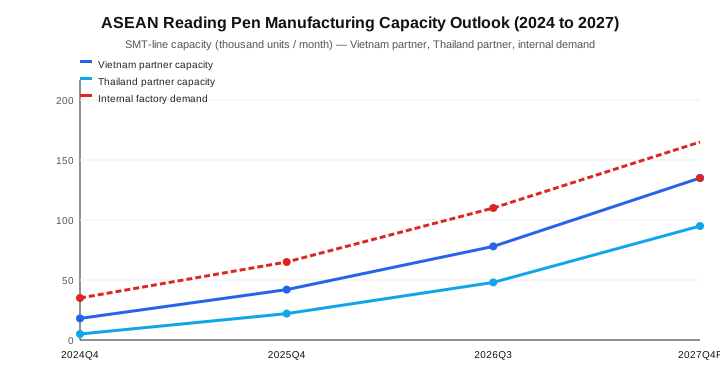
The chart tells a clear story. Vietnam partner capacity grew 333 percent from 18,000 units/month (2024Q4) to 78,000 units/month (2026Q3), and is forecast at 135,000 units/month by 2027Q4. Thailand partner capacity grew 860 percent from 5,000 to 48,000 units/month, and is forecast at 95,000 units/month. Internal factory demand (our own catalog order book) grew from 35,000 to 110,000 units/month, forecast at 165,000 units/month by 2027Q4. The gap between Vietnam capacity (135K) and internal demand (165K) by 2027Q4 is the structural reason why 2026 buyers should be locking their 2027 partner allocation now — if every B2B buyer waits until 2027 to chase ASEAN capacity, the available slots will be exhausted.
6. Implications — What 2026 Buyers Should Do This Quarter
Five actions fall out of the data. Decide your China+1 pattern now — Pattern A (Vietnam final) for US-market distributors, Pattern B (Thailand sub) for EU-market distributors. Audit your country-of-origin documentation if you have already moved packaging to Vietnam — confirm that PCBA and final assembly also happen there. Lock a 2027 partner allocation LOI by 31 December 2026 — capacity at both Vietnam and Thailand partners is filling ahead of the 2027 demand curve. Run a tariff scenario for the 2027 US Section 301 review — the upper-bound 35–45 percent outcome would shift the China FOB vs Vietnam final breakeven from 5,000 units to 2,500 units. Re-quote your last HS code to OID book sub-components — the OID book under HS 4901.99 attracts a much lower duty than HS 8543.70 in some ASEAN origin stacks, and a book-binding move to Vietnam can save $0.40 per unit on the duty line.
| Action | Deadline | Saving / Impact |
|---|---|---|
| Decide China+1 pattern (A vs B) | 31 Oct 2026 | Locks 2027 capacity slot |
| Audit COO documentation | 30 Nov 2026 | Avoid $5,000–$10,000 per shipment penalty |
| Lock 2027 partner allocation LOI | 31 Dec 2026 | Secures 80–135K units/month slot |
| Run tariff scenario for 2027 Section 301 | 31 Jan 2027 | Braces for 35–45% upper bound |
| Re-quote OID book duty line | 31 Mar 2027 | Save $0.40 per unit on HS 4901.99 |
7. Recommendations for B2B Buyers by Market Focus
For US-market distributors (Amazon, Walmart, school district bids): engage Pattern A — Vietnam final assembly in Binh Duong — and budget a $1.20 FOB premium per unit in exchange for the $1.58 per unit duty saving at the 25 percent Section 301 tariff. For EU-market distributors (germany, France, Spain, Italy): engage Pattern B — Thailand sub-assembly in Chonburi — and budget a $1.90 FOB premium per unit in exchange for the 0 percent GSP+ duty into the EU. For dual-market distributors (US + EU): a hybrid Vietnam-SMT + China-final model will fail the country-of-origin test in both markets; commit to one or the other. For ASEAN-domestic distributors: a Thai sub-assembly contract makes the most sense even without tariff arbitrage, because ASEAN intra-regional logistics saves 4–6 days of ocean transit time versus a China FOB origin.
8. Outlook — Where ASEAN Reading Pen Manufacturing Goes From Here
Three scenarios frame the 2027 ASEAN reading pen manufacturing picture. Base case (60 percent probability): Vietnam partner capacity hits 135K units/month by 2027Q4, Thailand hits 95K, and our internal factory order book fills 75–80 percent of that combined ASEAN capacity. Upside case (20 percent probability): the US Section 301 upper bound goes to 35–45 percent in 2027, accelerating the China+1 shift and pushing Vietnam partner capacity toward 175K units/month. Downside case (20 percent probability): ASEAN labour cost inflation (Vietnam wages projected +12–18 percent in 2027) erodes the tariff arbitrage, and the Vietnam final FOB premium rises to $1.80–$2.20 per unit, narrowing the duty saving. None of these scenarios changes the immediate 2026 buyer action: the ASEAN capacity window closes ahead of the demand curve, and the buyers who move first in 2026Q4 own the 2027 supply mix.
Buyer tip: When you sign a Vietnam final-assembly contract, ask for the partner factory's last three FCC and CE audit reports plus the Vietnam-origin substantial transformation checklist. We include these in our audit report sample template, and the right Vietnam partner will already have them.
9. Frequently Asked Questions (FAQ)
{
  "@context": "https://schema.org",
  "@type": "FAQPage",
  "mainEntity": [
    {
      "@type": "Question",
      "name": "Does Vietnam final assembly actually save tariff cost on reading pens?",
      "acceptedAnswer": {
        "@type": "Answer",
        "text": "Yes, but only if substantial transformation happens in Vietnam. A Vietnam final-assembly contract moves a 5,000-unit L5 reading pen from $12.40 landed to US East Coast (China FOB at 25 percent Section 301) to $12.17 landed (Vietnam at 5 percent MFN), a $0.23 per unit saving on a single shipment and roughly $1,150 per 5,000-unit container."
      }
    },
    {
      "@type": "Question",
      "name": "What is the substantial transformation rule for Made in Vietnam reading pens?",
      "acceptedAnswer": {
        "@type": "Answer",
        "text": "Under FTC substantial transformation rules, the reading pen must undergo PCB population, final enclosure assembly, firmware flashing with per-device serial number, and OID book binding in Vietnam. A reading pen that only undergoes packaging in Vietnam is still considered Chinese origin and may face $5,000 to $10,000 per shipment liquidated damages plus anti-dumping duty reassessment."
      }
    },
    {
      "@type": "Question",
      "name": "Can Thai sub-assembly deliver reading pens duty-free to the EU?",
      "acceptedAnswer": {
        "@type": "Answer",
        "text": "Yes, under the EU GSP+ scheme and the EU-Thailand FTA. A reading pen with sufficient Thai origin content (typically 40 to 45 percent by value) clears EU Customs at 0 percent duty into HS 8543.70. The Thailand sub-assembly FOB premium of $1.90 per unit is offset by the 0 percent duty line versus 1.7 to 3.5 percent MFN for a China-origin import."
      }
    },
    {
      "@type": "Question",
      "name": "How much does Vietnam electronics assembly labour cost in 2026?",
      "acceptedAnswer": {
        "@type": "Answer",
        "text": "Vietnamese electronics assembler wages sit at $345 to $420 per month in 2026, versus $720 to $880 per month in Shenzhen and Dongguan. The 50 to 55 percent wage gap is the structural reason that Vietnam final assembly can absorb the 14.6 percent FOB premium and still break even on tariff arbitrage."
      }
    },
    {
      "@type": "Question",
      "name": "What is the 2027 Vietnam partner capacity for reading pen assembly?",
      "acceptedAnswer": {
        "@type": "Answer",
        "text": "Vietnam partner SMT-line capacity is forecast at 135,000 reading pen units per month by 2027Q4, up from 78,000 in 2026Q3. Thailand partner capacity is forecast at 95,000 units per month. Combined ASEAN partner capacity of 230,000 units/month by 2027Q4 is sufficient to absorb most of the projected 165,000 unit/month internal factory order book."
      }
    },
    {
      "@type": "Question",
      "name": "Is country-of-origin labelling required for ASEAN reading pen imports?",
      "acceptedAnswer": {
        "@type": "Answer",
        "text": "Yes. Reading pen imports into the US must carry 'Made in Vietnam' or 'Made in Thailand' on the device, master carton, and commercial invoice. EU imports require the same marking under EU non-preferential origin rules. Mis-claiming origin triggers anti-dumping duty reassessment, customs penalties of $5,000 to $10,000 per shipment, and possible seizure of the consignment."
      }
    }
  ]
}
10. Related Reading
- Reading Pen HS Code and Customs
- Reading Pen Tariff Rates by Country
- Reading Pen Country of Origin Rules
- Reading Pen Incoterms Guide
- Reading Pen Factory Audit Checklist
- Reading Pen Supply Chain BOM Sourcing
- Reading Pen Shenzhen Manufacturing Hub
- Reading Pen ASEAN Manufacturing Sourcing
- Reading Pen Vietnam Import Guide
- Reading Pen Thailand TIS Import Guide