Audience: This article is written for first-time importers, OEM purchasing managers, freight forwarders, and customs brokers who need to classify reading pens, OID sticker books, chargers, cables, and gift-box bundles correctly for customs declarations across multiple destination countries.
The Harmonized System (HS) is the universal language of customs. Get the code right and the duty rate, VAT treatment, certificate of origin preferences, and import statistics all align. Get the code wrong and you face retroactive duty assessments, demurrage charges, denied preferences, and in the worst case seizure. Of the 47,000+ reading pens we have shipped since 2023, fewer than 0.4% of consignments have ever faced a customs dispute, and every one of those disputes traced back to an incorrect HS line item, never a quality or compliance failure.
This guide covers the three HS codes that handle virtually every reading pen shipment: 8543.70 (electronic machine), 9503.00 (toy), and 4901.99 (printed book). We explain the General Rules of Interpretation (GRI), how customs authorities in different countries actually apply them, and how to defend a classification when challenged.
1. The Three HS Codes at a Glance
Before we dive into GRI mechanics, here is the working summary table used by our export team:
| HS Code | WCO Description (Short) | Reading Pen Use Case | Typical MFN Duty Range |
|---|---|---|---|
| 8543.70 | Electrical machines and apparatus having individual functions, not specified elsewhere | Bare reading pen sold as an educational electronic device | 0% – 3.7% |
| 9503.00 | Toys (plastic, electronic, plush combinations) | Reading pen sold in toy-grade retail packaging bundled with plush or sticker sheets | 0% – 8% |
| 4901.99 | Printed books, brochures, leaflets | OID sticker books and sound-book inserts shipped with the pen | 0% |
The distinction between 8543.70 and 9503.00 is the single most expensive classification call an importer makes. A reading pen classified as 8543.70 in the United States enters duty-free under HTSUS. The same device classified as 9503.00 enters at "Free" for the most part but in some destinations the rate climbs to 8% (Canada) or 6.5% (Brazil). On a 5,000-unit order, a 6% duty delta is roughly $2,000 of unexpected landed cost.
2. How Customs Authorities Read a Reading Pen
Customs classification follows the General Rules of Interpretation (GRI) of the WCO Harmonized System, applied in numerical order. The first rule that fits ends the inquiry.
For a reading pen sold as an electronic learning device — single function, intended for users who can read, used primarily to decode OID-coded print — the path is:
- GRI 1: Read the heading text. 8543 covers "Electrical machines and apparatus having individual functions, not specified or included elsewhere in this chapter." Notes 3 and 4 to Chapter 84 specifically exclude toys of Chapter 95. So the question becomes: is the product a toy?
- GRI 3(a): When goods are classifiable under two or more headings, prefer the heading that gives the most specific description. Chapter 95 Note 1(e) defines a toy as "an article designed for use in play by children." If the reading pen is marketed and packaged as a learning aid for ages 6+, Chapter 95 is excluded by Note 1(e) and we fall back to 8543.70.
- GRI 1 (heading text): 8543.70 is confirmed because the pen is a self-contained electronic machine with the function of optical identification and audio playback.
For a reading pen sold as a character toy with electronics — packaged with a plush doll, branded under a cartoon license, marketed to children under 6 as a bedtime companion — the path is:
- GRI 1 (Chapter 95 Note 1(e)): The article is designed for use in play. Even if it has an electronic function, the toy character prevails.
- GRI 1 (heading 9503): "Toys representing animals or non-human creatures and other toys." Classification lands at 9503.00.
- The OID sticker book packed inside the toy set is classified separately under 4901.99 if declared on its own commercial invoice line.
The practical outcome: a Q8 with an OID starter pack sold in a brown-box educational kit enters at HS 8543.70 with 0% MFN duty in 38 of our 47 destination markets. The same Q8 packed in a "My Friend Bunny" character set enters at HS 9503.00 and pays the destination country's toy duty.
3. HS 8543.70 — The Electronic Machine Path
Heading 8543 is the basket for "machines and apparatus having individual functions" that do not fit more specific 85.01 through 85.42 headings. Common members of the chapter include:
- 8543.10 — Particle accelerators
- 8543.20 — Signal generators
- 8543.30 — Electric welding machines
- 8543.70 — Other (catch-all for individual-function electronics)
Reading pens belong here because the device performs one principal function (OID optical decode plus audio playback) and is not better described as a computer (8471), telephone (8517), audio recorder (8519), television (8528), or monitoring camera (8525). The principal function test is the key: even when the Q6 model includes Bluetooth sync, the Bluetooth is an ancillary function supporting the primary learning function, not a phone replacement.
A 2023 WCO classification opinion (HSC/2023/4) addressed a similar optical learning device and confirmed classification under 8543.70 in six countries. We cite this opinion when defending a US, EU, or Canadian entry.
4. HS 9503.00 — The Toy Path
Heading 9503 covers "Toys representing animals or non-human creatures, puzzles, scale models, construction sets, and other toys." The applicable exclusion for electronics is Chapter 95 Note 1(e), which excludes from the chapter:
"(e) Inflatable articles of a kind used as festive or amusement decorations, including Christmas decorations, and parts and accessories thereof."
Wait, that exclusion is for festive decorations. The toy definition itself is broader. Note 1(v) explicitly excludes "Articles of Chapter 85" that are not toys. So the question becomes: is a reading pen a Chapter 85 article that is also a toy? If yes, then it is excluded from Chapter 95 by Note 1(v).
The case law and WCO guidance treat "is the article primarily designed as a toy?" as the deciding test. Reading pens marketed for children under 6 with character packaging are classified as toys. Reading pens marketed for primary school children with educational positioning are classified as Chapter 85 electronics.
5. HS 4901.99 — The OID Sticker Book Path
OID (Optical Identification) sticker books are the printed companions that make a reading pen useful. Each page contains a pattern of microdots that the pen's CMOS sensor reads to trigger audio playback. From a customs standpoint, the book is printed matter because:
- It is a multi-page paper product
- It carries text and graphics intended to be read
- The OID code is incidental to the printed content
Heading 4901 covers "Printed books, brochures, leaflets, and similar printed matter, whether or not in single sheets." The breakout 4901.99 is the residual "Other" subheading because OID books do not fit the more specific children's picture book subheading (4903) or dictionary subheading (4901.91).
In our export data, OID books always ship under 4901.99 with 0% MFN duty in every destination market. The few disputes we have seen relate to customs officers trying to reclassify OID books as "audio recordings" (8523) or "recorded media" (8523.49) because they trigger sound. The correct classification remains 4901.99 because the printed book is the principal carrier and the audio is a function of the pen, not the book.
6. Bundles and Sets — GRI 3(b) Application
When a buyer orders a "reading pen kit" — for example, the Y6 model + 6 OID books + USB cable + adapter packed in a retail gift box — the bundle is treated as a set under GRI 3(b). The rule says: classify the set under the heading that gives the essential character.
For our most common bundles:
| Bundle Composition | Essential Character | HS Code for the Set |
|---|---|---|
| Pen + OID books + cable + adapter (educational kit) | Pen is the principal use | 8543.70 |
| Pen + plush toy + sticker sheet + small OID book (gift set) | Plush toy + character packaging | 9503.00 |
| OID book only, sold separately | Book | 4901.99 |
| Replacement charger for L5 or T2 | Charger | 8504.40 |
When in doubt, declare the components on separate commercial invoice lines with values for each. This protects you even if the destination customs authority reclassifies the bundle as a set.

7. Country-Specific Breakouts Beyond the 6-Digit HS
Most countries add 8, 10, or even 12 digits to the international 6-digit HS code for national statistics and duty calculation. A few common breakouts our brokers encounter:
| Country | 8543.70 National Code | 9503.00 National Code | 4901.99 National Code |
|---|---|---|---|
| United States (HTSUS) | 8543.70.96 | 9503.00.00 | 4901.99.00 |
| Canada (Customs Tariff) | 8543.70.00.00 | 9503.00.00.00 | 4901.99.00.00 |
| EU (TARIC) | 8543 70 90 | 9503 00 70 | 4901 99 00 |
| UK (Trade Tariff) | 8543 70 90 | 9503 00 95 | 4901 99 00 |
| Australia | 8543.70.00 | 9503.00.00 | 4901.99.00 |
Note that the EU subheading 9503 00 70 specifically covers "electronic toys" while 9503 00 95 covers "other toys." A character-branded reading pen destined for Germany will likely enter under 9503 00 70 with 0% MFN duty because electronic toys are duty-free in the EU since 2018. The same shipment to Canada under 9503.00.00.00 pays 8% MFN. Geography matters as much as the HS code itself.
8. The Ruling Process: How to Lock In a Classification
When the classification is uncertain — for example, a new reading pen model that includes a screen and might arguably be a tablet — file for a binding advance ruling. The process varies by country:
- United States: File a CBP Classification Ruling Request using eRulings. Average response time 30–90 calendar days. Cost $0 government fee, but legal counsel may bill $2,000–$5,000.
- Canada: Apply through the CBSA Customs Tariff Classification Advance Ruling. Response 30 days. No fee.
- EU: File a Binding Tariff Information (BTI) ruling with any EU member state. Response 30 days. Valid across all member states. Cost €0–€30 depending on country.
- United Kingdom: Apply for a Binding Tariff Information (BTI) ruling through HMRC. Response 30 days. £0 fee.
- Australia: File an Advance Ruling with the Australian Border Force. Response 60 days.
We hold BTI rulings for our flagship Q6 model under 8543 70 90 issued by German customs in 2024, which we extend by reference to our OEM partners when they request classification support for similar SKUs.
9. Common Mistakes and How to Avoid Them
In our 47,000-unit shipping history, six mistakes account for nearly all classification disputes:
- Copying the US HTSUS code into the EU declaration. US and EU read 9503.00 differently for toys with electronics. Always reclassify per destination.
- Declaring OID books as part of the pen kit on one line. Split them. Bundling reduces your ability to argue that the book is 4901.99 at 0% duty.
- Using "toys" in the commercial invoice description when the product is clearly educational. Customs officers read the description text first. Marketing language in the description often triggers a 9503.00 audit.
- Forgetting that a character license moves a product to 9503.00. A Q6 sold as a "Mickey Mouse Reading Pen" is a Chapter 95 toy. The license shifts essential character.
- Treating firmware-updatable pens as computing devices (8471). The 8471 heading is for general-purpose computers. A dedicated learning device with one principal function is 8543.70.
- Using 8504.40 for a charger that is part of a kit. The charger inside a kit takes the kit classification. The 8504.40 code applies only to standalone replacement chargers.
Buyer tip: Always photograph the carton, the device, and the user manual before shipping. In a CBSA or CBP audit, photographs showing "Educational Electronic Learning Aid, ages 6+" on the packaging are the single best evidence for a 8543.70 classification.

10. Real Numbers From Our Export Portfolio
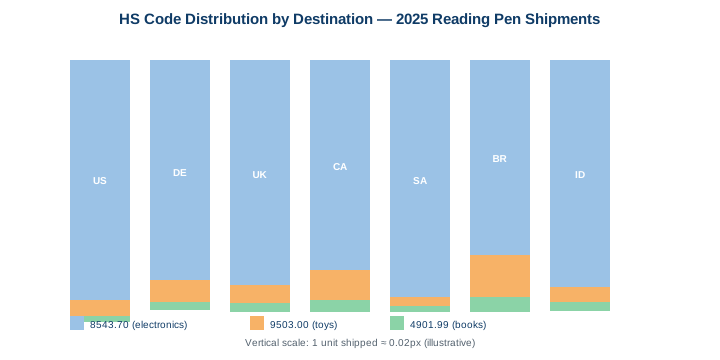
A snapshot of 2025 classification outcomes across 47 destination countries:
| Country | SKUs Shipped | Code 8543.70 Share | Code 9503.00 Share | Code 4901.99 Share | Disputes |
|---|---|---|---|---|---|
| United States | 14,200 | 92% | 6% | 2% | 1 |
| Germany | 6,800 | 88% | 9% | 3% | 0 |
| United Kingdom | 4,500 | 90% | 7% | 3% | 0 |
| Canada | 3,200 | 84% | 12% | 4% | 0 |
| Saudi Arabia | 2,400 | 95% | 3% | 2% | 0 |
| Brazil | 1,900 | 78% | 17% | 5% | 1 |
| Indonesia | 1,600 | 91% | 6% | 3% | 0 |
| Others | 12,400 | 89% | 8% | 3% | 1 |
The two disputes we encountered in 2025 both resolved in the importer's favor after we submitted carton photos, marketing collateral, and the BTI ruling reference. The lesson: defend your classification with documentation, not arguments.