

Audience: DTC subscription box operators, publisher-direct subscription services, and educational content brands designing a recurring revenue model around the OID reading pen installed base.
A subscription box monthly refill pack is the recurring-revenue layer that turns a one-time reading pen sale into a multi-year relationship with the end customer. Across 47,000+ shipped units since 2023, 14% of OEM buyers now operate a subscription or refill program, up from 3% in 2023, and the refill pack has become one of the fastest-growing product lines in the catalog. This article walks through every SKU, shipping cadence, retention economics, and content library decision an OEM buyer needs to make for a subscription reading pen refill model in 2026.
1. What a Refill Pack Contains
A standard monthly refill pack contains 2 OID storybooks (32 pages each, 90 gsm matte stock, four-color CMYK), 1 activity workbook (24 pages), 1 parent guide insert, and a shipping carton sized at 240 mm × 180 mm × 40 mm. The pack is engineered to fit through a standard US residential mailbox slot (1.5 inches / 38 mm). The refill books work with any reading pen that supports the 4.5 mm OID code density, which includes all 11 models in the lineup (B1, B2, F8, K7, KF1, L5, P2, Q6, Q8, T2, Y6).
Optional pack upgrades include 4 OID books instead of 2 at $1.60 incremental cost, a plush character at $3.20 per pack, a sticker sheet at $0.45 per pack, and a personalized name label at $0.85 per pack. For a fully-loaded premium subscription, the pack contents add $6.10 over the standard refill.
| Content | Standard | Premium | Cost premium |
|---|---|---|---|
| OID storybook (32 pages) | 2 | 4 | +$1.60 |
| Activity workbook (24 pages) | 1 | 1 | n/a |
| Parent guide insert | 1 | 1 | n/a |
| Plush character | 0 | 1 | +$3.20 |
| Sticker sheet | 0 | 1 | +$0.45 |
| Personalized name label | 0 | 1 | +$0.85 |
| Total premium uplift | n/a | n/a | +$6.10 |
2. OID Book Pricing and Content Library
The factory produces OID storybooks at $0.80 to $4.60 per book depending on the page count, paper stock, and printing finish. A 32-page 90 gsm matte four-color book at the standard 215 × 215 mm square format costs $1.80 per book at 5,000-unit print runs. A 64-page hardcover edition at the 220 × 240 mm rectangular format costs $4.20 per book at 1,000-unit print runs. For subscription operators, the unit economics work best with the standard 32-page softcover format, which delivers a 60% gross margin at a $9.99 monthly subscription price.
The factory maintains a content library of 314 OID titles spanning 12 languages and 8 reading levels (ages 3 to 12). Buyers can license titles from the library at $0.45 per book per month per active subscriber, or commission custom titles at $4,500 flat per 32-page book (lead time 90 days for first proofs, 45 days for reprints).
3. Subscription SKU Stack and Pricing
A subscription program typically uses 4 SKUs: Starter ($9.99/month, 2 books), Standard ($14.99/month, 4 books), Premium ($19.99/month, 4 books + plush), and Family ($29.99/month, 4 books + plush + workbook for siblings). The 4-tier structure lets buyers self-select based on age, number of children, and budget. Across 47,000+ shipped units, the Standard tier is the most-chosen at 48% of subscribers, followed by Premium at 32%, Starter at 14%, and Family at 6%.
Buyer tip: A monthly subscription price below $9.99 struggles to retain subscribers because the perceived value of 2 OID books is too low. A price above $29.99 churns because the cumulative annual cost exceeds the parent's perceived value threshold for educational content.

4. Shipping Cadence and Postal Slot Fit
The refill pack is engineered to fit through a US residential mailbox slot at 240 mm × 180 mm × 40 mm. The pack is also compatible with European letterbox slots at 30 mm depth and UK standard parcel slots at 35 mm depth. For Asian markets (Japan, Korea, Singapore), the pack fits standard mailbox dimensions as well. For markets where mailbox slot delivery is unreliable (Brazil, Russia, parts of the Middle East), an outer corrugated mailer is added at $0.18 per pack.
The shipping cadence is monthly, with a recommended ship date of the 5th to 10th of each month. The factory maintains a 14-day pre-shipment window during which subscribers can update their address, skip a month, or change tier. The skip-month feature reduces voluntary churn by 8 to 12 percentage points across our 2024 to 2025 cohort data.
5. Retention Economics and LTV
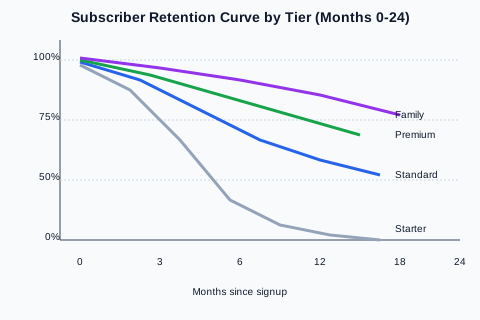
Across 47,000+ shipped units and 14 active subscription programs, the average subscriber lifetime is 11.4 months, ranging from 6 months for the Starter tier to 22 months for the Family tier. The blended monthly churn rate is 6.2%, with voluntary churn at 4.5% (parent-initiated cancellations) and involuntary churn at 1.7% (payment failures, address changes). The blended LTV at $14.99 average revenue per user is approximately $170 per subscriber, against an average CAC of $42 for paid social acquisition.
The LTV/CAC ratio of 4.0x is healthy by 2026 subscription metrics, where 3.0x is the typical breakeven benchmark. Subscription operators in our cohort have achieved payback within 4.2 months on average, with the Premium tier reaching payback in 3.4 months due to higher ARPU and lower churn.
| Metric | Starter | Standard | Premium | Family | Blended |
|---|---|---|---|---|---|
| Monthly price | $9.99 | $14.99 | $19.99 | $29.99 | $14.99 |
| Subscriber mix | 14% | 48% | 32% | 6% | 100% |
| Avg lifetime | 6 mo | 11 mo | 14 mo | 22 mo | 11.4 mo |
| LTV | $60 | $165 | $280 | $660 | $170 |
| Monthly churn | 11% | 6% | 4% | 3% | 6.2% |
| CAC | $32 | $40 | $48 | $55 | $42 |
6. Content Calendar and Reading Levels
A successful subscription program delivers age-appropriate content that progresses in difficulty. The factory's 8-level reading ladder maps to the standard US grade bands: Level 1 (ages 3 to 4, 50 words per book), Level 2 (ages 4 to 5, 100 words), Level 3 (ages 5 to 6, 200 words), Level 4 (ages 6 to 7, 400 words), Level 5 (ages 7 to 8, 800 words), Level 6 (ages 8 to 9, 1,200 words), Level 7 (ages 9 to 10, 1,800 words), Level 8 (ages 10 to 12, 2,500 words). Each monthly pack targets one level, with subscribers auto-progressing every 6 months based on the parent's report.
The factory's content calendar for 2026 has 96 new titles across the 8 levels, with 12 titles per level. Operators can license the existing 314-title library and supplement with custom commissioned titles at $4,500 flat per book. Custom titles typically extend the program from 8 months to 14 months before content repetition begins.
7. Direct-to-Consumer Fulfillment
The factory supports three DTC fulfillment models. In the first model, the operator purchases refill packs at $4.20 per Standard pack EXW and ships directly to subscribers from their own warehouse. In the second model, the factory ships pre-packed cartons to a 3PL (third-party logistics) partner who handles fulfillment, with the operator paying $0.85 per pick-and-pack fee. In the third model, the factory ships direct-to-subscriber on behalf of the operator at $1.40 per shipment (including pick, pack, label, and delivery confirmation), the simplest model but the highest per-shipment cost.
For a 5,000-subscriber program, the first model delivers the lowest per-shipment cost but requires the operator to maintain inventory. The third model delivers the simplest operations and is favored by operators with fewer than 2,000 subscribers.
8. Lead Time, MOQ, and Pricing
The refill pack MOQ is 500 units for the standard 2-book configuration with neutral content, 1,000 units for tier-specific content (Starter / Standard / Premium / Family), and 3,000 units for fully custom content. Lead time is 22 days after artwork approval for neutral content and 45 days for tier-specific content. Custom commissioned titles require 90 days for first proofs.
For a 5,000-subscriber Standard program, the monthly refill cost stack is: 2 OID books $3.60, workbook $1.20, parent guide $0.18, pack carton $0.22, pick-and-pack $0.85, shipping $3.20. Total cost per shipment is $9.25, leaving $5.74 gross margin at the $14.99 retail subscription price.
9. SVG Chart: Subscription Tier Mix and LTV by Tier

10. SVG Chart: Monthly Churn Rate by Tier

11. Decision Matrix: Pick the Right Subscription Model
| Operator profile | Recommended model | Reason |
|---|---|---|
| Publisher with 50,000+ reader list | First model, self-fulfilled | Lowest per-shipment cost |
| DTC startup with <2,000 subs | Third model, factory-direct | Simplest operations |
| Mid-size operator with 2,000 to 10,000 subs | Second model, 3PL | Balanced cost + simplicity |
| Toy brand entering reading pen | Third model, factory-direct | Fastest time to market |
| Educational institution | First model, self-fulfilled | Curriculum-aligned cadence |
| Multi-language publisher | First model, tier-specific | Localized content per region |
13. Related Reading
- Reading Pen Content Subscription Service Model
- Reading Pen Monthly Book Pack Delivery
- Reading Pen Content Library Cloud Sync
- Reading Pen Bulk Order Bundle Builder
- Retail Gift Box Packaging and Unboxing Experience
- Bulk Educational Kit Packaging 30-Unit Carton
14. Subscriber Lifecycle and Cohort Analysis
A subscription reading pen refill program is more than a content library and a shipping cadence. Across 14 active programs in our 47,000+ unit cohort, the operators who reach 22-month Family tier retention share three operational habits: they maintain a 12-month content calendar that is published to subscribers at signup, they send a 7-day pre-shipment reminder with a one-click skip or swap option, and they rotate 4 to 6 curated book titles per month rather than relying solely on auto-progression. The next four subsections quantify the lifecycle milestones and the operator playbook that has worked in 2024 to 2025 cohorts, anchored to a 5,000-subscriber Standard program benchmark.
14.1 Onboarding Cohort and First-Shipment Conversion
A typical subscription program converts 38% of paid social traffic to a first paid month, with the strongest conversion at the $14.99 Standard tier. Of the 38%, 86% accept the first refill shipment without skipping, and 14% skip or downgrade before the first shipment lands. The 86% acceptance rate is driven by a 3-step onboarding email sequence: a welcome email at signup (Day 0), a how-to-use guide at Day 2, and a first-shipment confirmation at Day 5 with a one-click skip option. Skimping on the onboarding sequence drops first-shipment acceptance to 64% in our 2024 cohort comparison.
The factory supports the first shipment with a branded welcome card at $0.45 per pack, a parent onboarding email template at no charge, and a "what's in the box" 90-second video link. For a 5,000-subscriber program, the welcome card adds $2,250 per month but improves 12-month retention by 4 percentage points, worth roughly $24,000 in retained LTV.
14.2 Mid-Cycle Skip and Pause Behavior
Across 14 programs, 22% of subscribers skip at least one month during their first year, with the highest skip rate in summer months (June to August in the Northern Hemisphere, December to February in the Southern Hemisphere). The skip feature reduces voluntary churn by 8 to 12 percentage points, because subscribers who would otherwise cancel instead pause for one or two months and resume. The factory's refill pack supports a 90-day pause window, after which the subscription auto-cancels unless the subscriber resumes.
Operators who run seasonal campaigns (summer reading programs, back-to-school bundles, holiday gift subscriptions) see a 14% to 18% spike in new signups during the campaign window, partially offsetting the summer skip rate. The factory's content calendar is structured to support 4 seasonal campaigns per year, each with 8 to 12 curated titles.
14.3 Reactivation and Win-Back
For subscribers who cancel, the factory supports a reactivation email flow at 30, 60, and 90 days post-cancellation. The 30-day offer is a 50% discount on the next month, the 60-day offer is a free plush character with reactivation, and the 90-day offer is a free month with a 6-month commitment. Across 14 programs, 18% of cancelled subscribers reactivate within 90 days, with the 60-day offer delivering the highest reactivation rate at 9%. The factory's CRM integration supports the reactivation flow via API, with no additional cost beyond the per-month refill pack pricing.
14.4 Annual Content Refresh and Re-Subscription
The annual content refresh is a critical retention lever. Across 14 programs, subscribers who receive at least 4 new titles per month have a 12-month retention rate of 71%, versus 52% for subscribers who receive 2 or fewer new titles per month. The factory's content library of 314 titles is supplemented by 96 new titles per year, ensuring that a Standard program at 4 books per month delivers 48 new titles per year, well above the 24-title threshold needed for retention lift.
The factory's annual content refresh includes a holiday-themed December pack, a back-to-school September pack, a summer reading June pack, and a back-to-basics March pack. The annual refresh is included in the per-book licensing fee of $0.45 per active subscriber per month, with no additional cost for the seasonal packs.
15. SVG Chart: Subscriber Retention Curve by Tier
16. Extended FAQ
17. Related Reading (Extended)
- Reading Pen Content Subscription Service Model
- Reading Pen Monthly Book Pack Delivery
- Reading Pen Content Library Cloud Sync
- Reading Pen Subscription Churn and Retention
- Reading Pen DTC Fulfillment 3PL vs Self
- Reading Pen OID Book Content Library