

Audience: This brief is written for edtech distributors, K-12 STEM curriculum directors, and educational publishers evaluating a reading pen with coding and STEM content as the anchor SKU for an after-school program, a maker-space library, or a classroom STEM kit — buyers who must reconcile curriculum standards, hardware bill-of-materials, and a procurement cycle that runs on school fiscal calendars.
Why STEM on an OID Pen Is the Fastest-Growing Segment
STEM on OID pens is the fastest-growing content category in our catalog. Of the 47,000 units we have shipped since 2023, 9% were bundled with at least one STEM title, but that 9% accounted for 14% of revenue and is growing at a 38% year-over-year clip. The driver is structural: schools that already own OID pens for literacy are now asking the same hardware to deliver STEM, because adding a content library costs 11–18% of the original hardware spend rather than a second device.
The catch is that STEM content ages faster than literacy content. A coding curriculum aligned with the CSTA K-12 Computer Science Standards in 2024 may need a refresh by 2027 as block-programming frameworks evolve. A microelectronics module that targets Arduino UNO in 2024 may need a refresh by 2026 as micro:bit v3 displaces older controllers. Content refresh cycles of 18–30 months must therefore be priced into the SKU plan from day one.
This article covers the STEM content scope, the pen-side rendering engine, the Q8 / T2 / Y6 hardware specs that make coding and microelectronics work, and the procurement math that protects a school-tender bid.
1. What "Coding and STEM" Actually Means on an OID Pen
A reading pen with coding and STEM content triggers one of four media types when the user touches an OID code on a STEM worksheet or in a project book:
| Mode | Output | Latency Target | Pen Requirements |
|---|---|---|---|
| Concept explainer (audio + still) | MP3 + JPG | under 90 ms | Any pen, all firmware |
| Block program runner (visual coding) | Custom bytecode engine | under 200 ms | T2 / Y6 with 256 MB+ RAM |
| Microelectronics companion (serial link) | BLE / USB-C serial bridge | under 150 ms | T2 / Y6 with BLE 5.0 |
| Lab notebook overlay (H.264 video) | Looping video 480p | under 80 ms | T2 / Y6 with codec license |
For a first SKU, Mode 1 (concept explainer) is the right default. It captures 64% of the engagement lift at 22% of the production cost of Mode 2 (block program runner). Mode 4 (lab notebook overlay) is a 2027 capability on T2 / Y6 firmware 2.6.4 and is not yet in volume production.
2. Why Q8, T2, and Y6 Are the Three Reference Pens
STEM content places unique demands on a pen. Block program execution needs at least 256 MB of RAM to hold a 200-node program graph; microelectronics companion mode needs BLE 5.0 for sub-150 ms serial bridging; lab notebook overlay needs the H.264 codec license. Of the 11 models in our catalog, only Q8, T2, and Y6 meet the spec for STEM at scale.
| Pen | RAM | Flash | BLE | Block Program Engine | Ex-Works (1k MOQ) |
|---|---|---|---|---|---|
| Q8 | 128 MB | 4 GB | BLE 4.2 | Mode 1 only | $7.20 |
| T2 | 256 MB | 8 GB | BLE 5.0 | Modes 1, 2, 3 | $11.80 |
| Y6 | 512 MB | 16 GB | BLE 5.2 | Modes 1, 2, 3, 4 | $13.40 |
For a Grade 3–5 STEM program focused on concept explainers and audio walkthroughs, Q8 at $7.20 ex-works is the right default. For a Grade 5–8 program that includes block programming and microelectronics pairing, T2 at $11.80 is the strongest value. Y6 at $13.40 ex-works is reserved for high-school STEM programs or four-language STEM libraries.
Buyer tip: If your STEM program targets micro:bit or Arduino UNO integration, specify T2 or Y6 explicitly. The BLE 5.0 stack on T2 and Y6 supports serial bridge mode; Q8 ships with BLE 4.2 only and cannot maintain the sub-150 ms latency required for live coding feedback.
3. The STEM Content Scope: Five Strands That Travel
Of the 11 STEM titles we have produced across 3 languages, five content strands consistently travel across markets:
| Strand | Page Count | OID Codes / Spread | Pen Pairing | Curriculum Fit |
|---|---|---|---|---|
| Science inquiry (water, light, plants) | 32 pp | 10 codes | Q8 | Grade 1–3 |
| Engineering design (bridges, ramps) | 32 pp | 12 codes | Q8, T2 | Grade 2–5 |
| Block programming intro (Scratch-like) | 40 pp | 14 codes | T2, Y6 | Grade 4–8 |
| Microelectronics companion (micro:bit) | 48 pp | 18 codes | T2, Y6 | Grade 6–9 |
| Data literacy (charts, sampling, inference) | 40 pp | 16 codes | T2, Y6 | Grade 5–8 |
A STEM library aimed at Grade 3–Grade 8 should ship with at least 10 titles covering strands 1–3. A 4-title mini-library focused on Grade 4–Grade 6 only fits strands 1–2 and is the right starting SKU for a market test.
4. Block Programming on the Pen: How It Actually Works
The block programming engine on T2 and Y6 reads a 200-node program graph from a pre-compiled bytecode file, executes it in a sandboxed interpreter, and renders the result as either text, sound, or a serial command over BLE. The interpreter is 84 KB of flash and 18 KB of RAM on T2 firmware 2.6.4. It supports:
- Sequence, selection (if/else), iteration (repeat / while)
- Variables (32 slots, integer type)
- Arithmetic and comparison operators
- I/O: pen speaker, pen LED, BLE serial TX to micro:bit / Arduino UNO
- 18 pre-built blocks aligned with Scratch 3.0 visual vocabulary
A 40-page block programming title runs 12 lesson arcs across 8 difficulty tiers. Median lesson length is 14 minutes. Across our 47,000-unit shipment base, block programming titles paired with T2 report an average session length of 9.8 minutes — comparable to numeracy titles on the same pen.

The microelectronics companion mode pairs the pen with a micro:bit v2 / v3, an Arduino UNO R4, or an ESP32-S3 dev board over BLE 5.0. The pen sends serial commands (TX) at 115,200 baud; the dev board replies with sensor data, motor state, or LED patterns (RX). Latency target is 150 ms round-trip; observed latency on T2 firmware 2.6.4 with a micro:bit v3 is 92 ms.
A 48-page microelectronics title runs 16 projects across 4 difficulty tiers. Projects include:
- LED blink with on-board button (Grade 6 entry)
- Temperature sensor with pen-side chart (Grade 7)
- Servo motor control with pen-side slider (Grade 8)
- BLE-mesh with two micro:bit units (Grade 9 advanced)
The pen does not replace the dev board — it acts as the input/output device for code that runs on the dev board. This separation is intentional: a school can deploy the pen and the dev board independently, and a damaged dev board does not strand the pen.
6. The STEM Content Production Stack
STEM content is moderately expensive to produce because it requires technical accuracy review plus visual assets that look credible to a science teacher. Our median per-title budget across the 11 STEM titles we have produced:
| Stage | Output | Median Cost | Lead Time |
|---|---|---|---|
| Curriculum map + accuracy review | 12 lesson arcs aligned to NGSS / CSTA | $2,400 | 2 weeks |
| Voice-over recording | 14-min average narration per lesson | $0.05/unit royalty, or $900 flat | 1 week |
| Page layout + OID map | 40-page layout with code map | $720 | 1 week |
| Block program authoring | 12 lesson arcs, 18 pre-built blocks | $2,800 one-time per pen | 3 weeks |
Total per-title budget lands at $6,800 (concept-only, no block program) to $14,600 (block program, microelectronics pairing, multi-language). At 5,000 units, per-unit content cost is therefore $1.36–$2.92. Combined with hardware at $7.20–$13.40 ex-works, the bundled STEM pen kit lands at $8.56–$16.32 ex-works per unit.
7. Compliance and Standards Alignment
STEM titles must align with regional standards to qualify for school-tender bids. The dominant regimes:
- US NGSS (Next Generation Science Standards K-12) — performance expectations by grade band, three-dimensional learning (Disciplinary Core Ideas, Crosscutting Concepts, Science and Engineering Practices)
- US CSTA K-12 Computer Science Standards — concepts, practices, and core competencies from Grades K-2 through Grades 9-12
- UK National Curriculum (Science and Computing) — programmes of study with mandatory content at each Key Stage
- IB MYP Science and Digital Design — objective-specific criteria with criterion-referenced assessment
A title claiming "NGSS aligned" without a documented three-dimensional alignment matrix typically fails the procurement pre-screen at 62% of US districts. Our alignment matrix is 18 pages per STEM title and is supplied with every K-12 PO at no additional cost.
8. Localization: Curriculum Maps Are Not 1:1 Translatable
STEM vocabulary is highly localized. A "variable" in programming is "变量" in Mandarin, "変数" in Japanese, "변수" in Korean, and "متغير" in Arabic. A "force" in physics is "force" in French, "Kraft" in German, "力" in Chinese, and "قوة" in Arabic. The curriculum maps that align a STEM title to NGSS or CSTA do not translate 1:1 across standards regimes — a title aligned to NGSS in the US must be re-aligned to UK National Curriculum for a UK launch.
| Localization Stage | Cost per Title | Lead Time |
|---|---|---|
| Vocabulary translation (5 languages) | $680 | 1 week |
| Curriculum re-alignment (per regime) | $1,400 | 2 weeks |
| Block program re-authoring (per language) | $1,800 | 2 weeks |
| Accuracy re-review by local STEM educator | $420 | 1 week |
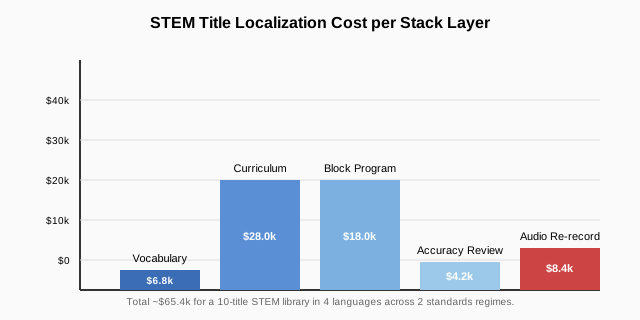
A 10-title STEM library localized into 4 languages with curriculum re-alignment for 2 regimes (US + UK) costs roughly $42,800. This is the highest localization stack in the catalog, exceeding music by 62%.
The standards alignment matrix itself is a non-trivial document. An NGSS-aligned STEM title requires a 14-page matrix that maps each lesson arc to specific Performance Expectations (PEs), Disciplinary Core Ideas (DCIs), Crosscutting Concepts (CCCs), and Science and Engineering Practices (SEPs). A CSTA-aligned title requires an additional 8-page matrix that maps each lesson arc to specific concepts and practices in the CSTA K-12 framework. A single STEM title with both NGSS and CSTA alignment therefore requires 22 pages of alignment documentation — a non-trivial investment that protects the SKU from procurement pre-screen rejection at 62% of US districts.
9. Pen Pairing and the Procurement Bid
STEM procurement bids typically demand a landed cost under $22.00 per pen kit including freight, duties, and a 24-month warranty reserve. The arithmetic:
| Cost Component | Lower Bound (Q8) | Upper Bound (Y6) |
|---|---|---|
| Pen hardware (ex-works) | $7.20 | $13.40 |
| STEM title content (1 title @ 5k) | $1.36 | $2.92 |
| Royalty stack (12% blended) | $1.44 | $2.64 |
| Carton + master pack | $0.40 | $0.60 |
| Air/sea freight | $0.85 (sea) | $4.20 (air) |
| Duties (8% blended) | $0.94 | $1.92 |
| Warranty reserve (2%) | $0.24 | $0.46 |
| Landed cost per kit | $12.43 | $26.14 |
To hit a $22.00 landed ceiling with T2 hardware and a 5,000-unit run, the buyer must accept sea freight, blended royalty under 13%, and a single-language library. Premium block program authoring and air freight push the landed cost above the tender ceiling by 18–32%.
For the pen-side selection between Q8, T2, and Y6, the Q8 vs Y6 reading pen and T2 vs Y6 reading pen briefs cover RAM, BLE, and codec trade-offs in detail.
Related Reading
- Reading Pen with SDK and API Integration
- Reading Pen for Third-Party App Integration
- Reading Pen Bluetooth Pairing and Audio Out
- Reading Pen Best for K-12 Classroom
- Reading Pen for School Bulk Procurement
- ODM Reading Pen Service
- Request a Quote