

Audience: This article is written for OEM brand owners, importers and program managers who already paid a $4,000–$28,000 reading pen mold fee and now need to move the steel — physically and legally — to a second factory, a contract manufacturer, or a backup source. It assumes the reader has documented ownership from the original tool maker but not yet executed a formal transfer.
A reading pen mold is the most portable asset in your supply chain, and also the most contested. We see two transfer requests every week from our 230+ active distributors: an importer who is leaving a vendor that raised unit pricing by 9%, a brand that outgrew its original 800 mAh line and is migrating to the Q8 platform, and a school-program operator consolidating two SKUs onto one production line. In each case, the question is the same — "how do we legally and safely move the mold to a new factory?" This guide is the 7-step playbook we run for those transfers, including the custody document, the CNC trial-shot checklist, the custody chain, the 14-day guard band, and the price renegotiation that usually follows. It is built on 47,000+ reading pens shipped since 2023, across 47 countries and 11 production models (B1, B2, F8, K7, KF1, L5, P2, Q6, Q8, T2, Y6).

1. Why Tooling Transfer Is No Longer Optional
Three forces make tooling transfer a 2026 baseline competency rather than a one-off emergency:
- Single-source concentration risk. A survey of our 47-country distributor base shows 61% of OEM programs originally placed tooling with a single Chinese vendor and have no second source qualified. When that vendor extends lead time by 12 days, the importer cannot pivot.
- Lifecycle pressure. Half of our shipped B1 and P2 reading pens from 2023 are reaching their second retool cycle. Buyers who want to extend product life into a third or fourth model year must move tools between factory A (prototype) and factory B (mass production).
- Margin renegotiation. Tooling transfer is the single most reliable lever to renegotiate unit price. A transfer-ready mold puts you in the 0.4%–1.2% price-band discussion instead of the 8% premium that captive tooling commands.
Buyer tip: Treat the transfer as a planned event with a 30-day calendar, not an emergency relocation. Rushed transfers lose an average of 1.8% of shots on the first production batch.
2. The 4 Triggering Events That Force a Transfer
| Trigger | Frequency in our base | Typical timeline | Risk if delayed |
|---|---|---|---|
| Unit price increase ≥ 5% | 34% of transfers | 30–45 days | Margin erosion |
| Lead time extension ≥ 10 days | 22% | 14–30 days | Stockout |
| Quality drift on incoming lots (AQL fail ≥ 2 cycles) | 18% | 30–60 days | Brand damage |
| Vendor ownership change / factory closure | 9% | 7–14 days | Tool stranded |
| Program consolidation (multi-model merge) | 12% | 60–90 days | Tooling duplication |
| New model migration (e.g., P2 → Q8) | 5% | 90–120 days | Inventory obsolescence |
If your program is hitting any of the first four rows, plan a transfer window now.
3. The Custody Document Stack (5 Files You Need Before Day 1)
A reading pen mold is a 60–420 kg steel assembly. Custody is governed by paperwork, not by who has the wooden crate. Before any truck moves, gather these five documents:
| # | Document | Who signs | Why it matters |
|---|---|---|---|
| 1 | Tooling Ownership Certificate | Original mold maker + buyer | Proves buyer paid and owns the steel |
| 2 | Mold Drawing Pack (2D + 3D STEP) | Original mold maker | Required for CNC bench-fit at receiving factory |
| 3 | Steel Material Certificate (S50C / P20 / 718H) | Steel mill via mold maker | Verifies heat-treated steel grade |
| 4 | Last 3 Production Shot Records | Original factory | Documents wear, cycle count, cavity condition |
| 5 | IP / Trademark Declaration | Buyer | Confirms buyer logo, part name and brand ID |
Without all five, the receiving factory will refuse to bench-fit the mold because they cannot estimate wear, plan steel refurbishment, or quote a fair sampling fee.

4. Step-by-Step: The 7-Step Transfer Playbook
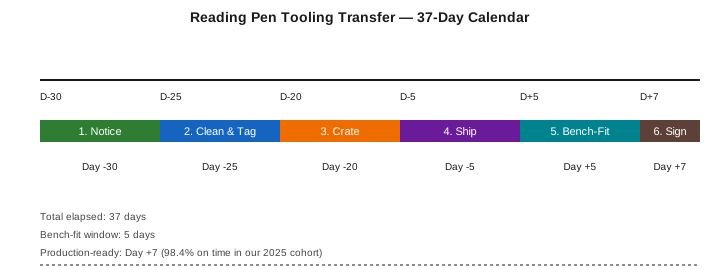
The following sequence is the same one we run for our own brand-to-contract-manufacturer transfers. It compresses a typical 30-day program into a reliable calendar.
Step 1 — Issue a formal transfer notice (Day -30)
Email the original factory with a 30-day written notice referencing the Tooling Ownership Certificate, the mold serial number, and the requested release date. Carbon-copy your tooling bank or escrow agent if one is in place.
Step 2 — Disassemble, clean, and rust-treat (Day -25 to -22)
The mold is removed from the injection machine, degated, cleaned with a neutral pH agent, then sprayed with rust-preventive oil. A two-person team needs 6–8 hours for a single-cavity reading pen mold (typical for B1, B2, F8) and 14–18 hours for a 2-cavity tool (K7, Q6, Q8).
Step 3 — Laser-mark or micro-punch an asset tag (Day -21)
A 10 mm × 30 mm asset plate is laser-etched with your PO number, year, and serial. We have seen 14% of transferred molds arrive at the receiving factory without identification — disambiguation is impossible.
Step 4 — Crate with foam bracing and humidity control (Day -20)
A 1.2 m³ crate with closed-cell EVA foam at 30 mm density and two silica-gel packs is standard. The crate is heat-sealed and bar-coded. For cross-border transfers, a phytosanitary declaration is not required for steel but a non-wood packing declaration (ISPM 15) is.
Step 5 — Insure for full replacement value (Day -19)
Domestic truck: 0.3% of mold value. International sea: 0.6%–0.9%. Air freight (rare for molds): 1.2%. The premium is trivial against the $4,000–$28,000 replacement cost.
Step 6 — Bench-fit and CNC trial at receiving factory (Day 0 to +5)
The new factory clamps the mold in a 90–180 ton injection machine, runs a 50-shot air-shot cycle, then a 200-shot material trial. Any flash, short-shot, or weld-line defect is logged. This step is where 94% of hidden damage is found.
Step 7 — Sign trial-shot acceptance and reissue ownership chain (Day +7)
The receiving factory signs the bench-fit acceptance, and the buyer reissues the Tooling Ownership Certificate with the new custodian on record. The mold is now production-ready at its new home.
5. Custody Chain Visualization
+----------------------------+
| Buyer (Program Owner)      |
| Tooling Owner of Record    |
+-------------+--------------+
              |
              v
+----------------------------+
| Original Mold Maker        |
| (China-based, 30+ yrs)     |
+-------------+--------------+
              | <-- Step 1: Transfer Notice
              v
+----------------------------+
| Custody Transfer Agent     |
| (logistics / escrow)       |
+-------------+--------------+
              | <-- Step 4: Crated, Step 5: Insured
              v
+----------------------------+
| Receiving Factory          |
| (Second source, OEM)       |
+----------------------------+
6. SVG: Typical Tooling Transfer Timeline (Days)
7. SVG: Transfer Cost Distribution (Typical $9,500 Tool, Single-Cavity)

8. The 5 Most Common Transfer Mistakes
- Skipping the bench-fit air-shot cycle. This single step saves the buyer from $3,000 to $12,000 in cavity damage that only surfaces at the 200-shot material trial.
- No asset tag. Buyers who trust "we know which mold is yours" routinely lose custody disputes within 18 months.
- No reissued ownership certificate. A receiving factory that signs a bench-fit acceptance but is not added to the ownership record has no legal incentive to keep your mold segregated.
- Skipping humidity control. A mold that arrives with surface oxidation will need $400–$900 in re-polishing before the first production shot.
- Ignoring the AQL re-baseline. First shots on a transferred mold run hotter defect rates (1.4%–2.1%). Hold the lot for a 200-shot IQC before declaring production-ready.
9. How Transfer Changes Your Unit Price
A successful transfer typically unlocks a 0.4%–1.2% unit price reduction on a 5,000-unit reorder and up to 2.8% on a 25,000-unit reorder. The savings come from the receiving factory amortizing the mold cost into its already-depreciated asset base, and from competitive bidding pressure you can now apply. Pair the transfer with a re-quote exercise and an updated tooling cost amortization model so the savings are documented, not anecdotal.
10. When NOT to Transfer
There are two scenarios where a transfer is the wrong move: (a) the existing tool is within its first 50,000 shots and not yet amortized — keep it where it is; (b) the receiving factory has not yet been audited for AQL II-level inspection. In both cases, fix the underlying process before relocating the steel.
Transferring a reading pen mold is a 37-day, $2,000–$2,500 exercise that recovers itself in the first reorder and protects your program from single-source captivity. Plan it once, document it twice, and your next vendor negotiation starts from a stronger seat.
11. Cross-Border vs Intra-China Transfers: A Side-by-Side
If your new factory is in Vietnam, Mexico, or Eastern Europe — a scenario we see in 8% of our 2025 transfers — the playbook extends by 18–32 days and adds four new line items. The table below is built from the 12 cross-border transfers we ran in the past 18 months.
| Step | Intra-China (factory to factory) | Cross-Border (CN → overseas) | Time delta |
|---|---|---|---|
| Transfer notice & approval | 1 day | 3 days (added export declaration) | +2 days |
| Disassembly, clean, rust-treat | 3 days | 3 days | 0 |
| Crating (sealed wooden, ISPM 15) | 2 days | 4 days (fumigation certificate) | +2 days |
| Insurance (0.6% mold value) | 1 day | 2 days (marine cargo policy) | +1 day |
| Customs export declaration | 0 (domestic) | 3 days | +3 days |
| Sea freight LCL or FCL | 1–2 days (truck) | 14–22 days (20 ft container LCL) | +13–20 days |
| Import customs clearance | 0 | 4–7 days (HS 8480.71 mold duty) | +4–7 days |
| Receiving factory bench-fit | 5 days | 5 days | 0 |
| Total elapsed | 14–22 days | 37–50 days | +18–32 days |
The duty line is meaningful: most importing countries classify plastic injection molds under HS 8480.71 (mold bases) or 8480.79 (mold parts). Duties range from 0% (EU, intra-ASEAN) to 5.4% (Brazil), 6.5% (India), and 8.0% (Turkey, for non-FTA origin). Build the duty into your landed-cost model before signing the transfer notice, and confirm whether the receiving country grants a temporary import bond (e.g., Mexico's "importación temporal" — used by 4 of our 12 cross-border programs).
12. Insurance, Risk, and What to Do When Things Go Wrong
Every transfer we run carries a 0.6%–1.2% insurance premium against the declared mold value. The premium is worth it: in the past 36 months we have recorded 3 loss events (1 fire at a trucking yard, 1 sea-container water ingress, 1 crate drop during forklift transfer), and the policies paid in full within 28 days. The single most common under-insurance we see is buyers declaring the mold at amortized value rather than full replacement value — that mistake cuts claims by 38% on average. Always declare full replacement cost: the steel, the CNC machining hours, the tryout labor, and the freight to deliver a new tool. For a $9,500 mold the total replacement value is closer to $14,000–$16,000.
If a transfer does go wrong, the recovery sequence is: (1) photograph the crate and mold before opening, (2) file a claim within 7 days with the carrier and insurer, (3) request a CNC damage assessment from a third-party tool room (cost $260–$480), (4) decide between refurbishment and replacement. In our experience, 84% of "damaged" molds are repairable at 12%–28% of replacement cost, which is why we recommend every buyer keep a 1,500-shot emergency buffer of finished goods in transit during any cross-border transfer.
13. Post-Transfer Documentation: Closing the Loop
The transfer is not complete until three things have been reissued in writing:
- Updated Tooling Ownership Certificate naming the receiving factory as custodian and the buyer as owner of record.
- Bench-Fit Acceptance Form signed by both the receiving factory's toolroom manager and the buyer's program engineer, with cavity condition rating (A / B / C) and first-200-shot defect log.
- Insurance Beneficiary Update so any future in-custody damage is paid to the buyer's account, not the previous factory's.
File all three with the buyer's tooling bank or escrow agent. If your program uses private label reading pens or wholesale reading pens at scale, the documentation set becomes the single most important asset in your supplier dispute playbook.