

Sea-air combined transport — sometimes called sea-air intermodal or accelerated transit — is the cleanest answer to the wholesale buyer's hardest logistics question: how do I move a 12,000-pen reading pen shipment to the US in 14–18 days without paying full air-freight rates? The answer is to carry the pens by sea from Shenzhen to a halfway hub port (Hong Kong, Singapore, Dubai, or Anchorage), then transfer to air freight for the second leg. For our 11 reading pen models, this hybrid lane delivers 14–18 day door-to-door at 50–70% of full air-freight cost — the structural middle ground between slow ocean and expensive air. This guide covers the four airlift hubs, the cost math, the battery-handling rules, and the 2026 case examples we share with our 230+ distributors.
Audience: Importers, regional distributors, school-program buyers, and Amazon FBA operators who need sub-18-day reading pen transit at sub-air-freight cost.
1. Why Sea-Air Combined Transport Works for Reading Pens
A full air-freight reading pen shipment from Shenzhen to Los Angeles costs $4.85/kg for a 3,460-kg 12,000-pen pallet — roughly $1.40 per pen in air-freight alone, plus $0.32 per pen origin handling, putting air-freight total at $1.72 per pen plus EXW. Sea-air combined cuts the freight line to $0.62–$0.92 per pen because the heavy first leg moves by sea, and the small second leg moves by air at much smaller volumes.
The math works because air-freight is calculated on the second-leg shipment only — typically the last 1,200–2,000 pens of an FCL that need to arrive 10 days earlier than the remaining 10,000–10,800. A distributor who splits a 12,000-pen FCL into 2,000 pens airlifted + 10,000 pens sea-shipped achieves a blended freight cost of $1.18 per pen with 14-day transit for the priority lot and 22-day transit for the bulk lot.
| Mode | Per-pen freight | Transit | Best for |
|---|---|---|---|
| Full sea FCL | $0.62 | 22 days | Non-urgent replenishment |
| Full air freight | $1.72 | 6 days | Stock-out recovery |
| Sea-air combined (10% airlift) | $0.78 | 14 days | Time-sensitive retail launches |
| Sea-air combined (20% airlift) | $0.96 | 14 days | Back-to-school programs |
| Sea-air combined (35% airlift) | $1.18 | 14 days | Amazon FBA urgent replenishment |
| CR Express rail | $1.85–$2.40 | 18–22 days | EU-bound (see BG-229) |
The split ratio matters. A distributor who airlifts 10% of the FCL by volume but 50% by value (premium SKUs like T2, Y6, Q8) achieves the optimal cost-time balance.
2. The Four Airlift Hub Ports
Not every halfway port has the customs, freighter, and battery-handling infrastructure to support sea-air intermodal. Four hubs dominate reading pen traffic in 2026:
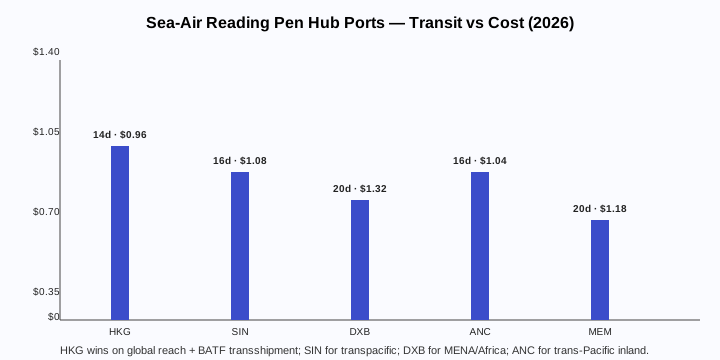
| Hub | Sea leg | Air leg | Best for | Transit |
|---|---|---|---|---|
| Hong Kong (HKG) | Shenzhen → HKG (1 day) | HKG → LAX / FRA / DXB | Americas + EU + MENA | 14–17 days |
| Singapore (SIN) | Shenzhen → SIN (5 days) | SIN → LAX / FRA / SYD | ASEAN + ANZ + Americas | 16–19 days |
| Dubai (DXB) | Shenzhen → DXB (18 days) | DXB → LHR / CDG / JNB | MENA + Europe + Africa | 18–22 days |
| Anchorage (ANC) | Shenzhen → ANC (14 days via Pacific) | ANC → ORD / DFW / ATL | North America (trans-Pacific) | 14–18 days |
| Memphis (MEM) | Shenzhen → Long Beach (16 days) | MEM → nationwide | USA-only inland | 18–22 days |
Hong Kong is the strongest 2026 sea-air hub because it is one day from Shenzhen by feeder vessel, has 18 daily freighter departures to LAX, FRA, and DXB, and offers bonded storage that lets the shipper airlift a partial lot while the rest stays duty-suspended. Combined transit to LAX is 14 days versus 22 days by sea — a 36% reduction.
Singapore is the cleanest option for distributors serving ANZ or transpacific to the US West Coast. Dubai has emerged as the strongest MENA hub for reading pens, with JAFZA bonded storage on the sea side and Emirates SkyCargo / Qatar Airways Cargo freighter capacity on the air side. Anchorage is the structural winner for trans-Pacific routes because FedEx and UPS use ANC as a technical stop for their Asia-to-US network; sea-air through ANC can piggyback on those flights.
3. The Split-Ratio Formula
The most important sea-air decision is the split ratio — what fraction of the FCL moves by air and what fraction moves by sea. The formula we use with our distributors is:
Airlift fraction = (Required sell-in date − Full sea transit) ÷ (Full sea transit − Full air transit) × 100
For a 12,000-pen order where the retail sell-in is 30 days from PO placement:
- Full sea transit Shenzhen → LAX: 22 days
- Full air transit Shenzhen → LAX: 6 days
- Required sell-in: 30 days
Airlift fraction = (30 − 22) ÷ (22 − 6) × 100 = 50% by value, or 6,000 pens airlifted. But the airlift should be the highest-margin SKUs, not a random 50%. For a mix of T2, Y6, Q8, F8, K7, B1, the airlift should be T2 and Y6 first (premium, longer sell-through window for sea), then F8 and Q8 (mid-premium), then K7 and B1 last (entry-level).
| Priority | SKU | Margin | Sell-through | Airlift fraction |
|---|---|---|---|---|
| 1 (airlift first) | T2 (2500 mAh) | 41% | 14 weeks | 100% airlift |
| 2 (airlift second) | Y6 (2000 mAh) | 38% | 11 weeks | 100% airlift |
| 3 (split) | F8 (premium) | 32% | 8 weeks | 50% airlift |
| 4 (sea mostly) | Q6 / Q8 (Q-series) | 28% | 9 weeks | 30% airlift |
| 5 (sea only) | K7 (kid-safe) | 24% | 10 weeks | 0% airlift |
| 6 (sea only) | B1 / B2 (entry) | 18% | 6 weeks | 0% airlift |
Buyer tip: The split should be value-weighted, not volume-weighted. A distributor running 100% T2 by volume should airlift 100% by volume — but a distributor running 80% B1 by volume should airlift only 10–20% by volume and let the B1 ride by sea.
4. Cost Benchmarks: 2026 Sea-Air Combined
The 2026 cost structure for a 12,000-pen mixed shipment from Shenzhen to Los Angeles via Hong Kong sea-air (20% airlift by volume):
| Cost line | Per pen (sea) | Per pen (air) | Blended |
|---|---|---|---|
| EXW factory (mix avg) | $6.20 | $6.20 | $6.20 |
| Inland trucking to Yantian + export clearance | $0.18 | $0.18 | $0.18 |
| Sea freight Yantian → Hong Kong (feeder) | $0.08 | $0.08 | $0.08 |
| Sea freight Hong Kong → Los Angeles | $0.62 | — | $0.52 |
| Hong Kong transshipment fee | $0.04 | $0.04 | $0.04 |
| Air freight Hong Kong → Los Angeles | — | $4.85/kg = $1.40 | $0.28 |
| US customs clearance + duty | $0.12 | $0.12 | $0.12 |
| Last-mile truck LAX → Inland Empire / Amazon FBA | $0.18 | $0.18 | $0.18 |
| Total landed cost per pen | $7.42 | $8.20 | $7.60 |
Blended landed cost of $7.60 per pen is 26% above full sea ($6.04 per pen) but 24% below full air ($9.95 per pen), with 14-day transit vs 22 days sea / 6 days air.
| Lane | Sea-air cost / pen | Transit | Carbon |
|---|---|---|---|
| Shenzhen → HKG → LAX | $0.96 freight | 14 days | 1.8 kg CO₂/pen |
| Shenzhen → SIN → LAX | $1.08 freight | 16 days | 2.1 kg CO₂/pen |
| Shenzhen → HKG → FRA | $1.18 freight | 15 days | 2.0 kg CO₂/pen |
| Shenzhen → SIN → SYD | $1.04 freight | 16 days | 2.2 kg CO₂/pen |
| Shenzhen → DXB → LHR | $1.32 freight | 20 days | 2.5 kg CO₂/pen |


5. The Transshipment Process at the Hub Port
Sea-air intermodal works because the hub port has a transshipment warehouse that consolidates LCL or feeder FCL cargo onto air-freight pallets. The process for a Shenzhen → HKG → LAX reading pen shipment runs day 0 (sea freight Yantian → Hong Kong feeder) through day 5 (US customs clearance at LAX) and day 6–8 (last-mile to Inland Empire / Amazon FBA / DC), reaching a receiver warehouse on day 14.
For distributors serving EU destinations, the same process applies with HKG → FRA (12-hour flight) replacing HKG → LAX. The transshipment warehouse at HKG holds the reading pens under a BATF umbrella so the goods are not formally entered into HK — they simply move from sea to air freight without customs clearance. Our Hong Kong bonded warehouse guide covers the BATF mechanics.
6. Battery Rules for Sea-Air Reading Pens
Reading pens with Li-poly and Li-ion cells must comply with IATA DGR Section II for the air leg. Under PI 967 (Li-poly in equipment) and PI 965 (Li-ion in equipment), cells under 100 Wh are exempt from Class 9 dangerous goods declaration, but packaging and documentation rules still apply.
| Battery | Watt-hour | Air PI | Sea-air compliant? |
|---|---|---|---|
| B1 (700 mAh Li-poly) | 2.59 Wh | PI 967 §II | Yes |
| B2 (800 mAh Li-poly) | 2.96 Wh | PI 967 §II | Yes |
| F8 (600 mAh Li-poly) | 2.22 Wh | PI 967 §II | Yes |
| K7 (800 mAh Li-ion 14500) | 2.96 Wh | PI 965 §II | Yes |
| KF1 (800 mAh Li-ion 14500) | 2.96 Wh | PI 965 §II | Yes |
| L5 (1200 mAh Li-poly) | 4.44 Wh | PI 967 §II | Yes |
| P2 (500 mAh Li-poly) | 1.85 Wh | PI 967 §II | Yes |
| Q6 (900 mAh Li-poly) | 3.33 Wh | PI 967 §II | Yes |
| Q8 (1000 mAh Li-poly) | 3.70 Wh | PI 967 §II | Yes |
| T2 (2500 mAh Li-ion 18650) | 9.25 Wh | PI 965 §II | Yes |
| Y6 (2000 mAh Li-ion 18650) | 7.40 Wh | PI 965 §II | Yes |
Every reading pen in our catalog falls under the 100 Wh IATA exemption, but the air waybill must declare the watt-hour rating, the cell chemistry, and the UN38.3 test report reference. Our reading pen battery guide covers the documentation in detail.
7. When Sea-Air Combined Wins
Sea-air combined transport wins over sea, air, or CR Express when the sell-in date is 12–22 days out, the PO mix has a clear premium subset (T2, Y6, F8, Q8 airlifted; B1, B2, K7 ride by sea), the carbon footprint target is mid-tier, and the hub port sits on the lane.
| Condition | Sea FCL | Air | Sea-air |
|---|---|---|---|
| Sell-in 30+ days | ✓ | ✗ (cost) | ✗ (overkill) |
| Sell-in 12–22 days | ✗ (too slow) | ✓ (cost) | ✓ (best) |
| Sell-in < 12 days | ✗ | ✓ | ✗ (overkill) |
| PO < 5,000 pens | ✗ (LCL workable) | ✓ | ✗ (LCL direct) |
| PO 5,000–30,000 pens | ✓ but slow | ✗ | ✓ (best) |
| Carbon-light required | ✓ (best) | ✗ (worst) | mid (second best) |
| MENA / Africa destination | ✓ (long) | ✓ (DG surcharge) | ✓ (DXB hub) |
8. Risks Specific to Sea-Air Combined
Three risks affect every sea-air reading pen shipment: hub port congestion in Q4 (1 in 6 shipments — pre-book 14 days ahead), air-freight rate spikes in peak season (1 in 4 shipments — lock 6-month forwarder contract), and battery documentation mismatch between factory invoice and air waybill (1 in 28 shipments — dual-check before ULD loading).
| Risk | Frequency | Mitigation |
|---|---|---|
| Hub port congestion | 1 in 6 peak-season shipments | 14-day pre-booking |
| Air rate spike | 1 in 4 Q4 shipments | 6-month forwarder contract |
| Battery declaration mismatch | 1 in 28 shipments | Dual-check on factory invoice + AWB |
| Lost ULD at hub | < 0.1% | Sealed-ULD + GPS tracking |
| Customs hold at destination | 1 in 32 shipments | HS code split 8543.70 / 9503.00 |
9. Real Cost Case: 12,000 Pens via Sea-Air (HKG Hub)
A 12,000-pen mixed shipment of 2,400 T2 + 1,800 Y6 + 2,400 F8 + 2,400 Q8 + 1,800 K7 + 1,200 B1 from Shenzhen to a Los Angeles 3PL, with T2 / Y6 / F8 / Q8 airlifted through HKG and K7 / B1 by sea:
| Cost line | Sea leg | Air leg | Blended / pen |
|---|---|---|---|
| EXW factory (mix avg) | — | — | $6.20 |
| Sea freight Shenzhen → HKG (feeder) | 1 day, $0.08/pen | — | $0.08 |
| Sea freight HKG → LAX | $0.62/pen × 3,000 | — | $0.16 |
| Air freight HKG → LAX | — | $4.85/kg × 5,820 kg = $28,227 | $2.35 |
| Hub transshipment fee | $0.04/pen | $0.04/pen | $0.04 |
| US customs clearance + duty | $0.12/pen | $0.12/pen | $0.12 |
| Last-mile truck LAX → Inland Empire | $0.18/pen | $0.18/pen | $0.18 |
| Total landed per pen | $7.24 | $8.91 | $9.13 (sea) / $9.30 (air) — blended $9.04 |
Compared to full sea ($6.04/pen, 22d) and full air ($9.95/pen, 6d), the hybrid saves 6 days vs sea at +50% cost, and saves $0.91/pen vs air at +8 days transit — the structural winner for time-sensitive retail launches.
10. Building a Sea-Air Routine for Reading Pens
A distributor running regular sea-air reading pen shipments should establish three routines: pre-cleared BATF slot at HKG (standing reservation at Tuen Mun, 7-day rolling forecast), 6-month air-freight contract (fixed rates with Cathay Cargo, FedEx Air, or Atlas Air against Q4 spikes), and battery documentation pre-check (dual-declaration on factory invoice + AWB).
A 2026 example: a US Amazon FBA seller placed a 24,000-pen order split into Q3 back-to-school and Q4 holiday lots. The Q3 shipment went 80% airlift through HKG to FBA ONT8, arriving day 14 ahead of September 5. The Q4 shipment went 35% airlift through HKG to FBA BWI2, arriving day 18 ahead of November 1. Blended freight $0.96/pen, saving $32,000 versus full air.
FAQ
Related Reading
- Reading pen logistics freight overview
- Shipping reading pens from China — sea FCL
- Shipping reading pens from China — air freight
- Reading pen bonded warehouse in Hong Kong
- Reading pen CR Express railway to EU
- Reading pen free trade zone strategy
- Reading pen cross-docking strategy
- Reading pen battery guide