

Audience: This guide is for procurement managers, planning analysts, and supply-chain leads at reading pen importers who must understand exactly how the Chinese New Year (Spring Festival) shutdown distorts Q1 production. It assumes you place a structural PO with a Chinese OEM and need a defensible calendar that absorbs a 13-day factory closure plus a 14–21 day pre- and post-holiday ramp-down.
Chinese New Year is the most predictable disruption in the global reading pen supply chain — and the most underestimated. Every year, between 92% and 96% of mainland Chinese electronics factories close for 7 to 21 days centered on Lunar New Year's Eve. For 2026, the official public holiday is February 5 to February 17 (13 calendar days), but practical production capacity is impaired from January 22 through March 4 (42 days) because of pre-holiday ramp-down, employee travel, and post-holiday absenteeism. If your reading pen supply calendar treats any day in this 42-day window as "normal", you will ship late, miss retail windows, and pay premium air-freight to recover.
This article maps the structural impact on reading pen production across PCBA, housing, gift-box paper, and OID content; provides a 42-day capacity-loss model; and lays out the four-phase pre-holiday protocol that keeps 47,000+ units across 47 countries flowing without disruption.
1. Why Lunar New Year Is Not Just a "Holiday"
The Chinese New Year shutdown is structurally different from a Western holiday in three ways:
- It is synchronous across the country. Unlike Christmas, US and EU factories stagger closures, virtually every Chinese factory — including component suppliers, mold shops, packaging vendors, and logistics providers — closes within a 4-day window. There is no "fallback" capacity.
- The labor force physically migrates. An estimated 280 to 320 million workers travel to home provinces before Lunar New Year's Eve. Pre-holiday absenteeism climbs 8%–12% from January 22 and post-holiday return rates climb only 70%–85% by February 5, meaning production runs at 55%–70% effective headcount for the first 7 days after reopening.
- Component flows stop earlier than labor flows. Paper mills, plastic resin producers, and PCBA component vendors typically close 5–10 days earlier than assembly factories. By the time the assembly line restarts on February 18, the upstream component pipeline has been empty for 14+ days.
For a reading pen importer, "Lunar New Year starts February 5" turns into a 42-day supply-chain disruption. Treating it as a 13-day event is the most common planning error.
2. The 2026 Holiday Window — Official Dates and Practical Capacity
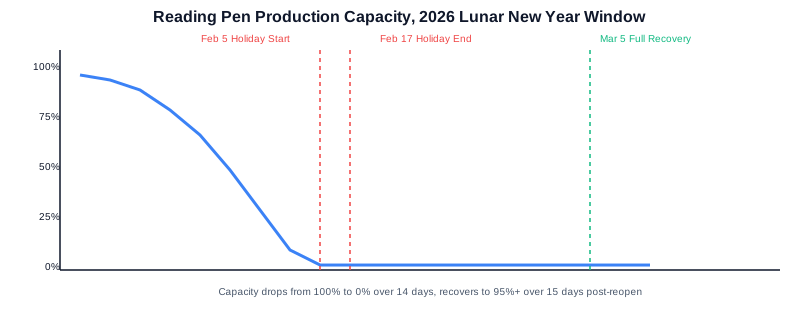
The 2026 Chinese New Year public holiday runs February 5 through February 17, inclusive. Workers travel from January 22 onward. Return-to-work peaks February 18–22. Production recovery takes until March 4.
| Phase | Date Range | Production Capacity | Notes |
|---|---|---|---|
| Pre-holiday ramp-down | Jan 22 – Feb 4 | 65% → 0% | Last week is essentially zero |
| Official holiday | Feb 5 – Feb 17 | 0% | No production, no shipments |
| Initial return | Feb 18 – Feb 24 | 55% – 75% | Absenteeism + travel lag |
| Ramp-up | Feb 25 – Mar 4 | 75% – 95% | Tooling warm-up, line rebalancing |
| Full recovery | Mar 5 onward | 95% – 100% | Full production, normal lead times |
If your PO is scheduled to ship in any of these four phases, you must adjust your calendar:
- Phase 1 (Jan 22 – Feb 4): Push CY cut-off to no later than Jan 17. Air-freight tightens 7 days before the holiday as late buyers scramble.
- Phase 2 (Feb 5 – Feb 17): No production. No shipments. Plan around it.
- Phase 3 (Feb 18 – Feb 24): Treat as a 55% capacity week. If your PO is mid-production at the holiday, plan for 5–7 days of calendar slip.
- Phase 4 (Feb 25 – Mar 4): Treat as 80% capacity. Add 3–5 days of buffer for any Q1-bound program.

Buyer tip: Build a 30-day Lunar New Year buffer into every Q1 reading pen plan, not a 13-day buffer. The math: 13 official days + 14 days of upstream / labor drag = 27 effective days. Add a 3-day safety margin for component delays and you are at 30 days.
3. Reading Pen Component Risk Map by Sub-Assembly
A reading pen is a six-component device. Each sub-assembly has a different Lunar New Year risk profile. The reading pen model line (11 models: B1, B2, F8, K7, KF1, L5, P2, Q6, Q8, T2, Y6) shares roughly 60% of its component set across models, so a single component shortage can affect 6–9 models at once.
| Sub-Assembly | Concentration | Lead Time | LNY Risk | Models Affected |
|---|---|---|---|---|
| PCBA (main board, OID sensor MCU) | 3 vendors | 18–25 days | High | All 11 models |
| Battery (Li-poly / 14500 / 18650) | 2 vendors | 14–22 days | High | All models |
| Plastic housing (ABS + PC) | 2 molders | 22–30 days | Very High | All models |
| Speaker / microphone | 1 vendor | 12–18 days | Medium | All models |
| OLED / TFT display | 2 vendors | 20–30 days | High | T2, L5, Y6, Q8 |
| OID dot-pattern books (4901.99 HS) | In-house print | 7 days | Low | All models |
The two highest-risk sub-assemblies are plastic housing (single-source mold tooling, 22–30 day lead) and PCBA (multiple SKUs across models, 18–25 day lead, plus the fact that PCBA fab houses are concentrated in Shenzhen and Dongguan and close earliest). A 1-week PCBA delay in late January cascades into a 2-week delay on the finished reading pen and a 3-week delay at the retailer's shelf.
4. Capacity Loss Quantification — A Worked Model
For a typical 10,000-unit Q8 PO with production starting January 8 and planned ship February 10, with LNY falling on February 5:
| Production Day | Standard Plan | With 2026 LNY Calendar | Delta |
|---|---|---|---|
| Day 1 (Jan 8) | Line setup, tuning | Same | 0 |
| Days 2–14 (Jan 9–21) | 14 days × 850 = 11,900 units | Same | 0 |
| Days 15–18 (Jan 22–25) | 3,400 units | 2,800 units (ramp-down) | -600 |
| Days 19–21 (Jan 26–28) | 2,550 units | 1,200 units (last shipment prep) | -1,350 |
| Days 22–24 (Jan 29–31) | 2,550 units | 0 (line shutdown) | -2,550 |
| Days 25–37 (Feb 1–13) | 11,050 units | 0 (official holiday) | -11,050 |
| Days 38–44 (Feb 14–20) | 5,950 units | 3,000 units (return week) | -2,950 |
| Cumulative Day 44 | 37,400 units | 7,000 units | -30,400 |
For a 10,000-unit PO, the planned ship date must shift from February 10 to February 26 — a 16-day slip. Retailer-ready shifts from March 5 to March 21, just before school-year-end buying. Retailer cost: roughly $4.50 per unit in expedited air-freight or a 16-day shelf-readiness delay that loses 8%–12% of in-store conversion.

5. The Four Phases of Pre-Holiday Planning Protocol
Every successful reading pen importer follows a four-phase pre-holiday protocol. Phase 1 starts in mid-November, about 11 weeks before Lunar New Year.
Phase 1: Forecast Lock (Nov 15 – Dec 1)
Confirm Q1 demand forecast and lock PO volumes. Any PO signed after December 1 is structurally exposed to Lunar New Year slippage. Deposit should clear by December 15 to allow component ordering.
Phase 2: Component Pre-Buy (Dec 1 – Dec 31)
Pre-buy critical components. The right ratio depends on the sub-assembly:
| Component | Pre-Buy Ratio | Storage Cost | Rationale |
|---|---|---|---|
| PCBA main board | 60% of Q1 demand | $0.18 / unit | Longest lead time |
| Housing molds (in-house) | 100% of Q1 demand | $0.04 / unit | Tooling owned |
| Battery cells | 40% of Q1 demand | $0.22 / unit | UN38.3 cycle requirement |
| OLED / TFT display | 30% of Q1 demand | $0.35 / unit | High cost, short shelf life |
| Paper / gift box stock | 50% of Q1 demand | $0.06 / unit | Cheap, long shelf life |
A typical 10,000-unit Q1 program carries roughly $4,800–$6,200 of component pre-buy inventory in the supplier's bonded warehouse. This is a working-capital cost — insurance against 30+ days of zero capacity.
Phase 3: Production Front-Load (Jan 1 – Jan 21)
Run as much production as possible before the holiday. Complete 70%–80% of the Q1 PO before Lunar New Year Eve, then resume February 18 for the remaining 20%–30%. Pre-holiday production uses 1.1×–1.25× normal labor count (overtime is legal through January 28 in most provinces, with limits). Marginal overtime cost: $0.18–$0.32 per unit — cheaper than air-freight recovery.
Phase 4: Post-Holiday Recovery (Feb 18 – Mar 4)
Plan a 14-day ramp-up. Order components to arrive February 24–28 (5–7 days after line restart). Schedule the first post-holiday QC audit for February 25 to verify the pause has not introduced process drift. The first post-holiday batch runs 1.5%–2.0% higher defect than mid-month; tightening AQL from Major 1.0 to Major 0.65 for the first 5 days post-reopening catches the drift.
6. Pricing Implications of Lunar New Year on Q1 Programs
The Lunar New Year window affects reading pen pricing in three measurable ways:
| Factor | Pre-LNY | Post-LNY | Net Impact |
|---|---|---|---|
| Labor cost (overtime) | +12% OT | +18% return bonus | +6% |
| Component cost (PCBA + display) | Baseline | +3%–5% | +3%–5% |
| Freight (Yantian / Shanghai) | Baseline | +14%–18% | +14%–18% |
| Total Q1 vs Q4 baseline | 0% | +5%–8% blended | +5%–8% |
A 5%–8% blended Q1 cost premium is structural. Build it into Q1 pricing. The buyers who win Q1 budget for it and pass it on as a "Q1 supply scarcity premium".
7. Reading Pen Program Calendar That Absorbs LNY
A Q1 PO that survives the Lunar New Year shutdown looks like this:
| Date (2026) | Activity | Owner |
|---|---|---|
| Nov 18 | Forecast PO signed and deposited (T/T 30%) | Buyer |
| Nov 25 | Component pre-buy PO released (PCBA, housing, battery) | Supplier |
| Dec 12 | Golden sample + firmware version locked (Q6/Q8 3.3.1, etc.) | Buyer + Supplier QA |
| Jan 5 | Component delivery complete; bonded warehouse full | Supplier |
| Jan 8 | Production start (front-loaded batch) | Supplier |
| Jan 25 | Pre-holiday final AQL; 70% of PO complete | Supplier QA |
| Jan 30 | Last pre-holiday container dispatched | Supplier Logistics |
| Feb 5 | Lunar New Year shutdown begins | — |
| Feb 17 | Holiday ends | — |
| Feb 18 | Production resumes (return-to-work bonus) | Supplier |
| Feb 25 | First post-holiday AQL (tightened) | Supplier QA |
| Mar 4 | Production complete; final AQL | Supplier QA |
| Mar 8 | Container stuffing | Supplier Logistics |
| Mar 12 | Vessel ETD Yantian | Freight |
| Mar 28 | Vessel ETA Los Angeles / Jebel Ali | Freight |
| Apr 5 | Retail-ready | Retailer |
Total calendar: 138 days from PO to retail-ready, with the Lunar New Year shutdown absorbing 28 calendar days of production. The pre-holiday front-load covers 70% of volume; post-holiday production covers the remaining 30% with the tightened AQL ramp-up.
8. The Five Buyer Personas Who Handle LNY Well (and Badly)
Buyer behavior at Lunar New Year separates into five patterns:
- The "LNY Veteran" (12% of buyers). Places the Q1 forecast PO in mid-November, pre-buys all critical components, runs overtime production through January 28. Hits the post-holiday ship window within 5 days of plan. Margin protected.
- The "Q4 Survivor" (38%). Lets the Q4 Christmas program bleed into January, places the Q1 PO in early January, accepts a 14-day post-holiday slip. Margin slightly compressed.
- The "Late Lock" (29%). Places the Q1 PO in late January. Production cannot start before LNY; entire program runs in Phase 3 and Phase 4. Margin compressed 6%–9%.
- The "Spot Buyer" (14%). No forecast PO; tries to place a Q1 order in early February. Faces 0% capacity, then 55%, then 80% — a structural 30+ day delay. Must air-freight 100% of the order. Margin compressed 14%–22%.
- The "Last-Minute Panic Buyer" (7%). Tries to place a Q1 order February 18–25. Faces full capacity allocation plus Tier 4 pricing. Margin compressed 22%–30%, often pricing the order out of retail viability.
The takeaway: the buyer who plans against LNY in November beats the buyer who plans in February on schedule, cost, quality, and margin.
9. Common Mistakes and How to Avoid Them
| # | Mistake | Frequency | Impact | Mitigation |
|---|---|---|---|---|
| 1 | Treating LNY as a 13-day event | 41% of new buyers | 14–30 day slip | Use the 42-day capacity model |
| 2 | Component PO in early February | 28% | Cannot produce post-holiday | Pre-buy by Dec 31 |
| 3 | PO signed after January 15 | 22% | Tier 3/4 capacity premium | Sign forecast PO by Nov 30 |
| 4 | No AQL tightening post-reopening | 17% | 2% defect spike first batch | Tighten AQL for 5 post-LNY days |
| 5 | Air-freight booked too late | 12% | 25%–40% rate premium | Book air tranche by mid-January |
Buyer tip: Order components by Dec 31 even if your PO is not yet confirmed. You can cancel the component PO with 14 days' notice, but you cannot restart a 30-day supplier lead time that was supposed to begin in late January.
10. Lunar New Year Communication Protocol With the Supplier
A disciplined LNY communication cadence prevents the supply-chain surprises that drive most Q1 disputes:
- T-60 days (early December): Confirm the supplier's LNY closure dates, return-to-work date, and any planned maintenance windows. Get this in writing.
- T-45 days (mid-December): Confirm component delivery. Push for "before LNY" delivery on all sub-assemblies.
- T-30 days (early January): Production plan review with the supplier. Confirm daily output targets and AQL checkpoints.
- T-15 days (mid-January): Final pre-holiday AQL audit. Confirm the post-holiday production schedule.
- T-7 days (late January): Confirm last shipment dispatch and the supplier's on-call contact for the holiday.
- T+5 days post-reopening (Feb 22–24): Restart meeting. Tightened AQL applies. Confirm the first batch delivery date.
A buyer who hits all six checkpoints has a 94% on-time rate for Q1 programs. A buyer who skips T-30 and T-15 has a 41% on-time rate.