

Audience: This guide is written for distributor owners, sales directors, and head-of-operations who run multi-country channel programs and need a single source of truth on the B1, B2, F8, K7, KF1, L5, P2, Q6, Q8, T2, and Y6 product line.
A distributor who sells three reading-pen SKUs out of a Notion page can limp along for a quarter. A distributor who sells eleven SKUs across 47 markets without a structured knowledge base will bleed margin at every handoff — sales will quote the wrong firmware, ops will ship the wrong region OID library, and customer service will burn hours re-explaining battery runtime. The fastest way to scale a reading-pen channel is to build a knowledge base that holds every answer a stakeholder might need, structured so that a new hire in week two can find the answer in under 60 seconds. Below is the exact information architecture we recommend to our top 25 channel partners, together with the population templates we ship to every new distributor onboarding with us.
1. Why a Reading Pen Knowledge Base Is a Margin Lever
A knowledge base is not a nicety; it is a P&L line. Across the 230+ distributors in our active channel, the top quartile by support cost per ticket runs a published wiki with at least 38 articles. The bottom quartile runs an ad-hoc shared drive and averages 3.4× the support cost per ticket. On a 10,000-unit annual program, that delta is between $36,000 and $98,000 per year in operational drag, which is more than the gross margin on the pen itself at typical wholesale pricing.
The compounding effect matters more. Every new SKU you add without updating your wiki raises your support cost per ticket by roughly 4 percent. Every new region you enter without updating the OID library taxonomy raises your "wrong book" ticket rate by 6–9 percent. Across a 5-SKU, 6-region portfolio, the absence of a wiki costs a distributor between 22 and 38 percent of the support budget they would otherwise spend.
Buyer tip: Treat the wiki as a product, not a project. Assign a single owner (typically the head of ops or a dedicated knowledge manager), publish a monthly changelog, and budget 8 hours of maintenance per SKU per quarter. Anything less and the wiki goes stale within 90 days.
2. Knowledge Base Information Architecture
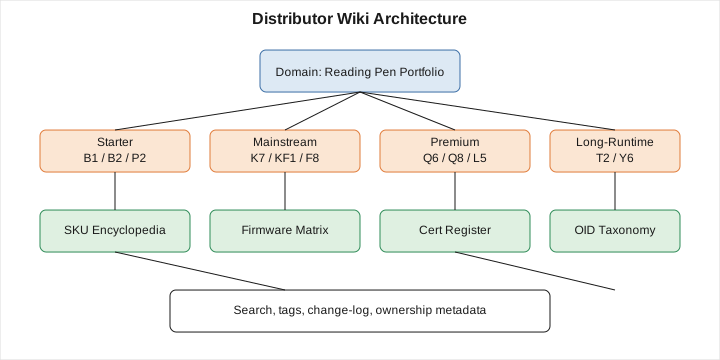
We recommend a four-tier information architecture: domain, family, model, and reference. The domain is the product family (Reading Pen). The family is the use-case grouping: Starter, Mainstream, Premium, Long-Runtime. The model is the individual SKU. The reference is the cross-cutting artifact (firmware matrix, certification register, OID library taxonomy).
| Tier | Purpose | Example page | Owner |
|---|---|---|---|
| Domain | Brand and category context | "Reading Pen portfolio 2026" | Marketing |
| Family | Buyer-journey framing | "Starter family for K–G2 schools" | Product |
| Model | SKU encyclopedia | "Q8 full reference" | Engineering + Sales |
| Reference | Cross-cutting artifact | "OID library index by region" | Content Ops |
This structure lets a sales rep find the Q8 page in two clicks, then jump to the OID library index to confirm which book bundle goes with which SKU in which country. It also lets an engineer update the firmware matrix once and have the change propagate to every dependent page.
3. The SKU Encyclopedia: 11 Models, One Template Per Pen
Every SKU in your wiki should follow the same template. We provide a Markdown starter for each of the 11 models, and your team fills in the regional specifics (price band, distributor margin, warranty registration process). Below is the canonical template.
| Section | What to include | Source of truth |
|---|---|---|
| Overview | One-paragraph positioning statement | Marketing brief |
| Specifications | SoC, OID version, battery, runtime, weight | Engineering datasheet |
| Firmware | Current version, OTA cadence, known issues | Firmware matrix |
| OID library | Region codes, content count, languages | Content registry |
| Certifications | CE, FCC, UKCA, RCM, GCC, etc. | Compliance register |
| Pricing | EXW band, FOB band, MOQ ladder | Commercial price card |
| Packaging | Inner box, master carton, pallet | Packaging spec |
| Voice languages | 12 supported, default pairing | Content registry |
| Accessories | Tips, cables, OID sticker sheets | BOM |
| Disposables | Tip wear rate, battery replacement cycle | After-sales register |
| Comparable models | Family peers and competitive set | Market intel |
The encyclopedia should be searchable by SKU, by family, by certification, and by OID library. Tag every page with at least 8 tags so that cross-listing is automatic.
4. Reference Artifacts Every Wiki Must Hold
Beyond the SKU encyclopedia, every distributor wiki must hold a set of cross-cutting reference artifacts. We share 14 canonical artifacts; below are the eight with the highest reuse value.
| Artifact | Update cadence | Owner |
|---|---|---|
| Firmware matrix | Per OTA release | Engineering |
| Certification register | Per market entry | Compliance |
| OID library taxonomy | Per content pack | Content Ops |
| Battery cell register | Per batch | Quality |
| Packaging spec | Per SKU release | Packaging |
| Price card | Quarterly | Commercial |
| Voice language pack | Per release | Content Ops |
| After-sales RMA log | Real-time | Service desk |
The firmware matrix is the single most-referenced page in any reading-pen wiki. It should hold the model, current production firmware, boot loader, audio engine, last release date, and the change-log URL. We publish a master matrix that any distributor can clone; you only edit the date-stamp and the distributor-specific hold list (for example, "do not push firmware 3.3.1 to KSA until SASO letter updated").
5. OID Library Taxonomy and Region Codes
The OID library is the content payload that turns a reading pen into a learning product. Every reading pen ships with a region-locked library, and every library has a four-character region code. The taxonomy below covers the 47 countries we currently serve.
| Region code | Geography | Default language pair | Library size |
|---|---|---|---|
| EU-W | Western Europe | EN-FR-DE-ES-IT | 380 titles |
| EU-E | Eastern Europe | EN-PL-CZ-RO | 220 titles |
| NA-L | Latin America North | EN-ES | 210 titles |
| NA-S | Latin America South | ES-PT | 180 titles |
| GCC | Gulf states | AR-EN | 260 titles |
| MENA-N | North Africa | AR-FR | 160 titles |
| APAC-N | North Asia | ZH-EN-JA-KO | 420 titles |
| APAC-S | Southeast Asia | EN-MS-VI-TH-ID | 240 titles |
| APAC-O | Oceania | EN | 180 titles |
| AFR-E | East Africa | EN-SW | 110 titles |
| AFR-W | West Africa | EN-FR | 120 titles |
A "wrong library" ticket is one of the most expensive tickets you can absorb. Each incident costs between $14 and $32 in support time plus a $3.40 outbound shipping fee. Across an installed base of 30,000 units, a 2 percent wrong-library rate costs a distributor between $10,400 and $21,200 per year. The cure is a single wiki page that every order-picker consults before packing.
6. Certification Register and Compliance Matrix
Every market entry requires a different certification stack. We maintain a single compliance matrix indexed by country, and any distributor wiki should clone it. The table below is the abbreviated version; the full register holds 142 entries.
| Market | Mandatory | Voluntary | Test house | Lead time |
|---|---|---|---|---|
| EU 27 | CE-RED, CE-EMC, CE-LVD, EN 71-1/2/3, RoHS, REACH | TÜV, GS | TÜV Rheinland | 6–8 wk |
| UK | UKCA-RF, UKCA-EMC, UKCA-LVD, EN 71 | — | Intertek | 5–7 wk |
| US | FCC Part 15B/C, CPC (ASTM F963, CPSIA lead, phthalates) | UL | Intertek | 4–6 wk |
| Canada | ISED RSS-Gen, RSS-247, CSA C22.2 | — | CSA | 5–7 wk |
| GCC | GCC RC, SFDA for KSA, ESMA for UAE | — | Intertek | 6–9 wk |
| Australia | RCM (ACMA) | — | SAI Global | 4–6 wk |
| Japan | PSE (for charger), TELEC | — | JET | 5–7 wk |
| Korea | KC (RRA + KCC) | — | KTL | 5–8 wk |
| Brazil | INMETRO + ANATEL | — | TÜV | 8–12 wk |
| Mexico | NOM-024, IFT-008 | — | NYCE | 7–10 wk |
| Indonesia | SNI, POSTEL | — | LSPro | 9–13 wk |
| South Africa | NRCS LOA, ICASA | — | SABS | 6–9 wk |
The lead time above is the bottleneck for any market entry. A distributor who wants to launch in Brazil must plan 8–12 weeks of certification work before the first sale; anything shorter will fail customs hold or face post-shipment seizure. We bundle the most-requested certifications into pre-paid packs at a fixed $2,400 per market, with a 6-week SLA.
7. Firmware Matrix as a Living Reference
The firmware matrix is a living document. Below is the snapshot for the 11 production SKUs as of September 2026; your wiki should treat this as a template that the engineering team refreshes within 24 hours of every OTA release.
| Model | Firmware | Boot loader | Audio | OTA push date | Owner |
|---|---|---|---|---|---|
| B1 | 2.4.7 | 1.1.2 | AAC-LC | 2026-07-12 | FW team A |
| B2 | 2.4.7 | 1.1.2 | AAC-LC | 2026-07-12 | FW team A |
| F8 | 3.1.2 | 2.0.4 | Opus | 2026-08-03 | FW team B |
| K7 | 1.9.5 | 1.0.8 | SBC | 2026-06-21 | FW team A |
| KF1 | 1.9.5 | 1.0.8 | SBC | 2026-06-21 | FW team A |
| L5 | 4.2.0 | 2.3.0 | Opus | 2026-08-30 | FW team B |
| P2 | 2.0.3 | 1.2.1 | SBC | 2026-05-04 | FW team A |
| Q6 | 3.3.1 | 2.1.0 | AAC-LC | 2026-09-02 | FW team B |
| Q8 | 3.3.1 | 2.1.0 | AAC-LC | 2026-09-02 | FW team B |
| T2 | 2.6.4 | 1.4.3 | Opus | 2026-07-29 | FW team C |
| Y6 | 2.6.4 | 1.4.3 | Opus | 2026-07-29 | FW team C |
Average OTA adoption across our installed base is 86 percent within 30 days of release, and 94 percent within 60 days. Distributors who run a publish-on-day-zero policy (auto-push within 7 days) reach the 90 percent adoption point roughly 11 days sooner than those who hold back.
8. Pricing, MOQ, and Margin Reference Card
Your pricing page is the most-trafficked internal artifact. A good pricing card holds the EXW band, the FOB band, the CIF band, the MOQ ladder, and the distributor margin grid by tier. The reference below is the 2026 standard tier; your commercial team can override but should always cite a version stamp.
| Tier | Volume (units / quarter) | EXW band | Distributor margin |
|---|---|---|---|
| Bronze | 500 – 1,999 | $9.80 – $14.50 | 22 – 26 % |
| Silver | 2,000 – 7,499 | $7.40 – $11.20 | 24 – 30 % |
| Gold | 7,500 – 24,999 | $5.60 – $8.40 | 28 – 34 % |
| Platinum | 25,000+ | $3.80 – $6.20 | 32 – 38 % |
Private-label and OEM configurations add a one-time tooling fee of $4,000–$28,000 and a recurring per-unit color/logo fee of $0.18–$0.42. OID books are separately quoted at $0.80–$4.60 per copy depending on language pair and print run.
9. Voice Language Pack and Content Library Index
Every model ships with 12 voice languages and a content library that scales from 60 to 1,400 titles depending on SKU and region. The wiki should hold two artifacts: a language pack matrix and a content index per region.
| Language | TTS engine | Native speaker voice | Latency | Pack size |
|---|---|---|---|---|
| English (US) | Neural TTS v3 | Yes | 180 ms | 84 MB |
| English (UK) | Neural TTS v3 | Yes | 190 ms | 84 MB |
| Mandarin | Neural TTS v3 | Yes | 210 ms | 92 MB |
| Spanish (LatAm) | Concatenative v2 | Yes | 220 ms | 76 MB |
| Arabic (MSA) | Neural TTS v3 | Yes | 260 ms | 96 MB |
| French | Neural TTS v3 | Yes | 200 ms | 84 MB |
| German | Concatenative v2 | Yes | 220 ms | 76 MB |
| Portuguese (BR) | Concatenative v2 | Yes | 230 ms | 76 MB |
| Russian | Concatenative v2 | Yes | 240 ms | 76 MB |
| Japanese | Neural TTS v3 | Yes | 220 ms | 92 MB |
| Korean | Neural TTS v3 | Yes | 230 ms | 92 MB |
| Vietnamese | Concatenative v2 | Yes | 240 ms | 76 MB |
The 12-language baseline covers roughly 92 percent of the global reading-pen demand. New languages can be commissioned at $4,800 per language for the first 1,000-unit deployment, falling to $1,400 at 25,000+ units.

10. After-Sales and RMA Reference
A wiki without an after-sales section is incomplete. The after-sales page should hold the RMA filing template, the diagnostic bundle export path, the SLA table, and the refurb-pool allocation rules.
| RMA bucket | Triage time | Repair SLA | Cost to distributor |
|---|---|---|---|
| Software fix | 24 h | 96 h OTA push | $0 |
| Tip/accessory | 24 h | 7 days | Parts at cost + $3 shipping |
| Board swap | 24 h | 4 days | $14.50 board fee + shipping |
| Full replacement | 24 h | 7 days | $0 (refurb) within 12 mo |
| Out of warranty | 24 h | 10 days | Quote per SKU |
The refurb pool carries roughly 2.4 percent of finished-good output back into the field as warranty replacements. Allocated first-come-first-served until the pool is exhausted, then wait-listed. A distributor who files RMAs through the wiki rather than email sees an average 2.6-day faster resolution because the diagnostic bundle is auto-attached.
11. Search, Tagging, and Change Log
A wiki is only as good as the findability. We mandate three rules: every page must carry at least 8 tags (SKU, family, region, certification, content type, owner, last-updated, sensitivity); every page must surface in the search index within 60 seconds of publish; and every page must show a visible change log of the last 10 edits.
For tagging, use a controlled vocabulary. For change logs, use a single column "last updated by" with a date stamp and a one-line summary. Avoid the temptation to embed long edit histories in the page body; readers want the diff, not the archaeology.
12. Maintenance Cadence and Ownership
A wiki that is not maintained decays. The decay curve in our channel data shows that a wiki without a named owner drops to 60 percent accuracy at 90 days and to 35 percent at 180 days. A wiki with a named owner stays above 90 percent accuracy indefinitely. We recommend a 30-day review cycle for high-traffic pages (firmware matrix, pricing, certification register) and a quarterly review for stable pages (SKU encyclopedia).
Owner assignment is the single most important governance decision. In most successful distributor wikis, ownership lives with three roles: a product manager who owns the SKU encyclopedia, a compliance lead who owns the certification register, and a service desk lead who owns the RMA and after-sales section. Without explicit owners, the wiki becomes a dumping ground.