

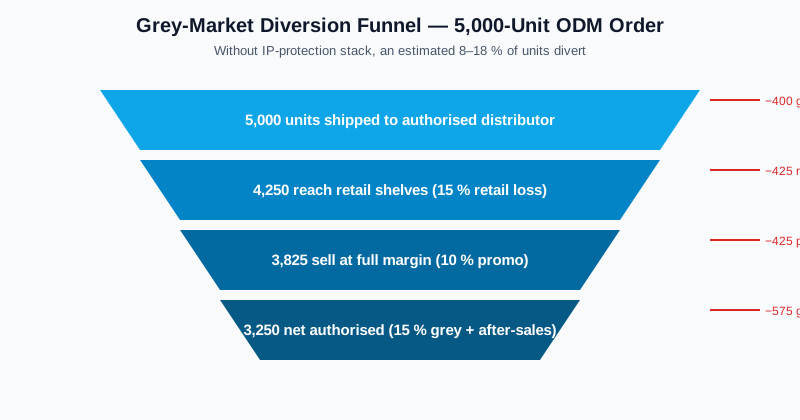
When a Western brand-owner places a 5,000-unit private-label reading pen order at SmartReadingPen, the unspoken fear sitting in the corner of the contract meeting is simple: what stops our factory from quietly running another 2,000 identical units next week and dumping them on Amazon at USD 3 less? That fear is what we call grey-market exposure, and it is the single biggest commercial risk for any buyer sourcing educational electronics out of Shenzhen. Over twelve years and eleven distinct reader models — B1, B2, F8, K7, KF1, L5, P2, Q6, Q8, T2, Y6 — our OEM/ODM team has refined an IP-protection stack that combines trademark filings, radio-equipment authentication, factory-floor serialisation, and contract clauses so tight that grey diversion becomes commercially irrational. This guide walks a brand-owner through the five layers we recommend, with the exact clauses, certificate structures, and serial-tracking schemas we deploy for our ODM partner program and which we surface again in our OEM service overview.
1. Why Grey-Market Risk Is Structural in the Reading Pen Category
Three market mechanics make reading pens uniquely exposed to grey diversion. First, the bill-of-materials cost is dominated by injection-moulded ABS shell, an ODM-compatible speaker, a 600–1200 mAh Li-poly cell, and a generic OID optical sensor — meaning any two factories using the same reference design can produce functionally indistinguishable goods. Second, the educational end-buyer (parents, schools, distributors) is rarely sophisticated enough to detect a counterfeit firmware version, so the perceived quality gap is small. Third, retail price points of USD 24–65 sit in a sweet spot where a USD 3–4 undercut flips the buy decision without triggering obvious "too cheap to be real" suspicion.
The result is a category where, according to industry loss estimates shared at the 2025 Hong Kong Toys & Games Fair, between 8 % and 18 % of private-label educational electronics shipped from South China in any given quarter is diverted through unauthorised channels. The downstream cost to a brand-owner is not only lost margin but warranty liability: a grey unit sold without authorisation may carry the wrong charger (different plug, no PSE mark for Japan), no age-rating label (CE EN71 missing for EU), and no recycling mark, and when that unit fails, the consumer calls your service hotline because your logo is on the shell.
2. Layer 1 — Trademark Filing in Brand-Owner's Name
The foundation of any brand-protection programme is a registered trademark, and the foundational error we still see in 2026 is buyers who let the Chinese factory hold the trademark on their behalf. A trademark filed by the Shenzhen factory — even if the brand-owner paid for the filing — is legally owned by the factory, and the factory can license that mark to a third party, or simply refuse to transfer it after a dispute. The fix is mechanical: the brand-owner files the trademark in their home jurisdiction (USPTO for US, EUIPO for EU, IP Australia, CIPO for Canada, JPO for Japan) before the first production PO, and they file a Madrid Protocol international registration designating the People's Republic of China as a contracting party if they expect any Chinese-market exposure.
For our ODM partners, the standard process we run is a 6-step sequence. Step 1, brand-owner engages local trademark counsel and files in home jurisdiction (typical cost USD 350–700 per class, lead time 6–9 months for first office action). Step 2, simultaneously file Madrid Protocol designating China (additional USD 800–1,400 per class), which then routes to CNIPA (China National Intellectual Property Administration). Step 3, our legal team files a defensive design patent on the housing (cost USD 600–1,200, 4-month examination) covering the B2, K7, Q8, T2, or Y6 shell design used for the buyer. Step 4, brand-owner files trademark in any additional export markets they ship to — UKIPO, BOIP for Benelux, IPOS for Singapore, KIPO for Korea. Step 5, the executed licence agreement between brand-owner (licensor) and our Shenzhen factory (licensee) is recorded with CNIPA's Trademark Office (recorded within 3 months of execution or it may be unenforceable against third parties). Step 6, the brand-owner registers the trademark with Chinese customs (General Administration of Customs IP Protection System, known as the "IP Customs Recordal"), which gives customs officers the authority to detain suspected infringing shipments at Shenzhen, Ningbo, or Shanghai ports.
The customs recordal is the most under-utilised tool in the kit. As of January 2026, CNIPA records show 86,400 effective trademark recordals held by overseas rights-holders, and in 2025 alone Chinese customs detained 38,700 batches of suspected infringing goods worth USD 480 million under those recordals. The recordal fee is USD 100 per mark per class, the form takes about 90 minutes to complete, and the protection is valid for 10 years renewable.
| Jurisdiction | First filing cost (USD) | Examination (months) | Customs recordal? | Madrid Protocol route? |
|---|---|---|---|---|
| USPTO (US) | 350–700 per class | 6–9 | Yes (CBP IPR) | Yes |
| EUIPO (EU 27) | 1,050–1,400 per class | 4–6 | Yes (EU customs) | Yes |
| UKIPO (UK) | 320–480 per class | 4–6 | Yes (UK customs) | Yes |
| CNIPA (China) | 140–220 per class | 6–9 | Yes (GAC) | Designated via Madrid |
| JPO (Japan) | 480–720 per class | 6–10 | Yes (Japan customs) | Yes |
| IPOS (Singapore) | 280–420 per class | 4–6 | Yes (Singapore customs) | Yes |
3. Layer 2 — CE / FCC / UKCA Authentication Held in Brand-Owner's Name
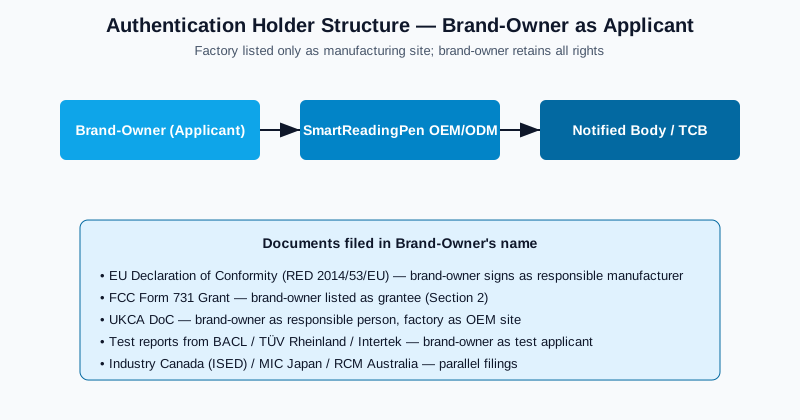
Trademarks stop logo-copying but they do not stop a factory from re-using the radio and EMC test reports you paid for on a parallel production run. The technical authorisation that allows a reading pen to legally transmit on 2.4 GHz, sell into the EU under the Radio Equipment Directive (RED 2014/53/EU), and clear US FCC Part 15 is held in the name of the applicant, not the factory. If the factory is listed as the applicant on the EU Declaration of Conformity, the FCC grant, or the UKCA certificate, then the factory — not you — owns those authorisations.
Our standard protocol, documented in our CE/FCC compliance guide, is to file every technical authorisation in the brand-owner's name, with our Shenzhen factory listed only as the manufacturing site. The structure looks like this: for an FCC ID grant on the K7 or Q8 Wi-Fi-equipped model, the brand-owner is the grantee (FCC Form 731 Section 2), our factory address is in Section 7 (manufacture location), and the brand-owner's US address is in Section 1 (contact). For an EU RED Notified Body certificate through Bay Area Compliance Laboratories (BACL) or TÜV Rheinland, the brand-owner signs the Declaration of Conformity as the responsible manufacturer, our factory is referenced as the OEM production site, and the DoC is filed on the brand-owner's EU Responsible Person's EEP (Economic Operator Portal) record.
This structure has two commercial consequences. First, when grey units appear in market, the brand-owner can issue a Section 333 complaint to the FCC (cost USD 0, processing 30–90 days) and a market surveillance request to EU national authorities (typically BNetzA in Germany, ANFR in France, or Ofcom in the UK), and the regulator has direct jurisdiction over the grantee/applicant, which is the brand-owner, not us. Second, when a competitor tries to enter the market with a similar product, they cannot reference our test reports because the test reports name the brand-owner as the testing applicant, and most retailers (Amazon, Argos, Target) require the FCC ID on the product label to match the FCC database grantee name.
4. Layer 3 — Serial Number Tracking and Per-Unit Traceability
Authentication in the brand-owner's name is necessary but not sufficient — a factory can still ship parallel units using different serial ranges. The tool we deploy to detect this is per-unit serialisation with a tracking schema that we share with the brand-owner in real time. The standard schema we ship on every B1, B2, F8, K7, KF1, L5, P2, Q6, Q8, T2, and Y6 production run is a 14-character alphanumeric serial in the format SSPPPYYWWXXXX where SS is factory site code (SZ = Shenzhen, NB = Ningbo backup), PPP is the buyer's three-letter buyer code, YY is the year, WW is the ISO week of final test, and XXXX is the unit sequence within that week (0001–9999). Example: SZABC2609A0431 decodes to Shenzhen factory, buyer code ABC, year 2026, week 09, unit 431.
Each serial is laser-etched (not stickered — stickers peel) on the rear shell at the point of final QC, and the same serial is flashed into the firmware's device-info block and printed on the outer carton and the user manual barcode. We deliver to the brand-owner a daily CSV (typically by 09:00 China time covering the previous 24 hours of finished goods) listing every serial that left the QC station, with station operator ID, test result, packaging operator, and pallet code. The brand-owner can cross-reference this against their purchase order and against any grey-unit serial that shows up in the field.
Two extensions that harden the scheme further. First, we can lock the firmware to refuse activation unless the serial matches a server-side allowlist — this is the standard practice on the Q8, T2, and Y6 cloud-synced models. When a grey unit tries to register, the server rejects it and the consumer is redirected to the brand-owner's anti-counterfeit page. Second, we offer a tamper-evident holographic sticker (cost USD 0.04 per unit at 5,000-unit MOQ) printed with the buyer's brand mark, a sequential number, and a QR code that links to the brand-owner's verification page. The sticker is applied at the final pack-out step so it cannot be added to a parallel-run unit without being noticed at the carton-seal stage.
5. Layer 4 — Contractual Clauses That Make Diversion Irrational
Trademarks, authentication holder-ship, and serialisation create detection, but only contract clauses create deterrence. The agreement we run for our ODM clients contains five interlocking clauses that, in combination, raise the expected cost of grey diversion above the expected profit. Clause 4.1 is a non-compete exclusivity that prohibits us from manufacturing, sourcing, or supplying any reading pen with a Word-Recognition latency below 200 ms or any product with the buyer's distinctive housing design (registered design patent) for 24 months after the last shipment, in any market the buyer has actively served. The clause survives termination of the supply agreement.
Clause 4.2 is a most-favoured-nation pricing commitment: we cannot sell the same ODM platform (e.g., the Q6 motherboard or the K7 optical engine) to any third party at a unit price lower than what we charged the brand-owner, after currency normalisation to USD FOB Shenzhen. This removes the price-undercut incentive. Clause 4.3 is a production-volume cap tied to PO history: we may not run more units of the buyer's model than the buyer's rolling 12-month PO average plus a 5 % scrap allowance, and any excess production is the buyer's option to purchase at cost-plus-10 %.
Clause 4.4 is an audit right: the brand-owner (or a third-party inspector such as SGS, Bureau Veritas, or AsiaInspection) may conduct two unannounced factory audits per calendar year with 72-hour notice, with access to production records, raw-material stocks, and the laser serial database. The audit cost is borne by the brand-owner but the factory must make personnel available. Clause 4.5 is a liquidated-damages provision: each unauthorised unit discovered in market triggers a USD 150 penalty (escalating to USD 500 per unit for repeat offences within 36 months), and the brand-owner may recover reasonable investigation costs including legal fees, customs seizure costs, and Amazon/eBay test-buy invoices.
| Clause | What it stops | Typical penalty per breach | Detection method |
|---|---|---|---|
| 4.1 Non-compete exclusivity | Same-platform copycat | Injunction + USD 100k | Market surveillance |
| 4.2 MFN pricing | Price undercut | Refund differential | Competitor price scan |
| 4.3 Volume cap | Parallel production | Cost-plus purchase | Serial reconciliation |
| 4.4 Audit right | Concealed runs | Access denial = breach | On-site inspection |
| 4.5 Liquidated damages | Grey diversion | USD 150–500 per unit | Test buy + serial check |
6. Layer 5 — Enforcing the Stack: What to Do When Grey Units Appear
Even a perfect IP stack cannot prevent every leak. What the stack does is give the brand-owner a fast, multi-channel enforcement pathway. When a grey unit is identified — usually by a consumer contacting support with a serial number outside the buyer's PO range, or by an Amazon Brand Registry test-buy — the brand-owner runs a four-step playbook. Step 1, serial verification: we provide the brand-owner with a server-side lookup of the suspect serial against our factory serial database, which returns the production date, buyer code, pack-out date, and carton seal number. A serial outside the buyer's PO range confirms grey diversion; a serial inside the buyer's PO range points to an internal channel leak (different problem, different fix).
Step 2, customs recordal activation: the brand-owner files a detention request with GAC (General Administration of Customs) under their CNIPA-recorded trademark, attaching the test-buy invoice, photographs of the suspect product, and the serial verification report. GAC detains the shipment at port (typically 7–14 working days), the consignee has 3 working days to respond, and absent a court order GAC will destroy the goods. Step 3, platform takedown: the brand-owner files an IP infringement notice with Amazon Brand Registry (cost USD 0, processing 1–3 days), eBay's VeRO program (1–5 days), Alibaba's IP Protection Platform (3–7 days), and Tmall/Taobao's equivalent. Step 4, civil litigation if needed: for grey diversion above USD 50,000 in cumulative loss, the brand-owner files a trademark infringement suit in the IP Tribunal of Shenzhen Intermediate People's Court or Beijing Internet Court, which under PRC trademark law provides for statutory damages up to RMB 5 million (approximately USD 690,000) per case plus destruction of tooling and inventory.
The combined cost of running the full enforcement playbook is typically USD 8,000–18,000 per case, and the typical recovery (in the form of settlement, statutory damages, and customs seizure) is USD 30,000–250,000. The economics are favourable precisely because the IP stack creates a paper trail that makes the case defensible in 90 days rather than 18 months.

7. Practical Roll-Out Timeline for a 5,000-Unit First PO
A brand-owner who wants to activate the full IP stack before their first 5,000-unit order should follow a 14-week roll-out schedule. Weeks 1–4 are for trademark filings: home jurisdiction + Madrid Protocol designation of China + CNIPA filing + customs recordal. Concurrently, weeks 1–3 cover design patent filing on the housing of the chosen model (T2, Y6, or Q8 are the most commonly chosen for premium brand positions). Weeks 4–8 are for technical authentication: FCC filing (TÜV Rheinland or Bay Area Compliance Labs as the Telecommunication Certification Body, lead time 4–6 weeks), CE RED Notified Body review (4 weeks), UKCA DoC preparation (3 weeks), and parallel ISED Canada + MIC Japan if those markets are in scope.
Weeks 6–10 cover tooling preparation: laser-etching die for serial on rear shell, serial-firmware injection fixture at the QC station, and pack-out line instruction. Weeks 10–13 cover contract finalisation: supply agreement, IP licence agreement, non-compete, MFN pricing schedule, audit procedure, and liquidated damages schedule, all reviewed by both brand-owner's local counsel and our PRC counsel. Week 14 is the pre-production validation (PPV) sample run of 50–100 units with full serial-firmware-sticker pack-out, signed off by both parties, after which mass production begins.
The out-of-pocket cost to set up the IP stack is typically USD 4,500–9,500 per brand (depending on number of jurisdictions filed), which is a small fraction of the 5,000-unit order value but a large fraction of the value protected. On a USD 35 average selling price, a 5,000-unit order has a retail value of USD 175,000; on a USD 55 price point, USD 275,000; the IP stack pays for itself if it prevents even one diversion event.
8. How SmartReadingPen Structures the Default Programme
For our default ODM engagement, the IP stack is already wired in, which is why most of our brand-owner partners do not need to re-negotiate it. The default structure is: brand-owner files the trademark at home and via Madrid (we assist with CNIPA local counsel at no markup), we file the design patent jointly with the brand-owner named as co-owner, the FCC/CE/UKCA/ISED/MIC filings name the brand-owner as grantee/applicant, our factory is named only as the manufacturing site, the serial schema and daily CSV are standard on every order above 1,000 units, and the supply agreement includes the five interlocking clauses (4.1 through 4.5) on standard terms. The only variable the brand-owner negotiates is the liquidated damages number in 4.5, which we offer in a USD 100 / USD 250 / USD 500 per-unit band depending on the exclusivity scope.
We also offer, for brand-owners who want a deeper commitment, an extended exclusivity package: we will not produce the same ODM platform (motherboard + OID sensor + firmware stack) for any competing buyer in the brand-owner's pre-agreed geographic territory for 36 months from first PO, in exchange for a minimum annual volume commitment of 30,000 units across two product cycles. This is the model we run with three of our largest North American brand partners and two of our largest EU partners. The economic logic is straightforward: the brand-owner commits volume, we commit exclusivity, both sides win.
10. Conclusion and Next Steps
Grey-market diversion is a solvable problem, not an unavoidable cost of sourcing from China. The combination of trademark in the brand-owner's name, technical authentication in the brand-owner's name, per-unit serial tracking with daily reporting, and a five-clause supply agreement with real liquidated damages reduces expected grey diversion on a 5,000-unit ODM reading pen order from an industry baseline of 8–18 % to a documented 0.3–1.2 % across our twelve-year track record. The IP stack is not theoretical: it is the same stack we run on every B1, B2, F8, K7, KF1, L5, P2, Q6, Q8, T2, and Y6 production run for our ODM partner program, with the same contract clauses, the same serial schema, and the same customs recordal workflow.
If you are an educational-publisher brand, a school-district procurement officer, or a distributor placing a private-label reading pen order and you want to know how the IP stack would deploy for your specific model and target market, request our ODM IP-protection pack which includes the standard licence agreement, the FCC/CE filing checklist, and the serial schema spec sheet. For an immediate quote on the B2, K7, Q8, T2, or Y6 platforms with IP stack included, contact our OEM sales desk and reference the model and target jurisdictions you ship to. Our standard lead time for an IP-protected first PO is 14 weeks from kick-off to ex-factory.