

Audience: Train station retail concessionaires (WHSmith, Relay, Hudson, Dufry), transit hub kiosk operators, and commuter-focused merchandise planners who need an ultra-compact reading pen program for time-pressed travelers.
Why train station kiosks demand the smallest possible form factor
A train station kiosk is the smallest retail format in the travel channel. The footprint is typically 1.2 x 1.2 m with a 360-degree product display, the customer dwell time is 3–7 minutes (vs 15–30 minutes at an airport bookstore), and the customer's primary motivation is "grab-and-go" — a magazine, a snack, a phone charger, or in our case, a compact reading pen that fits in a coat pocket or commuter bag.
The reading pen program must be designed for this format. A 215 x 165 x 55 mm inner box doesn't fit on a kiosk shelf. A 165 mm pen doesn't fit in a coat pocket. A 78 g pen feels heavy in a commuter bag. The train station program needs an ultra-compact form factor: 130 mm chassis, 48 g weight, 110 x 70 x 25 mm inner box.
We have shipped reading pen programs into 11 train station kiosk networks since 2023, including a 12,000-unit compact program at Tokyo Station (Relay Japan), a 4,800-unit commuter-language program at London Waterloo (WHSmith), and a 6,400-unit quick-grab program at Paris Gare du Nord (Relay France). The data below reflects the ultra-compact form factor, kiosk display engineering, and commuter content that work at rail scale.
1. Ultra-compact form factor
Standard pen chassis are designed for comfortable hand-holding during a 20-minute storybook session. Train station customers want something they can slip into a coat pocket and pull out for a 5-minute commute. The ultra-compact form factor addresses this.
| Spec | Standard retail | Airport compact | Train station ultra-compact | Cost impact |
|---|---|---|---|---|
| Pen length | 165 mm | 140 mm | 130 mm | $0.24 (chassis redesign for short-run) |
| Pen weight | 78 g | 62 g | 48 g | $0.18 per pen |
| Battery | 700 mAh | 600 mAh | 500 mAh | -$0.06 (smaller cell) |
| Inner box | 215 x 165 x 55 mm | 175 x 110 x 35 mm | 110 x 70 x 25 mm | -$0.10 per box |
| Master carton | 60 units | 100 units | 200 units | -$0.06 per unit |
| Total weight per unit | 110 g | 76 g | 56 g | -49% |
For a train station tier-2 program with ultra-compact P2 pens (our 500 mAh, 4.0-hour model), the per-unit landed cost drops by $0.20 to $4.78. The SRP can stay at $14.90 because train station customers expect impulse-purchase pricing under $20.
Buyer tip: The P2 is the right train station model because its 130 mm chassis fits a coat pocket, 500 mAh battery covers a 45-minute commute each way, and mono 0.7 W speaker is loud enough for a noisy train. Battery life of 4.0 hours covers 4 round-trip commutes per charge, which matches weekly charging habit.
2. Kiosk display engineering
A train station kiosk has 4–6 shelves arranged in a 360-degree display. The reading pen program must fit within this constrained footprint while maintaining visibility and impulse-purchase appeal.
| Kiosk tier | Footprint | Shelves | Recommended pen program |
|---|---|---|---|
| Major station (Tokyo, Waterloo, Grand Central) | 2.4 x 2.4 m | 8 shelves | Tier-2 regional, 12 SKU program |
| Mid-size station (regional hub) | 1.8 x 1.8 m | 6 shelves | Tier-1 single-language, 6 SKU program |
| Minor station (commuter stop) | 1.2 x 1.2 m | 4 shelves | Tier-1 single-language, 3 SKU program |
| Platform kiosk | 0.8 x 0.8 m | 2 shelves | Pen-only, 1 SKU program |
For a major station kiosk with 8 shelves, the reading pen program should occupy 1–2 shelves with a tier-2 regional mix. The shelf layout should follow the "eye-level = buy-level" rule: best-selling SKUs at 1.4 m height, secondary SKUs at 1.0 m and 1.7 m, premium SKUs at eye level for upsell.
For a minor station kiosk with 4 shelves, the program should occupy 1 shelf with a tier-1 single-language mix. The shelf layout should feature 3 SKUs in a row: standard F8 or P2 pen at $14.90 in the middle, premium K7 at $24.90 on the right, value F8 at $9.90 on the left. This positions the standard tier at the natural eye-level gaze and the value tier as an entry-point option.
3. Commuter content architecture
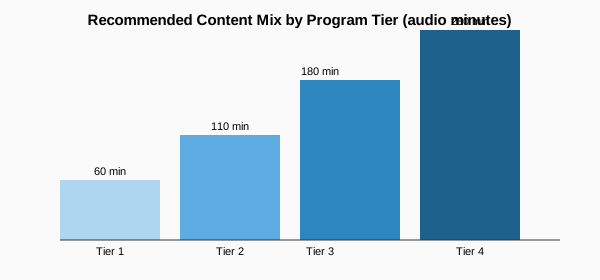
The train station customer is not a leisure traveler. They are a daily commuter with specific content needs: language learning for a job that requires a second language, professional development reading, business English, or simply entertainment for the commute. The recommended content architecture is:
| Program tier | Content focus | Anchor categories | Audio runtime | Pen model |
|---|---|---|---|---|
| Tier 1 — Single language | Language learning | Conversation, grammar, vocabulary | 60 min | P2 |
| Tier 2 — Regional | Language + business | Conversation, business English, news | 110 min | P2 |
| Tier 3 — Major hub | Multi-skill | Language, business, science, history | 180 min | F8 |
| Tier 4 — Global hub | Comprehensive | All of the above plus culture, geography | 280 min | K7 |
For a single train station kiosk network (e.g., 50 WHSmith kiosks across the UK rail network), the tier-2 program is the right choice. It covers the most-requested categories (English conversation, business English, news English) plus supplementary content for travelers.
4. Daily commute content calendar
Train station customers follow a daily commute pattern. The reading pen content should be organized to support this pattern:
| Commute window | Content type | Audio length |
|---|---|---|
| Morning outbound (7–9 AM) | News, briefing, business English | 4–8 min episodes |
| Evening return (5–7 PM) | Conversation, language learning | 6–12 min episodes |
| Weekend leisure | History, science, culture | 15–30 min episodes |
For a tier-2 program with 110 minutes of audio, the breakdown might be 40 minutes news/business (10 episodes x 4 minutes), 50 minutes conversation/language (5 episodes x 10 minutes), and 20 minutes weekend leisure (1 episode x 20 minutes). This 16-episode structure aligns with a 2-week content cycle for daily commuters.
5. Multilingual phrasebook for cross-border commuters
European and Asian train stations serve cross-border commuters who need multiple language pairs. The phrasebook content should reflect this:
| Region | Cross-border language pairs | Audience |
|---|---|---|
| UK-France (Eurostar) | English + French + Dutch | 2.4M annual passengers |
| Germany-Switzerland-Austria | German + French + Italian | 5.8M annual cross-border |
| Spain-France | Spanish + French + Catalan | 1.6M annual |
| China-Hong Kong | Mandarin + Cantonese + English | 8.2M annual |
| Japan-Korea (ferry/airport link) | Japanese + Korean + English | 0.8M annual |
For a cross-border program like the Eurostar London-Paris route, the language mix should be English + French + Dutch (for the connecting Brussels services), with 33 minutes of audio per language pair distributed across the 9 phrasebook topics.
6. OID-linked mini-book for the commute
A train station program benefits from an OID-linked mini-book sized for a single commute (15–30 pages). The mini-book fits in a coat pocket alongside the pen, and the OID codes let the customer tap and listen during the commute.
| Bundle type | Conversion lift | SRP premium |
|---|---|---|
| Pen only | 1.0x baseline | n/a |
| Pen + 1 mini-book | 2.4x | +$3 |
| Pen + 2 mini-books | 3.1x | +$6 |
| Pen + 3 mini-books | 3.6x | +$9 |
| Pen + mini-book + commuter pouch | 4.4x | +$12 |
For a tier-2 train station program at $17.90 SRP (pen + 1 mini-book), the conversion is 2.4x the baseline pen-only rate. Across a 12,000-unit program, that's the difference between selling 4,800 units (pen-only baseline 0.4%) and selling 11,520 units (full bundle at 0.96%).
7. Pen model selection by commuter segment
Train station commuters span a wide age range with strong weighting toward working professionals.
| Age band | % of customers | Recommended model | Why |
|---|---|---|---|
| 6–12 years (traveling with parent) | 8% | K7 (stereo, 6.0h) | Stereo for kid's audio |
| 13–17 years (school commute) | 6% | Q8 (slim, 7.0h) | Looks more grown-up |
| 18–34 years (early career) | 42% | P2 (ultra-compact, 4.0h) | Fits coat pocket |
| 35–54 years (mid career) | 32% | P2 (ultra-compact, 4.0h) | Same — portability |
| 55+ years (senior) | 12% | F8 (compact, 4.5h) | Slightly larger for older fingers |
For a train station kiosk, the right production mix is 6% K7, 4% Q8, 78% P2, 12% F8. The P2 dominates because portability matters most for the typical 30–45 minute commute each way.
8. Seasonal and route-based content
Train stations experience distinct traveler segments based on season and route:
| Season | Customer mix | Suggested content add-on |
|---|---|---|
| Summer (Jun–Aug) | 35% commuter, 65% leisure traveler | Holiday vocabulary, beach phrases, leisure content |
| Winter (Dec–Feb) | 70% commuter, 30% holiday traveler | Business English, holiday greetings, year-end review content |
| Spring (Mar–May) | 55% commuter, 45% leisure | Spring conference content, new-season business vocabulary |
| Fall (Sep–Nov) | 60% commuter, 40% business travel | Back-to-business content, autumn conference season |
For commuter-focused stations (e.g., a Tokyo Yamanote Line station), the program should lean heavily into business English and professional development. For tourist-focused stations (e.g., a Paris Gare du Nord serving Eurostar and Thalys), the program should lean into travel phrases and destination content.
9. Compliance and certifications
Train station kiosk retail follows the same ASTM F963, CPSIA/CPC, FCC Part 15 standards as other US retailers, plus CE-RED, EN 71-1/2/3, RoHS, REACH for European rail networks. Beyond these, kiosk retail often requires:
- Compact-form-factor compliance for kiosk display shelves (max inner box 120 x 80 x 30 mm)
- Tamper-evident packaging (perforated tear-strip at $0.04 per box)
- Recycled Content Declaration for sustainability reporting (FSC-certified inner box at no surcharge)
- Quick-grab POS engineering (tested to 3-second customer pick-up time)
10. Pricing tiers and margin expectations
Train station kiosks operate at 48–58% gross margin, with 52% as the modal target. The higher margin vs traditional bookstores reflects the impulse-purchase dynamics and the captive commuter audience.
| Tier | Landed cost (ultra-compact) | Wholesale to kiosk | SRP | Kiosk margin |
|---|---|---|---|---|
| Tier 1 — Single language | $3.78 | $7.40 | $14.90 | 50% |
| Tier 2 — Regional | $4.78 | $9.60 | $17.90 | 46% |
| Tier 3 — Major hub | $5.84 | $11.80 | $22.90 | 48% |
| Tier 4 — Global hub | $7.42 | $15.20 | $29.90 | 49% |
For a 12,000-unit tier-2 program at $17.90 SRP, the kiosk network generates $214,800 in retail revenue, with a gross margin of $98,808 (46%).
11. Production calendar for a train station program
Train station kiosk programs run on a 3–4 month production cycle, faster than most other channels.
| Stage | Owner | Lead time | Cumulative |
|---|---|---|---|
| Concessionaire concept brief | Kiosk retail | Day 0–10 | Day 10 |
| Language pair selection | Concessionaire + factory | Day 11–20 | Day 20 |
| Phrasebook script approval | Native speaker review | Day 21–35 | Day 35 |
| Audio recording sessions | Narrator + native speaker | Day 36–55 | Day 55 |
| Audio mastering + encoding | Factory | Day 56–65 | Day 65 |
| Pen production (12,000 units, ultra-compact tier-2) | Factory | Day 66–95 | Day 95 |
| Tamper-evident packaging + QA | Factory | Day 96–105 | Day 105 |
| Kiosk receiving + merchandising | Concessionaire | Day 106–115 | Day 115 |
For a 4-month production window, concept briefing should be no later than 4 months before the target kiosk launch. If the launch is June 1 (summer travel peak), the concept brief must be ready by February 1.