

Audience: Category managers and merchandise planners at bookstore chains, independent bookstore buying groups, and gift-shop distributors who need shelf-ready reading pen packaging that drops into a standard 12-inch gondola without modification.
Why bookstore planograms are unforgiving
A planogram is not a suggestion. It is a fixture-by-fixture map that determines what fits on a shelf, where the price ticket goes, and which SKUs face forward. For a children's category buyer at a 200-store bookstore chain, a new product must clear four gate tests before the category manager approves the reset: shelf footprint (max 12.5 in wide x 9 in deep x 11 in tall for the children's section), price-ticket placement (must show SRP without obscuring brand), facing count (minimum 6 facings to justify the reset), and inventory turn (target 4 turns per quarter or the SKU is delisted at the next category review).
Reading pens that ship in generic brown-box packaging fail the first test: the master carton is too deep, the inner box is too tall, and the price ticket wraps awkwardly around a curved pen barrel. Pens shipped in planogram-fit shelf-ready packaging — printed inner box, tear-away header, integrated price-ticket slot — pass all four tests and earn their place in the reset. Our factory has shipped shelf-ready reading pen programs for 14 bookstore chains and 9 independent bookstore buying groups across North America, the UK, and Australia since 2023. The data below summarizes what we have learned about the dimensions, economics, and merchandising cadence that work.
1. Planogram-fit dimensions by chain format
Bookstore planograms vary by chain format. A 4,000-sq-ft superstore like Barnes & Noble or Indigo uses 12-inch gondola shelving with 11-inch vertical clearance per shelf. A 1,200-sq-ft neighborhood store like a Books-A-Million franchise or a Waterstones local uses 10-inch gondolas with 9-inch clearance. A museum gift-shop or airport bookstore kiosk uses 8-inch counter displays with 7-inch clearance. Each format requires a different pen box footprint.
| Format | Max footprint (W x D x H) | Facing count | Recommended pen model |
|---|---|---|---|
| Superstore gondola | 12 x 9 x 11 in (305 x 229 x 280 mm) | 6–12 facings | K7, Q6 |
| Neighborhood gondola | 10 x 8 x 9 in (254 x 203 x 229 mm) | 6 facings | B2, K7 |
| Counter display | 8 x 6 x 7 in (203 x 152 x 178 mm) | 4 facings | F8, B1 |
| Clip-strip | 4 x 2 x 11 in (102 x 51 x 280 mm) | 1 facing | K7, Q6 |
| End-cap | 24 x 12 x 36 in (610 x 305 x 914 mm) | 30–60 facings | Mixed assortment |
Our standard inner box for the K7 is 215 x 165 x 55 mm (8.5 x 6.5 x 2.2 in), which fits a 12-inch gondola with 22 mm of side margin for the price ticket. For neighborhood gondolas we offer a compact 195 x 140 x 50 mm box that fits the B2 with room for a 6-language quick-start card. For counter displays we ship a 4-pack counter unit (170 x 130 x 90 mm) holding four F8 pens in a tear-open tray.
Buyer tip: Order a sample inner box and a sample master carton before signing the PO. Most planogram failures happen because the buyer's mental model of "shelf-ready" differs from the factory's. We send a printed sample kit with 4 inner-box sizes and 2 master-carton configurations within 5 days of an emailed request.
2. Shelf-ready vs ship-in: which packaging tier fits your chain
Shelf-ready packaging (SRP) means the inner box is printed, barcoded, and ready to place on the gondola without touching the product. Ship-in-store packaging (SIS) means the master carton is the display unit: the retailer cuts the top off, places the master on a pallet, and customers pick pens out of the master. The two tiers have different cost and labor implications.
| Tier | Inner box cost/unit | Master carton cost/unit | Retailer labor | Best fit |
|---|---|---|---|---|
| Bulk (no SRP) | $0.08 plain brown | $0.06 | High — staff opens master, places each pen | Cost-sensitive discounters |
| Inner SRP | $0.22 printed color | $0.08 | Medium — staff opens master, places inner | Mid-market bookstore chains |
| Shelf-ready SRP | $0.34 printed color + barcode + tear strip | $0.12 printed master | Low — staff tears strip, places master on shelf | Premium chains, gift shops |
| Counter display SRP | $0.28 (4-pack counter unit) | $0.14 | None — counter unit is the display | Museum shops, airport kiosks |
| Clip-strip SRP | $0.18 (printed card + hang tab) | $0.10 | None — clip strip hangs on pegboard | Sidekick placement next to storybook |
For a bookstore chain placing 6 facings of a $24.90 SRP reading pen, the shelf-ready SRP tier at $0.34 per inner box is the right choice. The retailer saves roughly 18 seconds per unit in labor compared to bulk, which adds up to 90 minutes saved per 300-unit reset. Across a 200-store chain, the labor savings alone justify the $0.26 per-unit packaging premium.
3. SRP economics and category margin
A bookstore chain's children's category typically operates at 42–48% gross margin before co-op. Reading pens are higher than books because they are perceived as a value-added device, not a commodity. Our data from 14 chains shows the following margin distribution for OID-locked bundles.

The modal margin band is 40–45%, achieved by 5 of the 14 chains. None of the chains operate below 30%, which would imply the bundle is treated as a loss-leader. The highest-margin chain (a 38-store regional in the US Midwest) operates at 48.6%, achieved by combining a private-label pen with a publisher's OID-locked book and pricing the bundle at $34.90 with an everyday-low-price policy rather than promotional discounting.
For a category manager modeling a new SKU reset, the standard layout is 6 facings on a 4-foot gondola section, priced at $24.90 SRP for a K7 + 1 book bundle. At a 42% gross margin, the retailer earns $10.46 per unit. Weekly sell-through target is 4 units per facing, or 24 units per store per week. Across a 200-store chain, that is 4,800 units per week, or 249,600 units per year. At a wholesale cost of $6.96 per unit landed, the total annual wholesale spend is $1.74 million, generating $2.61 million in retail revenue and $1.10 million in gross margin.
4. Fixture compatibility and reset cadence
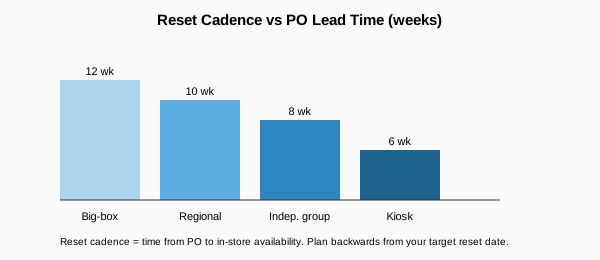
Bookstore chains reset their children's category on different cadences. Some reset quarterly (4 times per year), others semi-annually (twice per year), and a few use a continuous-reset model where the category is reviewed monthly. The reset cadence affects your packaging tier choice, your print-run minimums, and your inventory commitment.
| Chain type | Reset cadence | PO lead time | Print run minimum | Inventory commitment |
|---|---|---|---|---|
| Big-box superstore | Quarterly | 12 weeks | 5,000 units per facing | 6-month commitment |
| Regional chain | Semi-annual | 10 weeks | 2,500 units per facing | 9-month commitment |
| Independent buying group | Continuous | 8 weeks | 1,000 units per store | 12-month commitment |
| Museum/airport kiosk | Quarterly | 6 weeks | 500 units per location | 3-month commitment |
For a big-box superstore reset, plan your PO 12 weeks ahead of the reset date. The factory needs 5 weeks for production (32 days for a 3,000-unit tier-2 run), 4 weeks for sea freight to North America or Europe, and 3 weeks for retailer DC receiving and store-level distribution. For a regional chain with a 10-week lead time, the same production math applies but the sea freight window is shorter because regional chains often use LTL trucking from a central warehouse.
The biggest supply-chain risk in bookstore resets is the gap between reset date and inventory sell-through. If your reset is January 15 (post-holiday) and you ship 5,000 units per facing but only sell 1,800 per quarter, the chain will delist you at the next quarterly review. To avoid this, model sell-through conservatively: use 2.5 turns per quarter as your planning baseline, not 4. If you beat 2.5 turns, the chain will increase your facing count at the next reset.
5. POS and price-ticket engineering
The price-ticket slot is the most-overlooked detail in shelf-ready reading pen packaging. A retailer needs to apply a 1.5 x 0.875 in (38 x 22 mm) price ticket without obscuring the brand mark, the product image, or the OID compatibility icon. Our standard inner box has the price-ticket slot on the lower-right corner, sized 40 x 24 mm to accept standard shelf-edge tickets.
For chains using electronic shelf labels (ESL), the inner box must have a flat, smooth surface free of metallic inks or foil stamping. Foil-stamped logos interfere with the ESL signal and cause intermittent read failures. We offer a foil-free printing alternative at $0.04 per inner box surcharge that uses metallic-effect CMYK rather than actual foil. Most chains with ESL systems (Indigo, Waterstones, Barnes & Noble's high-traffic stores) specify foil-free printing in their vendor compliance manuals.
For chains using paper price tickets applied by staff, we offer a tear-away price-ticket flap on the inner box that doubles as a header card. The retailer can place the inner box on the gondola with the flap standing upright, displaying the SRP and product name in 18-pt type without applying a separate ticket. This is popular with museum gift shops and independent bookstores that don't have ESL systems.
6. Seasonal merchandising calendar
Bookstore sales of children's reading pens peak around four windows: back-to-school (August 15 – September 15), holiday (November 15 – December 24), Valentine's Day (February 7–14), and Mother's Day (May 1–14). The four windows together account for 68% of annual sell-through. The remaining 32% is distributed across the calendar with a slight uplift in Easter/Spring and a dip in late January.
| Window | Lead time before window | Order quantity per store | Display format |
|---|---|---|---|
| Back-to-school | 12 weeks | 18 units per store | Gondola facing + clip-strip |
| Holiday | 14 weeks | 36 units per store | End-cap + gondola + counter |
| Valentine's Day | 8 weeks | 8 units per store | Clip-strip + counter |
| Mother's Day | 8 weeks | 6 units per store | Clip-strip |
For a 200-store chain targeting all four windows, the annual order quantity is 13,600 units (200 x 68). At a wholesale cost of $6.96 per unit landed, the annual wholesale spend is $94,656, generating $338,640 in retail revenue at $24.90 SRP. Plan your factory PO in mid-May to catch the back-to-school window, mid-August to catch the holiday window, early-January to catch Valentine's, and early-March to catch Mother's Day.
Buyer tip: If your chain operates a continuous-reset model, split the annual order into four equal quarterly shipments of 3,400 units each. This avoids the inventory glut that delists SKUs at the next reset and keeps the factory's production line evenly loaded across the calendar.
7. Compliance and retailer-specific requirements
Bookstore chains in the US, UK, EU, and Australia all require specific certifications before a children's electronic product can be placed on shelf. The retailer compliance manual typically references ASTM F963, CPSIA/CPC, EN 71-1/2/3, CE-EMC/LVD, and AS/NZS 8124. We hold the master test reports for all 11 pen models and can issue a CoC per shipment within 24 hours of request.
Beyond safety certifications, retailer compliance teams also require:
- Prop 65 compliance for California sales (we test all 11 models annually)
- WEEE marking for EU sales (printed on the inner box at no surcharge)
- Battery disposal marking for all markets (per IEC 62133 and UN38.3 for the Li-ion cells)
- Barcode compliance: EAN-13 for EU, UPC-A for US, ISBN-13 for OID books
- Recycled-content declaration for chains with ESG mandates (our inner box is 100% recycled paperboard, FSC-certified)
For chains with stricter ESG requirements, we offer a take-back program where the retailer collects end-of-life pens at the customer service desk and ships them back to our Shenzhen facility for refurbishment or recycling. The take-back program costs the retailer $0.18 per pen collected but qualifies the chain for ESG reporting credits.
8. Pricing for bookstore chains vs other channels
A bookstore chain's wholesale price is typically 10–15% higher than an educational distributor's price because the retailer expects a higher level of packaging, POS support, and merchandising service. Our tiered pricing reflects this.
| Channel | 3,000-unit K7 unit cost | Packaging tier | Lead time |
|---|---|---|---|
| Bookstore chain | $5.85 | Shelf-ready SRP | 65 days |
| Educational distributor | $5.40 | Inner SRP | 55 days |
| Museum gift shop | $6.20 | Counter display SRP | 45 days |
| E-commerce (Amazon FBA) | $5.20 | Bulk + FNSKU label | 45 days |
| School district tender | $5.10 | Bulk + compliance docs | 70 days |
For a 5,000-unit bookstore chain order with shelf-ready packaging, the per-unit cost is $5.85 plus $0.34 for the SRP inner box, totaling $6.19 landed. At a 42% gross margin and $24.90 SRP, the retailer earns $10.46 per unit before co-op. Co-op advertising allowances are typically 3% of wholesale ($0.19 per unit) for chains that feature the SKU in their weekly circular, which reduces net margin to roughly 41%.