

Audience: Program managers and engineering leads at reading pen brands who need a defensible, 7-day ECO cycle that covers BOM swap, firmware bump, mold tweak, color change, packaging change, and label change. The article walks through the five ECO categories, the four approval roles, the 7-day cycle, the paperwork, the ERP cut-over, and the audit trail that survives a CE, FCC, or UKCA desk audit.
A reading pen program sees between 40 and 80 engineering change orders between launch and the 100,000-unit production milestone. The changes range from a $0.04 resistor swap to a $4,000 mold tweak to a firmware bump that ships 200,000 units in the field. Without a disciplined ECO cycle, the BOM drifts, the firmware version on the line no longer matches the firmware version in the ERP, and the next 12,000-unit order ships with three different shades of white. A disciplined 7-day ECO cycle eliminates the drift by forcing every change to clear four named approvers, a controlled document trail, and an ERP cut-over before the change hits the production line. A 7-day cycle is tight enough to keep pace with allocation events and supplier EOL notices, and slow enough to catch the safety, certification, and AQL implications before they reach the field.
1. The Five Categories of Reading Pen ECO
An engineering change order on a reading pen falls into one of five categories: BOM swap (resistor, capacitor, IC, connector, battery), firmware bump (boot logo, voice pack, audio decoder, bug fix), mold tweak (gate, ejector, rib, wall), color or finish change (Pantone, gloss, texture), and packaging or label change (box, manual, regulatory mark, barcode). Each category has a default cycle time, a default approver set, and a default set of downstream updates (BOM, ERP, label declaration, certification file).
| Category | Default Cycle | Approvers | Downstream Updates |
|---|---|---|---|
| BOM swap (passive) | 3 days | CE, SCM, QA | BOM, ERP, AVL |
| BOM swap (active) | 7 days | CE, SCM, QA, PM | BOM, ERP, AVL, ECO |
| Firmware bump | 7 days | FW lead, QA, PM | Flash image, ERP, field update |
| Mold tweak | 14 to 21 days | Tooling, CE, QA, PM | Tool, BOM, sample, certification if needed |
| Color or finish | 7 to 10 days | Industrial design, QA, PM | Pantone, ERP, color master |
| Packaging or label | 5 to 7 days | Package eng, QA, PM | Box BOM, ERP, regulatory mark |
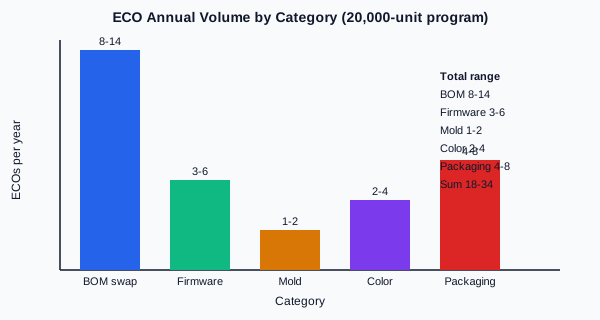
A 20,000-unit reading pen program will see 8 to 14 BOM ECOs, 3 to 6 firmware ECOs, 1 to 2 mold ECOs, 2 to 4 color ECOs, and 4 to 8 packaging ECOs in the first 12 months. The most common is a BOM swap driven by a supplier allocation or EOL notice; the most expensive is a mold tweak driven by a T2 finding or a VAVE landing.
2. The ECO Document
The ECO document is a one-page controlled form that lives in the engineering change order system. It carries the ECO number, the category, the change description, the affected models (one or more of B1, B2, F8, K7, KF1, L5, P2, Q6, Q8, T2, Y6), the affected production lots, the cost impact in dollars per unit, the schedule impact in days, the certification impact flag, the AQL risk flag, the four approver names, and the implementation date.
| ECO Field | Example (Battery cell swap, Q6) | Data Source |
|---|---|---|
| ECO number | ECO-2026-Q6-014 | ECO system |
| Category | BOM swap (active) | Requester |
| Description | Replace 900 mAh Li-poly with 950 mAh from Vendor B | Component engineer |
| Affected models | Q6 | AVL master |
| Affected lots | Lots Q6-2026-018 onward | ERP |
| Cost impact | -$0.06 per unit | Quote |
| Schedule impact | None | Production |
| Certification impact | Yes (UN38.3 re-file) | Compliance |
| AQL risk | Low (same form factor) | QA |
| Implementation date | 2026-04-22 | ERP cut-over |
The four approvers are: the component engineer (technical fit), the supply chain manager (cost and lead time), the QA manager (test plan and AQL risk), and the program manager (schedule risk and certification). Any approver can decline, which closes the ECO as rejected and forces the requester to revise.
3. The 7-Day ECO Cycle
The 7-day ECO cycle is the default for any active-component BOM swap, firmware bump, color change, or packaging change. The cycle runs from the day the ECO is opened to the day the ERP is updated and the production line is briefed. The 7 days are split as follows: Day 1 is the request and the approver assignment; Days 2 to 4 are the technical review and the risk review; Day 5 is the sign-off and the ERP update; Days 6 to 7 are the line briefing and the first production batch on the new BOM.
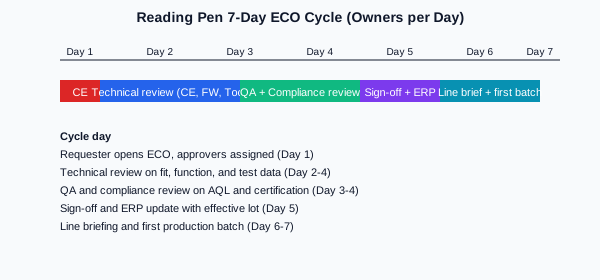
The 7-day cycle assumes the technical data is ready. A BOM swap that requires a 14-day reliability test cannot clear the cycle in 7 days; in that case, the cycle extends to 21 days and the ECO is tagged "pending reliability" until the test report lands. A disciplined cycle therefore has two modes: fast (7 days, data ready) and slow (14 to 45 days, data pending).
4. Approver Roles and Decision Rules
The four ECO approvers are the same four who sign off on an ACAR, but their decision logic is different. In an ACAR the question is "is this alternate fit for the AVL?"; in an ECO the question is "is this change safe to cut over to the production line on the effective date?". The four approvers bring four different lenses, and any one of them can block.
| Approver | Lens | Decision Rule |
|---|---|---|
| Component engineer | Technical fit | Does the new part meet spec on the bench? |
| Supply chain manager | Cost and lead time | Is the cost delta justified and the lead time stable? |
| QA manager | AQL risk | Does the test data show parity or improvement? |
| Program manager | Schedule and certification | Does the change break any certification file or PO commitment? |
The QA manager is the most likely to block. A BOM swap that has not been AQL-tested on at least 50 units is a hard block. A mold tweak that has not been AQL-tested on at least 200 units is a hard block. A firmware bump that has not been regression-tested on at least 200 units across the OID library is a hard block. The 50 / 200 / 200 sample sizes are not arbitrary; they correspond to the AQL II Major 1.0 plan for the relevant lot size.
5. Firmware ECO Special Case
A firmware bump is the most frequent ECO on a reading pen (3 to 6 per program per year) and the one most likely to slip through uncontrolled. A reading pen has 11 current firmware versions in production: B1/B2 at 2.4.7, F8 at 3.1.2, K7/KF1 at 1.9.5, L5 at 4.2.0, P2 at 2.0.3, Q6/Q8 at 3.3.1, T2/Y6 at 2.6.4. A bump from 3.3.1 to 3.3.2 on Q6/Q8 has to clear the regression suite (1,200 test cases), the field update compatibility check (back to 3.3.0), and the OID library compatibility check (12,000 patterns). A bump that touches the OID library also has to re-validate the EN 71 plus ASTM F963 plus CPSIA labeling if the bump changes the wake word.
| Firmware ECO Check | Sample | Pass Criterion |
|---|---|---|
| Regression suite | 200 units | 100 percent pass |
| OID library | 12,000 patterns | Above 99.6 percent recognition |
| Field update | 100 units down, 100 up | Zero brick |
| Wake word | 200 units, 5 languages | Above 98 percent detection |
| Battery life | 10 units, full cycle | Within 5 percent of baseline |
A firmware ECO that touches the wake word, the audio decoder, or the OID library extends the cycle from 7 days to 14 days because the regression suite takes 6 days on its own. A firmware ECO that only changes the boot logo, the splash screen, or the language pack stays at 7 days.
6. Mold ECO Special Case
A mold tweak is the most expensive ECO on a reading pen because every change touches steel. A mold tweak costs $1,400 to $9,000 depending on the change: a gate move is $1,400, an ejector pin move is $2,200, a rib thicken is $3,800, a wall stock adjustment is $4,500, and a complete cavity re-cut is $9,000. The cycle is 14 to 21 days because the mold has to come out of production, ship to the tool shop, get touched up, ship back, get sampled, get AQL tested, and get signed off.
| Mold Tweak | Tool Cost | Cycle |
|---|---|---|
| Gate move | $1,400 | 14 days |
| Ejector pin move | $2,200 | 14 days |
| Rib thicken | $3,800 | 18 days |
| Wall stock adjust | $4,500 | 18 days |
| Cavity re-cut | $9,000 | 21 days |
A mold ECO that touches the cosmetic A-surface (the part of the pen the customer sees) also requires a color master re-check. A mold ECO that touches the TPE overmold bond area requires a peel test at 1.2 N/mm minimum. A mold ECO that touches the OID sensor alignment requires a recognition retest at 99.6 percent minimum.
7. ERP Cut-Over and Lot Traceability
The ERP cut-over on Day 5 is the moment the new BOM or firmware becomes effective for production. The cut-over is done by lot number: every lot produced after the effective lot uses the new BOM. The old BOM is retired but kept in the AVL history for at least 7 years. A reading pen program that ships 25,000 units per year with 4 to 6 ECOs per year will have 4 to 6 effective lot cut-overs per year.
| Lot Range | BOM Version | Firmware | Color Master |
|---|---|---|---|
| Q6-2026-014 to 017 | BOM-Q6-v3.4 | 3.3.1 | CM-Q6-A4 |
| Q6-2026-018 to 021 | BOM-Q6-v3.5 | 3.3.1 | CM-Q6-A4 |
| Q6-2026-022 onward | BOM-Q6-v3.6 | 3.3.2 | CM-Q6-A4 |
The lot traceability is the document that survives a field complaint. If a consumer in Frankfurt reports a charging fault on a Q6 with serial prefix Q6-2026-018, the ERP can pull the BOM, the firmware, the color master, the lot date, the production line, the line operator, the IQC lot, the SMT lot, the battery lot, and the OID book lot. That full traceability is what the CE, FCC, or UKCA desk auditor asks for, and it is also what a brand needs to defend a product liability claim.
8. Audit Trail and Record Retention
Every ECO generates a 2- to 4-page controlled document that is stored in the engineering change order system for at least 7 years. The document contains the ECO form, the four signatures, the test data summary, the cost impact, the schedule impact, the certification impact, the effective lot, and the link to the ERP record. The retention window is 7 years for CE and FCC, 10 years for UKCA, and 10 years for Prop 65. A reading pen program that ships into the EU, the UK, and California must keep the ECO file for 10 years.
Buyer tip: When you audit a factory, ask to see the ECO log from the last 12 months. A factory with 8 to 14 BOM ECOs, 3 to 6 firmware ECOs, and a 7-day cycle is healthy; a factory with zero ECOs has either frozen the design (unusual after launch) or has been running changes informally (a red flag).
For how an ECO is triggered by an alternative component approval, see reading pen alternative component approval. For how an ECO captures a VAVE landing, see reading pen cost reduction (VAVE) workshop. For how the SKU is updated after an ECO, see reading pen version control for OEM SKUs. For the DFM review that should run before the first ECO on a new model, see reading pen DFM review.