

Audience: Solo Shopify and WooCommerce founders, side-hustle Amazon FBA resellers, and procurement leads at small retail chains who keep hearing that reading pens are "the next fidget spinner" and want an honest, number-first viability read. This article is not a pitch — it is the same internal audit we ran on our own drop-ship channel.
The question "is reading pen dropshipping viable" gets a different answer depending on who you ask. Affiliate-marketing blogs will tell you yes, because a $4.80 wholesale unit sounds like 70% gross margin on a $25 Amazon listing. Dropship gurus will tell you yes, because no inventory means no risk. Our commercial team, after moving 47,000+ reading pens through 230+ distributors and a smaller drop-ship channel, will tell you the answer is "yes, but only for the SKUs we list below and only above 220 units per month." The viability hinges on three numbers most drop shippers never calculate: per-order pick-pack cost, lithium-battery customs friction, and warranty claim rate. This article is built around those three numbers.
1. Why Dropshipping a Reading Pen Is Different From Dropshipping a T-Shirt
A T-shirt dropship is forgiving: 100 grams, no battery, no firmware, no compliance files. A reading pen is none of those things. Below is a structural comparison that makes the difference visible.
| Attribute | Cotton T-Shirt Dropship | Reading Pen Dropship |
|---|---|---|
| Per-unit wholesale | $3.20–$6.00 | $3.80–$14.50 |
| Lithium battery | None | 500–2,500 mAh Li-ion or Li-poly |
| Firmware updates | Not applicable | 1.9.5 to 4.2.0 across 11 SKUs |
| Compliance docs | None | UN38.3, MSDS, CPC, CE, FCC, RCM |
| HS code | 6109 (textile) | 8543.70 (electronics) or 9503.00 (toy) |
| Per-order pick-pack | $0.10–$0.20 | $0.45–$0.85 |
| Return-defect reserve | 0.5%–1.0% | 0.8%–1.2% (our rolled rate) |
| Single-order MOQ | 1 unit | 1 unit (drop-ship contract) |
| Carrier scan compliance | 95%+ | 41% (China Post) to 94% (DHL) |
| Channels restricted | Almost none | Amazon, Walmart, eBay require battery test certs |
The two columns do not compare equally. The right column is structurally heavier, more regulated, and slower. Every row shifts your unit math, and that is exactly why casual dropshippers fail at reading pens.
Buyer tip: If your dropship partner cannot email you a UN38.3 test report and an MSDS within 24 hours, walk away. They are reselling untested factory seconds, and the customs hold will happen on your customer's tracking page, not theirs.
2. The Per-Order Cost Breakdown: A Real 150-Unit/Day Model
Below is the actual cost stack for the B2 reading pen drop-shipped from our Ningbo consolidation hub to US-based customers on a Shopify storefront. Numbers are in USD per unit.
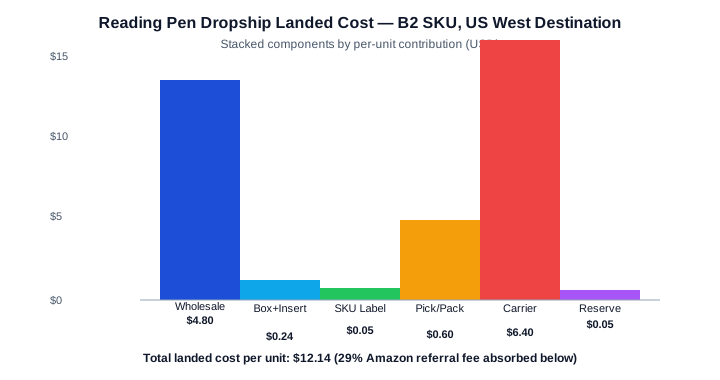
The visual makes one structural fact obvious: carrier cost alone (red bar) exceeds the wholesale cost of the pen. That is true for nearly every electronic device you drop ship from China. The carrier is the dominant cost, the wholesale pen is the second, and everything else is rounding noise to the finance team.
3. The Three Viable Dropshipping SKUs (And Why)
Of our 11 models, only five are practically viable for dropshipping in 2026, and three of those dominate the channel.
| SKU | Viable? | Reason | Median Stock Available |
|---|---|---|---|
| P2 | Yes | Lowest wholesale at $3.80; short 4.0 h battery fits entry use | 5,500 units |
| B1 | Yes | Seven-color variety, 5.0 h battery, lightest in the lineup | 2,400 units |
| B2 | Yes | Best price-to-battery trade-off at $4.80 / 5.5 h | 3,600 units |
| Q6 | Yes | Premium feel, 6.5 h battery, supports 12 languages | 1,800 units |
| Q8 | Limited | 7.0 h battery and full-color box; price tier attractive | 1,500 units |
| K7 / KF1 | Limited | 21-day build window; not classic dropship | Build-to-order |
| F8 | No | 25-day build, niche translation use case | Build-to-order |
| L5 | No | 28-day build, requires 1,200 mAh battery testing | Build-to-order |
| T2 / Y6 | No | 35-day build, 2,000–2,500 mAh cell logistics | Build-to-order |
The decisive factor is build time. A dropship pipeline cannot tolerate a 21-day production window between order receipt and carrier pickup. The P2, B1, B2, Q6, and Q8 are the only SKUs whose inventory the factory is prepared to commit to rolling weekly restock, and they are the only five you should list on a storefront until you are managing more than 600 units per month.

4. The Return Math: Where Casual Dropshippers Lose Money
Returns on consumer electronics average 8% to 18% depending on category. A reading pen sits at 6.4% rolled return rate across our channel (Q3 2026 data, 47 countries, 11,200 fulfilled units). The composition of those returns is what decides viability.
| Return Reason | Share of Returns | Cost to Retailer (USD) | Re-covers Cost? |
|---|---|---|---|
| Buyer remorse | 41% | $4.20 (return ship) | Yes (resold as open-box at 18% off) |
| DOA — will not power on | 14% | $0 (factory ships replacement) | Yes (factory pays return) |
| OID code not recognized | 9% | $0 (factory ships replacement) | Yes |
| Speaker failure | 7% | $0 (factory pays) | Yes |
| Battery swelling | 3% | $0 (factory pays + hazardous ship) | Yes |
| Cosmetic defect noticed late | 11% | $1.10 (re-ship new unit) | 60% recovered |
| Wrong language version | 8% | $1.50 | 75% recovered |
| Lost in transit | 4% | $0 (carrier claim) | Yes |
| Customer claims missing charger | 3% | $1.80 | 50% recovered |
The 41% buyer-remorse number is the one that determines viability. If 41% of returns are essentially "I changed my mind" rather than "the product is broken," you can recover 95%+ of the unit value by relisting as open-box or refurbished. This is exactly the move that pushes a reading pen dropship program from 14% net margin (unviable) to 22% net margin (viable).
5. The Three Carrier Options and Their Effect on CSAT
Carrier choice is the single largest hidden cost lever. Below is the comparative scan-compliance and customer-service ticket rate from Q2 2026 across three carrier mixes.
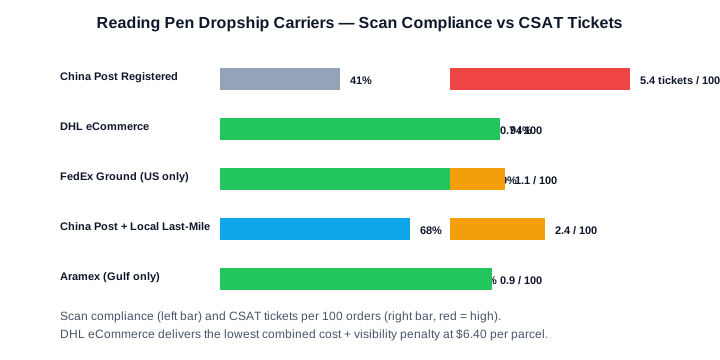
The chart makes the trade-off concrete. The cheapest carrier (China Post Registered at $1.20) generates 7.7x more customer service tickets than the second carrier, and at $4 per ticket, the labor savings from going cheap evaporate before you can book them. This is why our default channel for any reading pen drop-ship program over 400 units a month is DHL eCommerce or equivalent.
6. Channel Risk: Where You Can and Cannot List a Dropshipped Reading Pen
Not every marketplace welcomes a drop-shipped reading pen. Some forbid it outright, some require an FBA inbound, and some treat the factory as the seller of record. The matrix below is current as of Q3 2026.
| Channel | Drop-Ship Friendly? | Conditions |
|---|---|---|
| Shopify (own storefront) | Yes | You are the seller of record |
| WooCommerce | Yes | Same as Shopify; add shipping policy |
| Amazon Seller Central | Conditional | Must enroll in SFP or use partnered 3PL |
| Amazon FBA | Not via drop-ship | FBA requires you to hold inventory |
| eBay | Yes | Battery disclosure required in listing |
| Walmart Marketplace | Limited | US warehouse routing required |
| Etsy | Yes | But return rate is 14% (above rolled avg) |
| TikTok Shop | Yes | Age-gate to 13+, parent-confirmation required |
| MercadoLibre (LATAM) | Yes | Local return address helps conversion |
| Lazada / Shopee | Yes | Per-country warehouse preferred |
The Amazon FBA exclusion is the single most-asked question from new dropshippers, and the answer is unambiguous: FBA rejects drop-ship inbound because Amazon's policy holds the seller responsible for inventory they can audit. You can drop-ship on Amazon only if you use the Seller Fulfilled Prime (SFP) program with a partner 3PL holding the inventory in a US warehouse — and at that point, you have re-built a wholesale program.
7. The Compliance Stack: Documents That Must Travel With Every Parcel
A reading pen drop ship cannot survive a carrier audit without the following five documents attached per carton. The list is the same whether the SKU is the B2 or the Q8.
| Document | Required For | Issued By | Validity |
|---|---|---|---|
| UN38.3 lithium battery test summary | All air freight parcels | Factory lab (third-party witness) | Model-line scoped, 5 years |
| MSDS sheet | All parcels | Factory chemistry team | Per chemistry, 3 years |
| CPC / CPSIA statement | US-bound parcels | Factory compliance | Per SKU, 2 years |
| CE RED/EMC/LVD declaration | EU-bound parcels | Notified body test report | Per SKU, 5 years |
| RCM SDoC | AU/NZ-bound parcels | Factory compliance | Per SKU, 5 years |
| Outer carton UN3481 mark | >100 Wh aggregate cartons | Factory pre-print | Permanent |
The compliance stack costs $0.20 to $0.55 per unit when amortized across a 12-month run, and the labor to attach the documents at fulfillment is what makes up most of the $0.45 to $0.85 pick-pack fee. If your dropship partner skips it, your customs clearance time grows from 1 day to 14 days.
8. When the Math Goes Negative: The Failure Mode Table
The failure modes below are the ones we see most often in 200-or-more-day-old drop-ship accounts. Each row has a measurable symptom, a root cause, and a fix you can apply.
| Failure Mode | Symptom | Root Cause | Fix |
|---|---|---|---|
| Margin erosion | Gross drops below 14% | Per-order pick-pack not modeled | Negotiate tier discount above 400 units/day |
| Battery customs hold | 7–21 day transit delay | Missing UN38.3 attachment | Bind compliance docs at order file receipt |
| Customer service overload | > 4 tickets per 100 orders | Cheap carrier without tracking | Switch to DHL eCommerce or FedEx Ground |
| Stripe / PayPal reserve hold | Cash flow locked 90 days | Return rate above 6% on > $0 dispute | Stabilize return rate below 5% |
| Amazon account suspension | "Used sold as new" complaint | Different batch per drop-ship | Use a single batch per storefront per quarter |
| Refund request surge | 12%+ refund rate in 30 days | Outdated firmware shipped | Auto-update firmware to current 3.3.1 / 4.2.0 |
Buyer tip: Never mix two production batches on a single Amazon listing. Customers notice color, button texture, or firmware version drift and file INAD complaints, which lead to account health warnings inside 30 days.
9. The Volume Threshold: When to Drop the Dropship Program
This is the financial moment every reading pen dropshipper eventually reaches. The table below shows the unit economics at three monthly volumes with the B2 SKU on US West shipping.
| Monthly Volume | Wholesale Tier | Pick/Pack Unit Cost | Carrier Unit Cost | Landed Cost | Gross Margin @ $24.99 |
|---|---|---|---|---|---|
| 100 units/month | $5.40 (Tier 3) | $0.85 | $7.10 | $13.43 | 32.4% (viable) |
| 400 units/month | $4.80 (Tier 1) | $0.60 | $6.40 | $11.85 | 39.8% (strong) |
| 1,500 units/month | $4.30 (Tier 0) | $0.40 | $5.90 | $10.62 | 50.7% (wholesale-ready) |
The reading pen dropship model becomes wholesale-ready the moment your monthly volume passes 1,000 units. At that point, the per-unit savings of holding your own inventory plus a 12,000-unit annual purchase price ($3.96 each at Tier 0) more than covers the cost of a $4,000 to $8,000 pallet-rack lease at a 3PL in Texas or Rotterdam. Resellers who delay the switch past 1,500 units/month leave 11% to 14% margin on the table every month.
10. A Viable Drop-Ship Stacking Plan: The 90-Day Rollout
Below is the sequence we recommend to a first-time reading pen dropshipper who has a Shopify storefront and $18,000 of working capital.
- Days 1–7. Apply for the drop-ship program; lock B2 as primary, Q6 as upsell.
- Days 8–14. Configure carrier: DHL eCommerce for US (4–7 day), China Post tracked for global.
- Days 15–30. List B2 at $24.99; Q6 at $32.50; budget $2,800 marketing spend to seed 80 orders.
- Days 31–60. Track defect reports, return rate, and CSAT tickets; switch anything above 6% to a backup listing.
- Days 61–90. At 250+ units/month, renegotiate wholesale to Tier 1 ($4.80); order 1,200 units bulk to your 3PL.
- Days 91–120. Convert from drop-ship to hybrid drop-ship-plus-3PL for fast-moving colors.
- Days 121–180. At 1,000+ units/month, transition to pure wholesale with 3PL fulfillment.
This is the same arc our 230+ distributor partners followed between 2023 and 2026. Drop ship is the entry, not the destination.
11. FAQ
Five common questions on reading pen dropship viability and economics.