

Audience: QA managers, importers, and brand-side product owners who need a defect list they can hand to a third-party inspector on a Chinese production line — one that survives factory pushback because every defect has a written, photographable definition.
The reason AQL inspections fail in arbitration is almost never the sampling system. It is the defect list. A factory inspector finds a "scratch" on a reading pen and marks it Minor. The buyer's QC manager argues it is Major because it crosses the visible surface. The two sides spend three emails arguing over what "scratch" means, while 6,000 units sit in a warehouse. This guide is the reference that ends those arguments: 80+ specific reading-pen defects, each tagged Critical / Major / Minor with a written definition and a photo cue. Print it, hand it to the inspector, attach it to the PO as Annex A.
Buyer tip: Always attach the defect classification list as Annex A to your PO, with the words "Defects shall be classified per Annex A. Annex A supersedes factory internal QC standards." This single paragraph blocks 90% of "but our QC considers this acceptable" objections.
1. How Critical / Major / Minor works in a reading pen context
The classification system is layered, not flat. Each defect has one class, and the class determines the AQL limit applied to it during sampling. Critical defects use AQL 0 (single defect = lot reject). Major defects use AQL 1.0 (for consumer electronics aimed at children) or AQL 1.5 (for adult-use reading pens). Minor defects use AQL 2.5. The classification is also the gate to what action the factory must take — Critical defects trigger 100% sort and re-inspection; Major defects trigger zone-sort and re-inspection; Minor defects trigger rework on the affected units only.
The classification matters because misclassification is the single most expensive error in the inspection process. Classifying a battery overheating issue as Major instead of Critical means the lot passes with 1 in 80, and 75 overheating batteries ship to a school district that then triggers a recall. Classifying a 1.5 mm label misalignment as Critical instead of Minor means the lot fails on a defect that 95% of end users will never see, and the factory re-sorts 6,000 units unnecessarily.
2. Critical defects — the list that cannot be relaxed
Critical defects are zero-tolerance. They are defects that endanger the user, fail a regulatory requirement, or render the unit non-functional at unboxing. Each entry below is a defect we have seen on a real production line in the past 36 months.
| # | Defect | Where it appears | Regulatory trigger |
|---|---|---|---|
| C-01 | Battery leakage or visible swelling | Inside battery compartment or housing seam | UN38.3, IEC 62133, CE-EMC |
| C-02 | Exposed wiring or accessible sharp edge | Pen tip, USB port opening, speaker grille | EN 71-1, ASTM F963, CPSIA |
| C-03 | USB port overheating during charge (case temp > 60°C) | USB-C or Micro-USB port | CE-LVD, FCC Part 15B |
| C-04 | Speaker short circuit (no audio + housing heat) | Speaker cavity | CE-EMC, Prop 65 |
| C-05 | Missing or wrong compliance mark (CE, FCC, UKCA, age grading) | Housing back, packaging | CE-RED, FCC, UKCA |
| C-06 | Wrong battery chemistry vs. spec (Li-poly spec'd, Li-ion fitted) | Battery label | UN38.3, IEC 62133 |
| C-07 | Unit dead on first power-on (no LED, no boot tone) | Any | Function-block |
| C-08 | High-frequency noise above 90 dB at 10 cm | Speaker | EN 71-1, Prop 65 |
| C-09 | Detachable small part for under-3 age grading | Tip cap, battery door, SD slot cover | CPSIA, EN 71-1 |
| C-10 | Choking-hazard dimension on any accessible part | Pen tip, end cap | CPSIA, EN 71-1 |
| C-11 | OID sensor window missing or opaque | Pen tip | Function-block |
| C-12 | Firmware version mismatch vs. PO spec | Boot screen or settings menu | PO compliance |
| C-13 | Missing or unreadable serial number / batch code | Housing back, packaging | Traceability |
| C-14 | Wrong language in default boot prompt (not the PO language) | Audio prompt at boot | PO compliance |
| C-15 | Sharp mold flash on a child-accessible edge (>0.5 mm) | Housing parting line | EN 71-1, ASTM F963 |
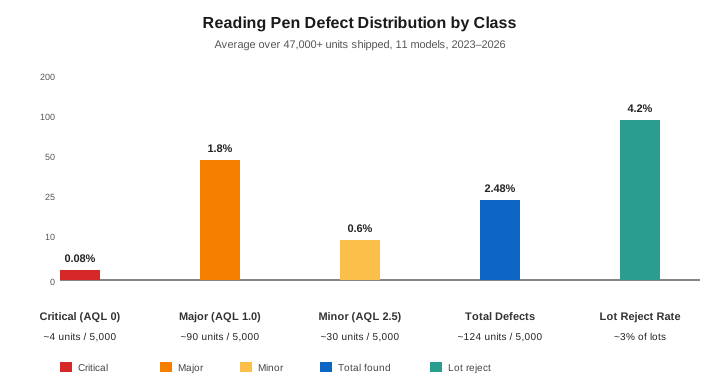
Across our 47,000-unit shipment data set, Critical defects account for 0.08% of total defects found at finished-goods inspection but 100% of the units quarantined. The top three Critical defects by frequency are C-07 (DOA), C-05 (compliance mark), and C-13 (serial number). The factory's own pre-shipment QC catches roughly 65% of Critical defects; the buyer's PSI catches the remaining 35%, which is exactly the reason the third-party inspector exists.
3. Major defects — the functional and brand-impact list
Major defects affect core function or visible brand presentation, but do not create immediate safety, regulatory, or choking-hazard risk. They use AQL 1.0 for child-use reading pens (most K7, KF1, L5, P2, Y6, T2 models with learning content) and AQL 1.5 for adult-use or general-purpose pens (B1, B2, F8, Q6, Q8 models).
| # | Defect | Where it appears | AQL class |
|---|---|---|---|
| M-01 | OID scan failure >20% miss rate on test cards | Pen tip sensor | Major 1.0 |
| M-02 | Button stuck or non-responsive on press | Any button | Major 1.0 |
| M-03 | LCD display dead pixel cluster (>3 pixels in 5 mm radius) | Display panel | Major 1.0 |
| M-04 | Battery loses >30% capacity in 30-day standby test | Battery | Major 1.0 |
| M-05 | Speaker distortion at 50% volume on 1 kHz test tone | Speaker | Major 1.0 |
| M-06 | Microphone recording fails (no audio capture) | Microphone | Major 1.0 |
| M-07 | USB charging intermittent (drops connection within 60 s) | USB port | Major 1.0 |
| M-08 | Visible scratch >5 mm on visible surface | Housing front or back | Major 1.0 |
| M-09 | Label misalignment >2 mm from approved layout | Housing back | Major 1.0 |
| M-10 | Loose screw or rattling part inside housing | Inside unit | Major 1.0 |
| M-11 | Headphone jack no audio output (3.5 mm) | Headphone jack | Major 1.0 |
| M-12 | Bluetooth pairing failure (will not pair with reference phone) | BT module | Major 1.0 |
| M-13 | Wi-Fi connection failure (will not join reference SSID) | Wi-Fi module | Major 1.0 |
| M-14 | Volume buttons reverse (up decreases volume) | Button mapping | Major 1.0 |
| M-15 | Power button requires >2 N force to actuate | Button feel | Major 1.0 |
| M-16 | Charging LED never indicates full charge | LED indicator | Major 1.0 |
| M-17 | Auto-shutdown at >30% battery (premature cutoff) | Firmware | Major 1.0 |
| M-18 | Audio playback skips or stutters during 10-min test | Speaker / firmware | Major 1.0 |
| M-19 | Touch zone (if present) unresponsive or registers ghost touches | Touch sensor | Major 1.0 |
| M-20 | Color of housing differs from approved sample by ΔE > 5 | Housing | Major 1.0 |
Across 47,000+ units shipped, Major defects account for roughly 71% of all defects recorded at finished-goods inspection. The top three Major defects by frequency are M-01 (OID scan), M-04 (battery capacity), and M-08 (visible scratch). OID scan failures cluster around batches where the sensor lens was ordered from a secondary supplier — a strong argument for single-source critical components and incoming IQC on every shipment of optical sensors.
4. Minor defects — the cosmetic list that still has to ship clean
Minor defects are cosmetic and do not affect safety, regulation, or core function. They use AQL 2.5, but on a 5,000-unit lot with sample size 125, that still means only 7 Minor defects are tolerated before lot reject. The Minor list below is long because end users notice cosmetic flaws, and a 5% Minor rate on a private-label order is a brand-damaging event even when every unit works.
| # | Defect | Where it appears | AQL class |
|---|---|---|---|
| m-01 | Light surface scratch <2 mm on non-visible surface | Housing side | Minor 2.5 |
| m-02 | Color variation ΔE 2–5 from approved sample | Housing | Minor 2.5 |
| m-03 | Packaging printing misalignment <1 mm | Inner box | Minor 2.5 |
| m-04 | Slight mold flash on non-accessible parting line | Housing seam | Minor 2.5 |
| m-05 | Smudge or fingerprint inside the housing (visible through grille) | Speaker grille | Minor 2.5 |
| m-06 | Micro-bubble in transparent window (diameter <0.5 mm) | OID window | Minor 2.5 |
| m-07 | Inner box dent on non-printed face | Inner box | Minor 2.5 |
| m-08 | Cable tie on USB cable slightly loose | USB cable | Minor 2.5 |
| m-09 | Manual print smudge on <5% of text area | User manual | Minor 2.5 |
| m-10 | Serial number font weight differs slightly from approved | Housing back | Minor 2.5 |
| m-11 | Slight click or rattle on shake that does not indicate loose part | Internal | Minor 2.5 |
| m-12 | Date code format mismatch (YYMMDD vs. YYYY-MM-DD) | Packaging | Minor 2.5 |
| m-13 | Lint or dust particle on housing before bagging | Housing | Minor 2.5 |
| m-14 | Protective film applied with air bubble <3 mm | Housing front | Minor 2.5 |
| m-15 | Inner box barcode scans but with 2 retries | Barcode | Minor 2.5 |
Minor defects are the easiest to argue over, because they are by definition cosmetic and the line between "ship it" and "reject it" is subjective. Annex A's value is that it removes the subjectivity by writing the size threshold (2 mm scratch), the color tolerance (ΔE 5), and the count threshold (5% text area) directly into the contract.
5. Visual: Defect distribution by class
The chart below shows the typical defect distribution we observe on a 5,000-unit reading-pen lot. Critical defects are rare but high-impact; Major defects dominate the count; Minor defects are frequent but individually cheap to fix. The asymmetry is the reason the classification system matters: a uniform AQL across all three classes would either reject too many lots on Minor (uncommercial) or accept too many Major defects (unsafe).
The pie chart below shows the same defect distribution as proportions of the total defect pool on a typical 5,000-unit lot. Critical defects are a sliver, Major defects dominate, and Minor defects are a meaningful but secondary slice. The visual reinforces why a single AQL across all three classes would fail commercially — Minor defects alone would consume 39% of the chart, and any buyer treating them like Critical would reject too many otherwise-acceptable lots.

6. The age-grading fork — child use vs. adult use
The classification list above is calibrated for child-use reading pens (the K7, KF1, L5, P2, Y6, T2 family of OID learning pens). For adult-use pens (B1, B2, F8, Q6, Q8 family of translation / professional pens), the Major AQL can be relaxed from 1.0 to 1.5 because the regulatory exposure is lower (no CPSIA, no EN 71 toy standard, no age-grading label). However, the Critical list does not change — a 1.5 mm exposed wire is dangerous to an adult too — and the Minor list does not change, because adult end users are equally intolerant of cosmetic flaws.
The school-tender case is the opposite. For school tenders, the Major AQL must stay at 1.0 (not 1.5) and the Minor AQL should be tightened from 2.5 to 1.5. The reason is reputational: a school that receives 30 scratched pens out of 5,000 will not reorder, even though the pens all work. The school procurement sensitivity to cosmetic defects is roughly 4× that of a commercial distributor.
7. How to handle disputed classifications
Three disputes come up so often we have developed a standard escalation path for each.
Dispute 1: "This scratch is 1.8 mm, not 2 mm." The factory argues the Minor threshold, the buyer argues it is over. Resolution: use a calibrated digital caliper, measure 3 points along the scratch, take the average. If the average is ≥2 mm, it is Minor but on the borderline of Major; if <2 mm it is below Minor and the unit passes. Document the caliper reading on the inspection report.
Dispute 2: "The label is offset 1.8 mm, within your 2 mm spec." Same caliper logic. If the offset is measured perpendicular to the housing edge, not along the diagonal, 1.8 mm is below Major and the unit passes. Always measure offset perpendicular to the reference edge.
Dispute 3: "This OID scan failure is <20%, within spec." The threshold is 20% miss rate over a 100-card test deck. The factory must produce the test deck and the inspector runs it. If the deck is unavailable, the inspector uses the factory's reference deck but counts the cards the buyer shipped separately. Tie-breaker: third-party lab test on 5 random units from the lot.
8. From classification to corrective action
A defect classification without a corrective action plan is just a list. The table below maps each class to the action the factory must take when the lot is rejected, and the timeline.
| Class | Factory action | Timeline | Cost bearer |
|---|---|---|---|
| Critical | 100% sort, replace defective units, re-inspect full lot | 3 working days | Factory |
| Major | Zone sort (sort by sub-batch), rework or replace defective units, re-inspect the affected zone | 2 working days | Factory |
| Minor | Rework affected units, re-inspect random sample of reworked units | 1 working day | Factory |
If the factory cannot complete the corrective action within the timeline, the buyer's PO should specify a daily delay penalty ($200 to $500 per day, capped at 10% of lot value). This is not punitive — it is the buyer's protection against the factory de-prioritizing rework in favor of the next PO. Our standard PO template includes this clause by default.
9. Three classification mistakes that cost real money
Mistake 1: Borrowing a tablet or phone defect list. Reading pens are not phones. The OID sensor, the optical codec, the age-grading label, the small-parts geometry — none of these appear on a tablet QC checklist. A defect list borrowed from phone manufacturing will miss 30% of reading-pen-specific defects. Use a reading-pen-specific list, like the one in this article.
Mistake 2: Treating the defect list as a one-time document. The defect list must be revised every 12 months or every 3 production batches, whichever comes first. New firmware, new battery suppliers, new housing molds, new OID book content all introduce new failure modes. The buyer who used the same defect list for 4 years is the buyer who missed the 2025 batch with the reversed volume button mapping.
Mistake 3: Letting the factory's internal classification override Annex A. Some factories have well-developed internal QC systems that are stricter than Annex A (good) or looser (bad). The PO must state Annex A is the binding reference. If the factory finds 12 Minor defects under Annex A and the lot passes, but their internal system rejects the lot for 15 Minor defects, the factory must still ship under Annex A. The opposite (factory internal passes, Annex A fails) is where the disputes concentrate.
10. Putting the defect list to work this quarter
Walk through this checklist on your next reading pen PO:
- Attach Annex A (the table above, formatted to your PO template) to every PO. No exceptions, no "we'll add it next time."
- Brief your third-party inspector on Annex A before the PSI. Walk the 80+ defects in 30 minutes. Pay the inspector's briefing time — it is the highest-ROI 30 minutes in the whole inspection.
- Track the class distribution across your last 5 lots. If Major defects trend up over 3 lots, trigger a factory audit before the next PO.
- Save every inspection report in a lot-level folder. When the factory disputes a defect 6 months later, you have the photo, the caliper reading, and the inspector's signature.
This is the workflow that turns the AQL system from an abstract standard into a working defense for your reading-pen inventory.
If you want Annex A pre-formatted to your PO template, our QA team will deliver it within 48 hours. Request a quote with your model (B1, B2, F8, K7, KF1, L5, P2, Q6, Q8, T2, or Y6), your destination market, and your target lot size, and we will return a draft PO with Annex A attached and the AQL clause already filled in.
11. FAQ
12. Related Reading
- Reading Pen AQL Sampling Plan (ISO 2859-1): The Statistical Defense
- Reading Pen Quality Control: AQL, Inspections, and Defect Classification
- How to Handle Reading Pen Defect Rate (AQL) with a Chinese Manufacturer
- Reading Pen Pre-Shipment Inspection
- Reading Pen Lab Testing Process
- Reading Pen Quality Claim Process
- Reading Pen Battery Customization
- Wholesale Reading Pens