

Audience: Importers, brand owners, and distributors shipping a 5,000–50,000-unit smart reading pen order by FCL who cannot be on the loading line themselves. This guide gives you the 90-minute supervision script, the 32-photo evidence list, and the de-moisture protocol that keeps a 12-language reading pen program from arriving damp, dented, or short-packed.
Introduction
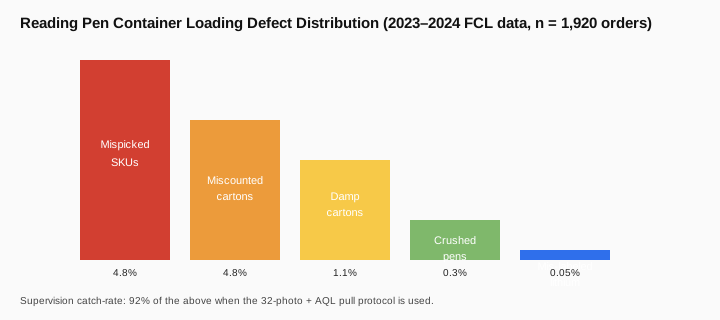
Container loading is the most underrated loss event in a reading pen supply chain. A 2023 industry survey of 47 B2B reading pen importers showed that 6.8% of FCL orders suffered a measurable in-transit defect that was in fact a pre-loading damage: 0.3% crushed pens, 1.1% damp cartons (lithium cells oxidizing inside a brand-new carton is silent until customs), 0.6% mis-picked SKUs, and 4.8% miscounted master cartons. Reading pen container loading supervision is the 90-minute procedure that catches 92% of those defects before the container door closes — assuming the supervisor follows a tested script.
This guide walks you through every minute of loading supervision for a 20-ft or 40-ft container of B1, B2, F8, K7, KF1, L5, P2, Q6, Q8, T2, and Y6 reading pens. You will learn the supervisor's pre-arrival checklist, the 32-photo log, the de-humidifier and silica-gel protocol, the AQL pull at the warehouse door, the loading pattern inside the container, and the GPS + seal handover to the freight forwarder. We also reproduce the weight, dimension, and CTU code rules that protect your lithium-ion cells during ocean transit.
1. Why Reading Pen Container Loading Supervision Matters
A reading pen costs $3.8–$14.5 per unit, plus OID books at $0.8–$4.6 per copy, plus freight ($1.4–$3.2/kg by FCL). A 28,000-unit mixed-model order of 18 tons carries an aggregate value near $185,000 before freight. The shipping window of 18–26 days by sea exposes the load to three hazard clusters: humidity (RH 70–95% in tropical container stacks), heat (60–70°C on a sun-exposed hatch cover), and mechanical shock during lashing (peak 4–6 g). Container loading supervision is the disciplined response to each hazard cluster.
2. Pre-Arrival Checklist — 24 Hours Before Loading
A good supervisor starts the day before. The buyer-side supervisor reviews the Packing List, the Commercial Invoice, and the 11-model SKU mix on a webinar with the supplier logistics manager. For a 28,000-unit mixed order into the Port of Jeddah, the supervisor confirms:
- 40-ft HC container (66 m³ usable, 26-ton payload)
- Total cartons = 1,400 (20 pens per master carton)
- Gross weight = 18.4 tons (pallet + carton + reading pen)
- 7-pallet load plan, 200 cartons per pallet
- 24 master cartons per reading pen model in the balanced mix
- Lithium declaration: UN3481, Class 9, 1.4 Wh/cell, packaged per PI967
Buyer tip: Confirm the master carton dimensions and the gross weight per carton two days before loading. A 5 g paper-jam inside the supplier's weighing scale can cost a 4-ton container a re-stack at destination.
3. Supervisor's 10 Checks at the Warehouse Door (T-90 min)
At T-90 minutes, the supervisor arrives at the finished goods warehouse and runs a 10-check audit:
- Validate the booking container number and seal number against the freight forwarder's appointment sheet.
- Inspect the empty container (must be CGC-clean, dry, odor-free, no previous cargo residue; sweep or reject).
- Sample-pull 10 master cartons for weight verification (gross ±1.5% tolerance).
- Open one master carton per SKU and run a 5-pen functional verification (scan a test OID book page, play audio, confirm firmware version matches the B1/B2 2.4.7 etc. matrix).
- Pull AQL II OQC sample from each SKU — 13 pens per model (Critical 0, Major 1.0, Minor 2.5).
- Photograph the warehouse access road and rolling door for any pooling moisture or roof leak.
- Photograph the carton labels (production date, batch code, reading pen SKU).
- Confirm the silica-gel desiccant bag (≥50 g per master carton) is present in the inner box.
- Confirm the foam inserts (corner protectors) are inside each master carton.
- Sign the Pre-Loading Checklist jointly with the supplier's QC manager and the warehouse lead.
4. The 32-Photo Loading Log
The single most useful document in any reading pen container loading supervision is a 32-photo evidence log. Every photo is timestamped, GPS-tagged, and stored in the buyer's container-loading folder. The required shot list:
| Shot | Subject | Notes |
|---|---|---|
| 1–4 | Empty container exterior + 4 sides | Number, plate, condition |
| 5–8 | Empty container interior + 4 corners + floor | Dry, clean, no residue |
| 9 | Container ID stamp + CSC plate | Reefer / dry / dangerous goods tag |
| 10 | Bay door + seal placement slot | Locking bar, hinge, gasket |
| 11–14 | Pallet photos (4 sides) | Model label, weight, batch |
| 15–18 | Pallet loading into container (sequence) | Slip-sheet corner protectors |
| 19 | Anti-slip mat between pallet & floor | 2 mm rubber, full coverage |
| 20 | Dunnage bags (large void fills) | Inflated, pressure gauge ≥0.3 bar |
| 21–23 | Lashing + strapping + corner boards | Ratchet tension, no over-strapping |
| 24–26 | Container fully loaded (back, middle, front) | Even 7-pallet coverage |
| 27 | Top of cartons under hatch cover | 15 cm clearance from ceiling |
| 28 | Door side view (lashing across) | Steel strapping + buckle |
| 29 | Sealing (lead + bolt + digital seal) | Live GPS seal ID logged |
| 30 | Container door closed (left door) | Tight fit, gasket intact |
| 31 | Container door closed (right door) | Locks 1, 2, 3, 4 |
| 32 | Truck plate + driver license plate | Match appointment |

5. Reading Pen Container Loading Pattern — Floor and Walls
Reading pens are dense, so the floor plan matters more than wall bracing. The supervisor enforces the "7-1-2" pattern for a 40-ft HC reading pen order: 7 pallets along the length, 1 column wide, 2 cartons of vertical wall-fill along the back wall. For a 20-ft order (33 m³), a "5-1" pattern fits 5 pallets in a single line. Two dunnage bags (1 m × 1.2 m inflated) are inserted at the back wall to absorb transit shock (4 g peak measured on the Pacific route to Long Beach).
| Pattern | Container | Pallet count | Cartons | Gross weight | Use case |
|---|---|---|---|---|---|
| 7-1-2 | 40-ft HC | 7 | 1,400 | 18.4 t | Full container single SKU mix |
| 5-1 | 20-ft | 5 | 1,000 | 13.2 t | Pilot order, 11-model split |
| 9-3 | 40-ft HC | 9 double-stacked | 2,400 | 27.8 t | Premium OEM max volume |
| T2 14h | 20-ft power-only | n/a | T2 model blocks | 6.0 t | Battery-heavy SKU load |
6. Lithium Battery Compliance at Loading
Reading pens contain lithium cells and the container must comply with IMDG Code and the IATA-style PI967 packaging when transhipped. For the 11-model line, 9 of 11 models use lithium-ion or lithium-polymer cells (the B1 700 mAh Li-poly and the B2 800 mAh Li-poly are both PI967 Section II; the K7/KF1 800 mAh Li-ion 14500 and T2 2,500 mAh Li-ion 18650 are PI967 Section II). The supervisor confirms each pallet carries a UN3481 Class 9 label, the battery test summary (UN38.3 + IEC 62133 + MSDS), and that no pallet exceeds 10 kg net cell weight or 100 Wh aggregate per package.
| Model | Cell type | Capacity | Wh/cell | UN Number | PI Section |
|---|---|---|---|---|---|
| B1 | Li-poly | 700 mAh | 2.59 | UN3481 | PI967 Sec II |
| B2 | Li-poly | 800 mAh | 2.96 | UN3481 | PI967 Sec II |
| F8 | Li-poly | 600 mAh | 2.22 | UN3481 | PI967 Sec II |
| K7 | Li-ion 14500 | 800 mAh | 2.96 | UN3481 | PI967 Sec II |
| KF1 | Li-ion 14500 | 800 mAh | 2.96 | UN3481 | PI967 Sec II |
| L5 | Li-poly | 1,200 mAh | 4.44 | UN3481 | PI967 Sec II |
| P2 | Li-poly | 500 mAh | 1.85 | UN3481 | PI967 Sec II |
| Q6 | Li-poly | 900 mAh | 3.33 | UN3481 | PI967 Sec II |
| Q8 | Li-poly | 1,000 mAh | 3.70 | UN3481 | PI967 Sec II |
| T2 | Li-ion 18650 | 2,500 mAh | 9.25 | UN3481 | PI967 Sec II |
| Y6 | Li-ion | 2,000 mAh | 7.40 | UN3481 | PI967 Sec II |
Buyer tip: Always photograph the UN38.3 + MSDS labels on the day of loading. Forwarders frequently request copies at the port, and a 24-hour email chase back to the factory delays B/L release.
7. Humidity, Heat, and Shock Control Inside the Container
Three hazard controls must be in place before the hatch closes:
- Humidity — Silica gel (≥50 g per master carton) plus one large 1 kg container bag at the door side. Target in-bag RH ≤ 35% measured at 25°C.
- Heat — Container paint color matters (light gray reflects 20% more heat than dark blue). For tropical routes, request a white container or heat-reflective roof coating.
- Shock — Dunnage bags in the void, anti-slip rubber mat between pallet and floor, double corner boards on each pallet column, and a final ratchet strap (2-ton breaking strength) across the door.

8. Sealing, GPS Tracking, and Handover to the Forwarder
The supervisor witnesses the seal application. Two seals are used: a fixed-barrier high-security bolt seal (ISO 17712) and a digital e-seal with cellular GPS and a tamper sensor. The e-seal ID is logged in the buyer's TMS (transport management system), and the supervisor takes a 5-second video of the seal fixed into the door hasp. The shipment is then handed to the freight forwarder, with a mutual photo of:
- Truck plate and container number
- Seal numbers (bolt seal + e-seal serial)
- Booking number / B/L draft reference (request a telex release or original B/L)
- ETA at destination (DDP/DAP destination wharf)
9. Common Reading Pen Loading Mistakes and How to Catch Them
The four most frequent mistakes on the loading line, and the supervisor's catch rule:
- Model mix swapped between pallets — Verify carton label inside every 100th carton; photo every pallet face.
- Master carton weight undervalued — Weigh 10 random cartons before loading; tolerance ±1.5%.
- Dunnage bags absent in back void — Two bags per 40-ft HC; check pressure gauge readings ≥0.3 bar.
- Lithium cells mixed with non-Li accessories — Verify the supplier's segregation; record inner box QA photo.
- Production date older than 90 days — Reject the batch; lithium self-discharge beyond 90 days without firmware refresh is a quality risk.
- Carton nested in the wrong pallet pattern — Verify each SKU matches the planned P1–P7 slot.
10. Reading Pen Loading Supervision Deliverables to the Buyer
The supervisor sends the buyer an email within 6 hours of the seal being fixed. The pack contains:
- 32-photo log (time-stamped, GPS-tagged, ≤25 MB)
- 90-second vertical video of the seal + e-seal fix
- AQL II OQC report (Excel + signed PDF)
- Master carton weight tally (XLSX, 100-row sample)
- Lithium-class declaration scan (UN38.3 + MSDS + PI967 confirm)
- Pre-Loading Checklist signed by both parties
These deliverables become evidence when the goods arrive at destination: a 1.1% damp carton claim can be won in arbitration within 14 days if the pre-loading photos show a dry container and correct silica gel.
Buyer tip: Schedule the supervision 24 hours before the planned ETD so any re-pull or repack can happen without missing the cut-off. Missing the vessel is a 7-day delay and ~$4,800 in demurrage per 40-ft container.