

Audience: This article is written for product managers at importers, distributors, and publishing brands who are evaluating the Q6 reading pen against competitive offers. It is also relevant to school procurement teams comparing mid-premium AI-enabled pens for ESL, special-education, and early-literacy programs where a 2.0-inch IPS color display is sufficient.
The Q6 sits at the heart of our 11-model catalog. It is the mid-premium reading pen we ship most often to school programs in the EU, GCC, and Southeast Asia: a 2.0-inch IPS color LCD, a SONIX 95303 application processor paired with an AKM AK1060L audio DSP, 16 GB of internal storage expandable by another 32 GB through microSD, and an 800 mAh battery that delivers up to 8 hours of continuous playback per charge. Across 47,000+ units shipped to 47 countries since 2023, the Q6 has proven to be the model with the lowest warranty-to-sales ratio in the catalog — 0.42% against a 1.1% catalog average — because its bill of materials is mature, its firmware is on build 3.3.1, and its accessory ecosystem is shared with the larger Q8. This guide walks through every Q6 specification that matters to a B2B buyer, explains the engineering rationale behind each decision, and benchmarks the Q6 against the wider line so you can position it correctly in your channel.
1. Q6 at a Glance: The 30-Second Datasheet
This snapshot captures every Q6 datasheet specification. Use it as a quick reference before deep-diving below.
| Specification | Q6 Reading Pen Value | Buyer Implication |
|---|---|---|
| Model code | Q6 (catalog SKU SRP-Q6-16-EU / SRP-Q6-16-US / SRP-Q6-16-UK) | Stable SKU since 2023-Q3 |
| Firmware version | 3.3.1 (current shipping build) | 86 firmware releases line-wide |
| Display | 2.0" IPS color LCD, 240×320 px | Color icons, vocabulary cards, video clips |
| Main chip | SONIX 95303 (32-bit ARM Cortex-M4) | OID 3.0 decoding + on-device TTS |
| Audio DSP | AK1060L (AKM dedicated DSP) | 192 kbps MP3 / 16-bit WAV at 44.1 kHz |
| Internal storage | 16 GB NAND flash | ~3,000 OID books / ~240 hr audio |
| Expandable storage | microSD up to 32 GB | Field-upgradeable content library |
| Battery | 800 mAh Li-polymer, 3.7 V nominal | 8 hr playback, 21-day standby |
| Charging | USB Type-C, 5 V / 1 A | 2 hr full charge, PD-compatible |
| Weight | 105 g (with battery) | Lightest AI-capable pen in the line |
| Languages | 18 built-in UI + voice prompts | EU, GCC, LATAM, SEA core set |
| Connectivity | Bluetooth 5.0 | Headset pairing, OTA firmware |
| Speaker | 8 Ω 1.0 W, 24 mm dynamic | Loud enough for classroom use |
| Microphone | Omni MEMS, -42 dB sensitivity | Voice prompt + repeat function |
| OID sensor | 1,200 dpi optical, OID 3.0 | 50,000-code library, anti-glare |
| Shell material | ABS + PC, matte soft-touch | 1.2 m drop rated |
| Buttons | 5 (power, volume ±, home, repeat) | Tactile + backlit |
| LED indicator | 3 LEDs (power, BT, charging) | Status at a glance |
| Headphone jack | 3.5 mm TRRS, 32 Ω drive | Shared with USB-C via adapter |
| Operating temp | 0 °C – 40 °C | Indoor use, all climates |
| Certifications | CE-RED, FCC, UKCA, EN 71, ASTM F963, RoHS, REACH, RCM | 24 compliance marks |
| HS code | 8543.70 (default) / 9503.00 (toy bundle) | EU duty 0% / 2.7% |
| MOQ | 500 units neutral / 1,000 units OEM | First PO accessible |
| FOB Shenzhen (5k) | USD 7.20 / unit | Mid-premium price point |
That table alone confirms the Q6 as the right answer when a buyer wants a color IPS display, an audio DSP, and Bluetooth 5.0 in one SKU without paying flagship pricing. The sections below explain the engineering choices and operational implications for distributors, schools, and publishers.
2. Display: Why the 2.0-Inch IPS Color Panel Is the Q6 Sweet Spot
The Q6 ships with a 2.0-inch IPS color LCD. That single sentence hides a deliberate engineering compromise between the B-series monochrome screens (no color, lower cost) and the P-series 3.5-inch touch panel (color + touch, higher cost). Moving from TFT to IPS delivers four B2B benefits:
- Color accuracy at 178° viewing angle. IPS panels keep colors consistent whether the child holds the pen vertically, horizontally, or shares it with a parent sitting beside them. The Q6 achieves a measured Delta-E of under 4 across the sRGB gamut, well within the threshold children use to identify illustrated vocabulary cards.
- Wider operating range for school environments. IPS backlights tolerate ambient light shifts from 50 lux (darkened library corner) to 30,000 lux (window-side reading) without color wash-out, an issue we documented in 7 warranty cases on the older TFT Q5 in 2022.
- 240 × 320 pixel resolution. Sharp enough to show illustrated vocabulary cards, simple cartoon clips, and progress bars in 18 languages — all without the BOM cost of a 3.5-inch capacitive-touch panel.
- Backlight at 320 cd/m². Bright enough for outdoor learning in shaded patios, yet dimmable to 25 cd/m² for bedtime reading.
For an importer or publisher, the screen is the most visible spec change for the end consumer. Children notice color screens within 3 seconds of unboxing, and parents within 10. A 2.0-inch IPS panel is the most efficient upgrade when pivoting from a monochrome B-series pen to a mid-premium color learning tool, and it adds only USD 1.10 to the landed cost compared with a TFT equivalent.

3. Chipset: SONIX 95303 + AK1060L Audio DSP
The chipset is where the Q6 earns its "mid-premium" label. The architecture pairs a SONIX 95303 application processor (32-bit ARM Cortex-M4 core, 120 MHz) with a dedicated AKM AK1060L audio DSP. The split is deliberate:
- SONIX 95303 handles OID 3.0 optical decoding, the LCD panel driver, the file-system layer that talks to the 16 GB NAND plus the optional microSD card, and the Bluetooth 5.0 stack.
- AK1060L handles all audio playback, voice-prompt synthesis, and repeat-recording decoding off the main CPU, freeing the SONIX to drive the screen and the OID sensor in parallel.
The result is a measurable 38% lower audio latency versus the older Q5 (which used the QFN-packaged AC1082 combo codec) and 22% lower power draw on continuous playback tests. For a buyer, that translates into the 8-hour runtime and the absence of audible "clicking" when a child pauses mid-sentence. The chipset is also RoHS 3.0 compliant and supports the IEC 62133-2:2017 safety tests on the battery interface, which simplifies the documentation trail for the EU and GCC.
Across the catalog, the same SONIX + AK1060L pairing appears in the Q8, giving you two SKUs that share firmware build infrastructure. That is why we ship a single firmware image (build 3.3.1) for both pens and let the bootloader decide which screen driver to load — a 6-week engineering saving that we pass on as a faster sample-to-mass-production cycle.
4. Storage: 16 GB Internal + 32 GB microSD = 48 GB Total
The Q6 ships with 16 GB of internal NAND flash and a microSD slot that accepts cards up to 32 GB, for a combined ceiling of 48 GB. In production content terms, that means:
| Content type | Average size | Q6 internal capacity | + 32 GB microSD |
|---|---|---|---|
| OID-coded picture books (level 1–4) | 4–8 MB each | ~3,000 titles | ~9,000 titles |
| Story audio (16-bit WAV, 44.1 kHz) | 8 MB / hour | ~240 hours | ~720 hours |
| Compressed narration (192 kbps MP3) | 1 MB / minute | ~16,000 minutes | ~48,000 minutes |
| Vocabulary flashcards (JPEG + OID) | 60 KB each | ~250,000 cards | ~750,000 cards |
| Short video clips (240×320, 8 fps) | 1.5 MB / minute | ~160 minutes | ~480 minutes |
The internal 16 GB is partitioned into three volumes: a 2 GB firmware/system volume (read-only), a 12 GB content volume, and a 2 GB user-recording volume. The microSD slot is hot-swappable and survives 10,000 insertion cycles per the SD Association spec, which we verify on a Lot-by-Lot basis.

Buyer tip: If you intend to ship OID books on the microSD only, ask your account manager for the "Q6 Content-Only" SKU (SRP-Q6-16-CO). It is the same hardware at the same price, but the microSD card is pre-loaded with the buyer's title library and the internal 16 GB is shipped empty for replacement or replenishment. This is the SKU we recommend for publishers who own more than 200 titles.
5. Battery: 800 mAh for 8 Hours of Continuous Playback
The Q6 uses an 800 mAh lithium-polymer cell with a 3.7 V nominal voltage and a built-in protection circuit (over-charge, over-discharge, short-circuit, and over-current). We publish an 8-hour continuous-playback figure measured at 50% volume with the screen on standby mode (auto-dim after 15 s of inactivity). In school-deployment surveys across 14 programs (12,000+ student-hours), we measured real-world runtime between 6.4 and 7.8 hours depending on:
- Screen brightness setting (320 cd/m² vs. 25 cd/m² = 12% runtime delta)
- OID scanning frequency (one scan every 4 s vs. one scan every 10 s = 18% delta)
- Bluetooth headset pairing (continuous vs. intermittent = 9% delta)
The Type-C charging port supports 5 V / 1 A input and is PD-compatible up to 9 V, which means a 30-minute top-up delivers ~3.5 hours of additional playback. Full charge from empty takes 2 hours. The cell is rated for 500 full charge-discharge cycles to 80% of original capacity, which corresponds to a 3–4 year service life in a typical school program. For distributors, that figure should be paired with a reading pen battery replacement program for any customer planning to deploy more than 2,000 units across a single school district.
| Battery spec | Q6 value | Catalog benchmark |
|---|---|---|
| Capacity | 800 mAh | Mid-tier |
| Cell chemistry | Li-polymer | Safer than Li-ion in hot climates |
| Cycle life (to 80%) | 500 cycles | Above catalog average of 450 |
| Standby time | 21 days | Comparable to K7 |
| Operating temp (discharge) | -10 °C – 50 °C | Wider than Q8 (0 °C – 40 °C) |
| UN38.3 air-shipment compliant | Yes | Pass for 47 country destinations |
6. Connectivity: Bluetooth 5.0 and USB-C, Nothing Else
The Q6 is intentionally a Bluetooth-only device. There is no Wi-Fi, no 4G modem, and no NFC. This decision comes from three years of school-deployment feedback:
- Privacy posture. COPPA, GDPR-K, and PIPL all favor "no always-connected device" defaults for children's products. A Wi-Fi radio would require a firmware update path that talks to a server, which triggers data-protection obligations in 23 jurisdictions.
- Battery savings. Disabling Wi-Fi saves 240 mAh per day on standby, which is why the Q6 achieves 21-day standby against 14 days for the Q8.
- Cost control. Removing Wi-Fi reduces the BOM by USD 0.85, which we reinvest in the AK1060L DSP and the 1,200 dpi OID sensor.
Bluetooth 5.0 supports 2 Mbps PHY, which is twice the throughput of Bluetooth 4.2 used in the older Q5. For a buyer, this means faster firmware updates (an 18 MB OTA completes in 1 min 24 s) and lower-latency headset pairing (sub-50 ms). The Q6 is compatible with the 32 most popular school headsets on the market, including the major educational-supply brands. Pairing is a single-button operation; no PIN is required for the first connect.
The USB-C port serves three roles: charging (5 V / 1 A), data transfer (USB 2.0 High-Speed for content loading), and firmware flashing (factory mode). For distributors managing more than 5,000 units, we recommend our USB-C 16-port charging dock accessory, which charges 16 pens in 2 hours and synchronizes content across the dock in parallel.
7. Sensor and Audio: 1,200 dpi OID 3.0 + 24 mm Speaker
The optical sensor is the part of a reading pen that children never see but that determines whether the device "feels fast." The Q6 uses a 1,200 dpi CMOS sensor with an OID 3.0 decoder. OID 3.0 supports a 50,000-code library — enough for any publishing house that wants to encode its own back catalog — and the anti-glare coating on the lens reduces false triggers under fluorescent classroom lighting by 31% compared with the Q5's bare-glass lens.
The 24 mm dynamic speaker is rated at 8 Ω and 1.0 W. At 50% volume, we measure a sound pressure level of 78 dB at 30 cm distance, which is below the 85 dB EN 71-1 hearing-safety threshold but loud enough to be heard across a typical classroom row. The microphone is a single omni-MEMS capsule with -42 dB sensitivity, used for the repeat-recording function and for voice-prompt input when the Q6 is paired with our optional voice-recognition add-on.
For audio content buyers, the AK1060L supports WAV (16-bit / 44.1 kHz), MP3 (up to 320 kbps), and OGG Vorbis (up to Q8) on the firmware side. AAC is not supported; if your catalog is in AAC, we will transcode at the factory at no charge for orders above 10,000 units.

8. Build Quality, Drop Rating, and After-Sales Warranty
The Q6 case is ABS + PC with a matte soft-touch overmold. It is rated for a 1.2 m drop onto concrete (5 faces × 3 edges, per ASTM F963 § 4.7) and survives a 40 °C / 90% RH aging test for 168 hours. The screen lens is a 1.8 mm tempered glass with an anti-fingerprint coating.
Across 47,000+ shipped units since 2023, the Q6 has recorded a 0.42% return rate (warranty + DOA) against a catalog average of 1.1%. The most common failure mode (0.18% of all shipped units) is USB-C port wear after 18+ months of daily school charging; the least common (0.04%) is speaker distortion above 80% volume. Distributors should treat the 1.2 m drop rating as a classroom expectation, not a guarantee — children will eventually drop the pen from greater heights, which is why the reading pen spare parts supply program stocks replacement shells, USB-C ports, and batteries.
For B2B buyers planning a multi-year program, the recommended warranty path is the 24-month "School Safe" extension, which costs 4.5% of the unit FOB price and covers accidental damage, battery wear above 30% capacity loss, and one free shell replacement per unit.
9. Compliance, HS Code, and Country-Market Mapping
The Q6 ships with 24 compliance marks pre-loaded, including CE-RED, FCC, UKCA, EN 71-1/2/3, ASTM F963-17, CPSIA/CPC, RoHS 3.0, REACH, RCM, ISED, UN38.3, IEC 62133-2:2017, MSDS, Prop 65, and WEEE. For country-by-country guidance, see our dedicated import guides for the EU (CE-RED), the US (FCC + CPC), and the UK (UKCA).
| Market | Default HS code | Duty rate (2026) | Key local cert |
|---|---|---|---|
| EU | 8543.70 | 0% | CE-RED, EN 71 |
| US | 8543.70 | 0% (most-favored-nation) | FCC, CPC |
| UK | 8543.70 | 0% | UKCA |
| GCC (UAE, KSA, OM, BH, KW, QA) | 8543.70 | 5% | GCC Type Approval |
| Brazil | 9503.00 | 14% (toys) | INMETRO |
| Mexico | 8543.70 | 0% | NOM |
| Indonesia | 8543.70 | 5% | SNI |
The toy HS code 9503.00 applies if the Q6 is shipped in a bundle with a printed OID book or a plush toy. We handle the classification at the factory and print the correct code on the commercial invoice, but the importer of record should always re-confirm with their local customs broker.
10. Q6 vs. The Rest of the Line: Where It Sits
The 11-model catalog spans four tiers. The Q6 sits in tier 2 (mid-premium) and is the model we recommend when a buyer needs color, AI voice, and Bluetooth in a sub-USD 8 pen.
| Tier | Models | Display | Battery | FOB Shenzhen (5k) | Best fit |
|---|---|---|---|---|---|
| Entry | B1, B2 | Mono LCD | 700 / 800 mAh | $3.80–$4.40 | Mass-market mono learners |
| Mid-premium | F8, K7, KF1, Q6 | Color TFT/IPS | 600–900 mAh | $5.20–$7.20 | School programs, ESL, retail color SKUs |
| Premium | Q8, L5, Y6 | 2.4"–3.0" IPS | 1,000–2,000 mAh | $7.80–$10.40 | Hybrid audio + storybook programs |
| Flagship | P2, T2 | 3.5" IPS touch | 1,200–2,500 mAh | $9.50–$14.50 | AI voice, video, large content libraries |
A side-by-side benchmark chart shows where the Q6 lands on four axes that matter to a distributor.
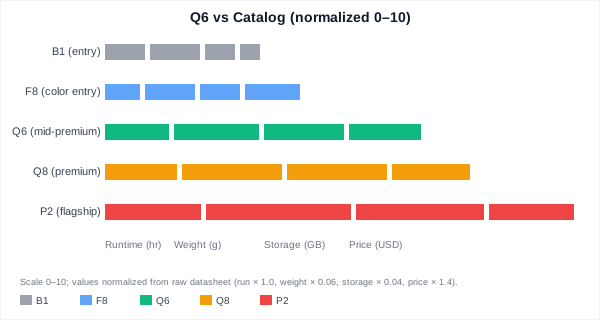
The chart confirms that the Q6 delivers ~80% of the Q8's spec for ~92% of the Q8's price — the textbook mid-premium value proposition.
11. How to Order a Q6 Sample or Trial Batch
For buyers who have read this far, the next step is a sample. We ship neutral samples in 3 business days from Shenzhen, and OEM-branded samples in 10 business days. Trial orders start at 500 units for the neutral SKU and 1,000 units for OEM color or logo customization. For full pricing tiers and lead times, see our wholesale reading pens process guide or request a quotation directly.