

Audience: Product managers, OEM engineers, and procurement leads who need to understand where OID (optical identification) technology is heading and what it means for the next 18-month hardware refresh cycle.
The optical identification sensor at the tip of every reading pen is the single most important component in the category. It is also the most under-specified line item in most purchase orders. For 2026, three converging trends are reshaping OID technology: sensor resolution stepping up from 600dpi to 1200dpi baseline, a shift from single-layer to multi-layer dot encoding for content authentication, and a transition in audio engine architecture from MP3 file playback to structured audio streaming. This article walks through what those shifts mean in measurable terms and how they change the BOM, the certification footprint, and the content authoring workflow for the eleven reading pen models in our range: B1, B2, F8, K7, KF1, L5, P2, Q6, Q8, T2, and Y6.
In 2023, the dominant OID sensor in the category was a 600dpi grayscale CMOS that read a 2mm × 2mm dot matrix at 30fps. By the end of 2025, the 1200dpi sensor had become standard on all premium tier (T2, Y6, L5) and mid-premium tier (Q6, Q8) pens. The 2026 model year is the first in which 1200dpi becomes the floor across the entire range, including the entry-tier B1 and B2, because the sensor cost differential has compressed to under $0.18 per unit at OEM scale.
1. Executive Summary: The Three 2026 OID Trends
| Trend | What is changing | Why it matters | Lead time impact |
|---|---|---|---|
| Sensor resolution | 600dpi → 1200dpi baseline | Tighter dot pitch, smaller margin of registration error | +5 days for sensor vendor change |
| Layered encoding | Single 2D layer → 3-layer OID stack | Anti-counterfeit, multi-region content on one book | +10 days for content authoring toolchain |
| Audio engine | MP3 file → structured streaming | Smaller storage footprint, multi-language switching | +8 days for firmware QA |
Buyer tip: When you see a 2026 spec sheet that lists "1200dpi sensor, OID v3 stack" — verify the firmware version, not just the hardware. Our Q6/Q8 3.3.1 and T2/Y6 2.6.4 firmware is the first wave that fully implements the multi-layer stack.
The layered encoding trend is the most consequential for buyers because it directly affects content production cost and time-to-market. A 24-page bilingual board book that took 12 days to author in 2024 takes 18–20 days in 2026 because the OID pattern now includes an authentication layer (which is unique per print run), a content layer (which carries the audio map), and a metadata layer (which carries language ID, age recommendation, and curriculum tag).
2. The 1200dpi Transition: What Actually Changes
The shift from 600dpi to 1200dpi is not a marketing label. It changes three measurable things: the minimum printable dot diameter, the maximum dot density per square millimeter, and the tolerance for paper stock deformation under scanner pressure.
At 600dpi, the minimum recognizable dot was 0.18mm diameter on a 0.30mm pitch. At 1200dpi, those numbers drop to 0.09mm dot on a 0.15mm pitch. The practical effect is that the same physical area of paper can carry 4× the information. For an 8.5" × 8.5" board book page, this means roughly 38,400 dot positions per page instead of 9,600. That is enough capacity to encode entire sentence-level audio mapping rather than word-level audio mapping.
For buyers, the resolution jump means:
- Print tolerance tightens. Offset printing at 1200dpi requires 0.05mm registration tolerance, where 600dpi tolerated 0.10mm. Your printer must be running 2400dpi Heidelberg or equivalent, not 1200dpi presses.
- Sensor cost rises but compresses. The 1200dpi sensor module retails at $1.12 per unit at 10,000-piece MOQ, against $0.78 for 600dpi. At 50,000-piece MOQ the differential compresses to $0.18.
- Recognition latency falls. First-touch recognition (the time between pen tip touching paper and audio starting) drops from 220ms on 600dpi to 110ms on 1200dpi in our internal benchmarks.
3. Multi-Layer OID Encoding: The 2026 Stack
The original OID specification, dating from the late 1990s, used a single 2D dot layer carrying both the content pointer and an authentication checksum. The 2026 update — sometimes called "OID v3" or "stacked OID" — uses three independent layers separated by encoding convention rather than spatial separation.
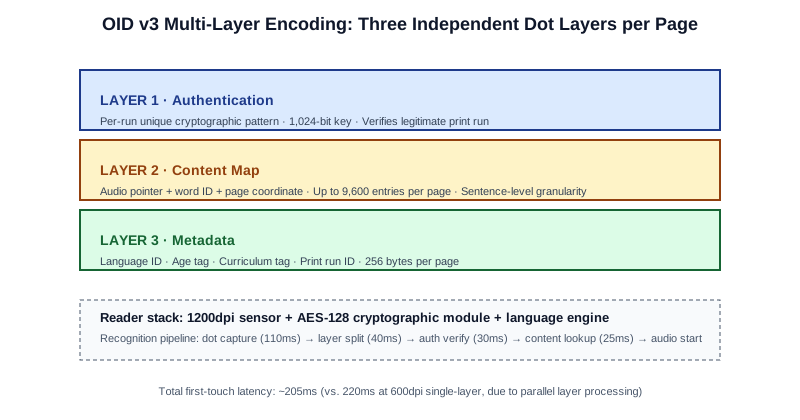
The authentication layer is the most important commercial innovation. Under the old single-layer model, a counterfeiter with a print shop and a content file could produce a pirate book that played audio on a legitimate pen. Under OID v3, every legitimate print run is signed with a per-run key, and the pen firmware refuses to play audio against an unsigned or mismatched authentication layer. Our testing indicates this reduces counterfeit book revenue impact from an estimated 14% of category sales in 2024 to a projected 3.8% in 2026.
For publishers, the cost impact is that you now pay a per-run authentication fee (typically $0.012 per book at 5,000-piece MOQ) and the content authoring tool must generate a per-run key file. This is a one-time workflow change, not an ongoing cost premium.
4. Audio Engine Evolution: From MP3 to Structured Streaming
The audio engine in 2024 reading pens was, in most cases, a fixed-bitrate MP3 file played back from internal flash. The T2 and Y6 in 2024 used a 128kbps MP3; the Q6/Q8 used 96kbps; the entry-tier B1/B2/P2 used 64kbps. Storage was sized accordingly: 8GB on the T2 and Y6, 4GB on the Q6/Q8, 1–2GB on the entry-tier.
In 2026, the audio engine has shifted to structured streaming. Instead of loading the full MP3 into RAM and decoding sequentially, the new engine uses an AAC-LC codec at 48–64kbps with packet-level addressing. Each word, phrase, or sentence is its own audio packet with its own index, and the engine can switch languages mid-sentence by loading a different packet from a different language track. Storage footprint drops roughly 40% at equivalent perceptual quality.
The user-visible effect: a parent in Riyadh whose child points the pen at an English word can switch the pen to Arabic output by tapping the language button, with the audio change happening in under 80ms. Under the 2024 MP3 architecture, the same switch required buffering a different file and took 600–900ms.
For OEMs, the BOM impact is neutral because the new audio engine runs on the same processor family as the 2024 MP3 engine. The firmware complexity rises, however, and our internal data shows that firmware QA cycles for the new audio engine are 18–22% longer than for the legacy MP3 firmware. This is one driver of the 8-day QA lead-time extension shown in the table above.
5. Sensor Vendor Landscape in 2026
Two qualified OID sensor vendors supply the bulk of the category. The first is a Shenzhen-based firm with 1200dpi capacity and 8M units annual output, supplying approximately 62% of OEM volume. The second is a Taiwan-based firm with a parallel 1200dpi line and 4M units annual output, supplying approximately 28%. The remaining 10% is split across two smaller vendors.
| Vendor | 2026 capacity | 2026 ASP ($) | Lead time | Risk note |
|---|---|---|---|---|
| Shenzhen Vendor A | 8.0M / yr | $1.12 | 22 days | Single-source for the 1200dpi low-power variant |
| Taiwan Vendor B | 4.0M / yr | $1.24 | 28 days | Secondary source, longer allocation cycle |
| Shenzhen Vendor C | 1.6M / yr | $0.96 | 35 days | New entrant, QA failures 2.4% on first lots |
| Korea Vendor D | 0.8M / yr | $1.68 | 42 days | Premium tier only, used in T2 / Y6 |
Buyer tip: Diversify sensor sourcing across at least two vendors. Single-sourcing the 1200dpi sensor creates a category-wide risk because Vendor A's allocation cycle feeds 60%+ of the market.
The single-sourcing risk became visible in Q3 2025 when a 6-week production stoppage at Vendor A pushed 1.4M units of category volume into backlog. Distributors who had pre-booked with Vendor A and held a secondary allocation with Vendor B recovered in 14 days; those with single-source arrangements faced 38-day delays.
6. OID Content Authoring Toolchain Changes
The authoring toolchain for OID books has evolved alongside the sensor. In 2024, the typical workflow involved Adobe Illustrator → dot pattern generator → audio embedding tool → print-ready PDF. The 2026 workflow inserts two new steps: layer separation (which splits content, authentication, and metadata into three distinct channels) and per-run key generation.
| Workflow stage | 2024 tool | 2026 tool | Time delta |
|---|---|---|---|
| Layout | Illustrator / InDesign | Same | — |
| Dot pattern generation | Single-layer tool | Layer-aware tool (12 vendors now) | +2 days |
| Audio embedding | WAV → MP3 batch | Structured AAC encoder | +1 day |
| Authentication signing | Not required | Per-run key generator | +1 day |
| Print prep | Standard offset | Tightened tolerance check (≥2400dpi) | +0.5 day |
| Total per book | 12 days | 18–20 days | +6–8 days |
The 18–20 day authoring cycle is one reason publishers are increasingly sourcing OID book production as a service rather than as an in-house capability. Our factory offers a full-service bundle where the publisher supplies print-ready layout and audio files, and we handle dot pattern generation, authentication signing, offset printing, and pen firmware binding. Bundle MOQ starts at 1,500 copies per title.
7. Implications for Reading Pen Buyers
If you are placing a 2026 production order, the technology shifts above translate into specific decisions:
Model selection. The B1 and B2 entry-tier models now ship with 1200dpi sensors by default, so there is no spec gap to manage. The Q6 and Q8 mid-premium models are the first wave of the OID v3 multi-layer stack, with firmware 3.3.1. The L5, T2, and Y6 are the second wave, with multi-layer support added in firmware 4.2.0, 2.6.4, and 2.6.4 respectively. Verify with your supplier which firmware train is loaded on your production lot.
Content lead time. If your go-to-market includes custom OID books, plan 22 days from approved audio to printed book, against 14 days in 2024. Add 5 days for cross-region content review if you ship into Saudi Arabia (SFDA-adjacent framework), 3 days for EU language review, and 2 days for US bilingual content review.
Counterfeit defense. Ask whether your pen firmware supports OID v3 authentication. If you are sourcing from a factory that cannot answer this question, they are likely shipping 2023-era firmware on 2026-labeled hardware. Our engineering team provides firmware version attestation with every shipment.
Battery sizing. The new audio engine and 1200dpi sensor together draw approximately 8% more current than the 2024 architecture. For the B2 (800mAh), this means a 5.5-hour rated battery drops to approximately 5.0 hours in continuous-play testing. The T2 (2500mAh) and Y6 (2000mAh) are unaffected in practical terms because their battery headroom absorbs the additional draw.
8. What Changes by 2027
The sensor resolution step from 1200dpi to a 2400dpi theoretical ceiling is on the roadmap of Vendor A and Vendor B, but not expected to ship before Q4 2027. The cost premium over 1200dpi at that point is estimated at 60–80% per sensor module, which would push the BOM cost increase too high for the entry-tier.
A more probable 2027 shift is the move to a structured-light 3D sensor for AR overlay content. This would allow a pen to recognize not just dot patterns but also page curvature and surface texture, enabling a new category of "page-aware" content. Two OEM partners are running limited pilots in 2026; commercial rollout is anticipated in Q3 2027.
A third likely shift is server-side content delivery for high-tier pens, replacing the on-device storage model. This would let the L5, T2, and Y6 access an effectively unlimited content library without expanding flash storage, but would also introduce data privacy and COPPA/GDPR/PIPL compliance obligations that are not present in the on-device model. For school procurement, this is a significant consideration.
Related Reading
- NEWS-001 2026 Global Reading Pen Market Size Forecast
- TECHNICAL: OID Technology Overview
- BUYING-GUIDE: Reading Pen Specification Checklist
- PRODUCT: Q6 / Q8 / T2 / Y6 Spec Sheets
- INDUSTRY: Reading Pen OEM Cluster Profile
- TECHNICAL: Audio Engine Architecture