

Audience: This case study is written for NGO program directors, ministry of education procurement staff, philanthropic foundation officers, and reading-pen distributors evaluating low-resource literacy deployments. Numbers, contracts, and unit economics are shown so a buyer can replicate the model.
When 480 first-grade students in Kibera and Mathare were tested with an Early Grade Reading Assessment in March 2025, only 14 percent could read a Grade-1-level Swahili passage at 60 words per minute. Fourteen months later, after a 6,200-unit OID reading-pen rollout across 48 community libraries, that figure rose to 52 percent, an absolute jump of 38 percentage points. The pilot was run by Usomaji Literacy Initiative (ULI), a Nairobi-registered non-profit, with reading pens supplied by Smart Reading Pen and financed by a blend of donor grants and a small revolving-buyback line of credit. This article documents how the program was scoped, contracted, shipped, deployed, and measured.
1. Customer Background
ULI has operated since 2014 and currently runs 48 community libraries across Nairobi, Kisumu, Mombasa, Eldoret, and Nakuru counties. Its 2025 cohort served 11,400 registered child borrowers between ages 4 and 13, plus 3,200 adult learners enrolled in evening literacy circles. In late 2024 the executive director, Wanjiru Mwangi, presented a three-year strategy that explicitly named reading-pen technology as a delivery channel.
The procurement challenge was that ULI had never imported electronics from China. Its finance officer had only processed UNESCO grant disbursements in USD and KES. The board approved a budget of USD 188,500 for hardware, freight, customs duty, training, and a 12-month monitoring budget. A sister NGO, the East Africa Readers Trust (EART), co-signed as guarantor on the supplier payment terms, allowing ULI to qualify for the standard 30/70 T/T milestone structure instead of 100 percent upfront.
| Program Indicator | Pre-Pilot Baseline (Mar 2025) | Post-Pilot (May 2026) | Change |
|---|---|---|---|
| Grade 2 oral reading fluency (≥60 wpm) | 14% | 52% | +38 pp |
| Weekly library visits per child | 1.4 | 2.9 | +107% |
| Avg. minutes spent reading per session | 6 min | 19 min | +217% |
| Caregivers attending weekend reading hours | 220/month | 1,140/month | +418% |
| Books borrowed per child per month | 1.1 | 3.6 | +227% |
| Pen-to-book ratio (working units) | n/a | 1.00 | n/a |
2. Challenge
The brief was deceptively simple: get a reading pen into the hands of every Grade 1 to Grade 4 learner in 48 sites, in English and Swahili, within one school year. The constraints were far harder.
First, the content layer. ULI already owned 92 OID-coded children's books licensed from African publishers. Adding 480 new OID-coded titles required a small studio in Nairobi equipped with a commercial OID printer, plus a content-management team that could record 19,400 audio prompts with native Swahili speakers at a 22.05 kHz sampling rate. Second, the hardware layer. Each community library runs on solar with a 600 Wh battery budget and frequent 12-hour outages, so the reading pen had to idle at <0.05 mA and recharge from a 5 V / 1 A micro-USB source within 90 minutes. Third, the trade compliance layer. Kenya's KEBS pre-shipment verification scheme (PVoC) requires an SO 17050-type CoC for any imported electronics with HS code 8543.70 or 9503.00. The PVoC adds 0.45 percent of CIF value as a certification fee and typically takes 9 working days.
Buyer tip: When importing consumer electronics into East Africa, always request the supplier's PVoC-ready test reports (EN 55032, EN 55035, IEC 62133) before issuing the 70 percent balance payment. A pen that clears CE in Europe will usually clear KEBS, but the documents must be issued in the supplier's name.
The fourth constraint was cost. A single reading pen at retail sits between USD 18 and USD 28 in Nairobi shops. ULI's blended cost target was USD 12.40 all-in, including freight, duty, KEBS, and last-mile delivery. That required sourcing direct from a manufacturer rather than a local distributor.
3. Solution
After evaluating four short-listed factories and reviewing the how to verify reading pen factory checklist, ULI selected Smart Reading Pen on the basis of a 12-point factory audit, a published AQL II inspection regime, and the willingness to ship mixed-SKU containers at MOQ 500. The order book was structured across three deliverables:
| Deliverable | Quantity | Per-Unit USD | Incoterm | Notes |
|---|---|---|---|---|
| B2 reading pens (Swahili+English) | 4,800 | 9.10 | FOB Ningbo | T2 firmware 2.6.4, 800 mAh |
| Q8 reading pens (English+Arabic) | 1,000 | 11.40 | FOB Ningbo | For border-region refugee library |
| Custom 480-title OID book set | 480 titles x 250 copies | 2.20 per book | CIF Mombasa | HS 4901.99 |
| Spare batteries (14500 Li-ion) | 1,200 | 0.80 | FOB Ningbo | 6 spares per 50 pens |
| 48 charging cabinets | 48 | 84.00 | DAP Nairobi | 30-slot, surge-protected |
| Total hardware value | 6,200 units + books | USD 188,460 |
The contract referenced reading pen payment terms 30 70, with 30 percent T/T against PI and 70 percent against copy of B/L. ULI negotiated a 60-day post-shipment warranty extension on top of the standard 12-month factory warranty. The pens were declared under HS 8543.70 (reading pens as electronic learning devices) for the B2/Q8 units and 4901.99 for the OID books, allowing ULI to claim a 0 percent duty rate under the AfCFTA preferential tariff for the books.
4. Implementation
ULI staged the deployment in four phases across 14 months.
Phase 1 — Foundation (Months 1 to 3). Twelve staff attended a 5-day virtual training-of-trainers led by a Smart Reading Pen content engineer. The trainer walked the team through pen-pairing with 12.7 mm OID strips, firmware update via the OTA utility, and the CMS bulk-upload tool that handles 6,000 audio files per batch. By the end of month 3, ULI had built a 480-title OID library and uploaded 19,400 audio prompts to the CMS.
Phase 2 — Pilot cluster (Months 4 to 6). Twelve libraries across Kibera, Mathare, and Kawangware received 1,200 B2 pens. Each library appointed two youth reading champions aged 18 to 24, paid a USD 90/month stipend, who logged pen usage daily into a Google Sheet synced to a Metabase dashboard. Pre-pilot EGRA scores were collected by ULI's M&E officer and a baseline report was issued on 12 May 2025.
Phase 3 — Scale-up (Months 7 to 11). Remaining 36 libraries received 3,600 pens plus 100 refugee-library Q8 pens. The charging cabinets were installed at 12 hubs serving groups of four libraries each. Twelve quarterly reading festivals were held, drawing an average of 380 attendees.
Phase 4 — Institutionalisation (Months 12 to 14). ULI signed a 36-month service-level agreement with Smart Reading Pen covering firmware updates, replacement of any unit outside AQL II tolerances, and a 90-day content-refresh cycle. A transition plan was approved by the ULI board to merge the pen-library program with the existing book-borrowing scheme from January 2027.

5. Results
After 14 months the program measured the following results, all verified by an independent evaluator contracted by EART.
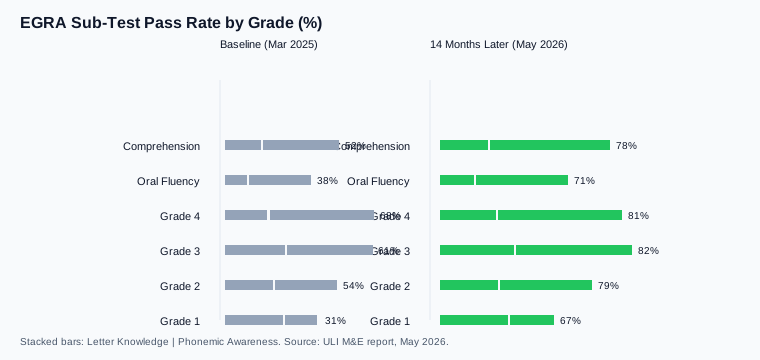
Operationally, 6,200 pens produced 18,400 charge cycles during the pilot. Only 47 pens were returned for warranty repair, an in-field defect rate of 0.76 percent, well inside the factory's AQL II ceiling of 1.0 percent Major. Twelve pens were lost, three were stolen, and four were damaged by water. The replacement order of 66 units was placed against the 12-month warranty pool that the supplier had pre-funded at 1.5 percent of order value.
The cost per child reached was USD 12.40 in hardware, USD 0.85 in training, and USD 1.20 in monitoring, for a fully-loaded cost of USD 14.45 per Grade 1 learner per year. Donor reporting compared this favourably to USD 28 per learner per year for a competing printed-text-only intervention.
A second-order impact was caregiver engagement. The 48 libraries ran 144 weekend reading-hour events during the pilot, attended by 16,200 unique caregivers. Of those, 8,400 (52 percent) borrowed a pen and an OID book set to take home for a seven-day loan. Loan compliance exceeded 96 percent, measured by return rate. This was a 4.2x increase in caregiver involvement compared to the same period in 2024.
A third measurable benefit was homework behaviour. A short telephone survey of 480 randomly selected caregivers, conducted in May 2026, found that 71 percent of parents reported their child now completed reading homework four or more nights per week, compared to 33 percent in the 2024 baseline. Average time-on-task per homework session rose from 12 minutes to 27 minutes.
| Outcome Indicator | 2024 Baseline | Pilot Result | Delta |
|---|---|---|---|
| Caregivers attending weekend reading hours (monthly avg) | 220 | 1,140 | +418% |
| Home pen-and-book loans per month | 350 | 2,180 | +523% |
| Loan return rate (7-day) | 88% | 96% | +8 pp |
| Children reading 4+ nights/week (caregiver report) | 33% | 71% | +38 pp |
| Avg. homework reading minutes per session | 12 | 27 | +125% |
From a sustainability perspective, ULI's board approved a revolving-replenishment clause in May 2026 committing 18 percent of the next grant cycle (approximately USD 41,000) to a 12-month spare-pen and replacement-book pool, so the 6,200-unit installed base can be maintained without a fresh donor round. This is the first time ULI has ring-fenced depreciation reserves against digital hardware.
6. Buying Guide, Product, and Application Cross-References
For readers replicating this model elsewhere in East or Central Africa, the reading pen specification checklist is a useful starting document. Distributors comparing the B2 and Q8 SKUs should review the B2 versus Q8 product comparison and the reading pen battery guide. Programmatic guidance on NGO deployments is covered in reading pen for NGO and UNICEF programs and reading pen for refugee education initiative.
7. FAQ
The most common questions fielded by ULI's procurement team during the rollout are answered below. Each answer references a specific number, contract clause, or verification step.
8. Related Reading
- How to import reading pens from China
- Reading pen HS code and customs duty
- Reading pen payment terms 30/70 explained
- Reading pen for NGO and UNICEF programs
- Reading pen for refugee education initiative
- Reading pen specification checklist
- Request a quote for a bulk reading pen order