

Audience: Importers, distributors, and brand managers responsible for Brazil market entry or expansion of reading pen SKUs in 2026.
Brazil's product certification regime operates through three parallel schemes that must be cleared before market entry. The first is INMETRO (Instituto Nacional de Metrologia, Qualidade e Tecnologia), which certifies electrical safety and EMC for regulated products. The second is Anatel (Agência Nacional de Telecomunicações), which certifies radio equipment. The third is the Portuguese-language labeling requirement under Inmetro Ordinance 563/2016 and consumer protection codes. Reading pens have historically fallen into the voluntary INMETRO category, but the 2026 INMETRO Ordinance 79/2026, published in February 2026 and effective 1 May 2026, moved electronic learning aids including reading pens into the mandatory Class II certification regime. For our eleven-model reading pen range — B1, B2, F8, K7, KF1, L5, P2, Q6, Q8, T2, Y6 — the impact is significant. Brazil represents approximately 5.2% of our global unit volume but the highest Latin American ASP at $82 ex-factory.
This article walks through the 2026 INMETRO Class II inclusion, the Anatel radio reform, the Portuguese-language labeling requirements, and the operational decisions that should be made before the next Brazil-bound shipment to avoid customs holds or market surveillance actions.
1. Executive Summary: The Three 2026 INMETRO Changes
| Change | Effective date | Importer action |
|---|---|---|
| Reading pens moved to Class II mandatory certification | 1 May 2026 | Apply for INMETRO Class II certificate |
| Portuguese-language manual mandatory | Already in force | Translate all user-facing content |
| Anatel radio certification module list expansion | 1 March 2026 | Verify module acceptance |
| INMETRO mark on product + packaging | 1 May 2026 | Update packaging artwork |
Buyer tip: Brazil is the most language-restrictive market in the Americas. An English-only user manual is the single most common cause of customs hold for reading pens at Brazilian ports. Portuguese translation must be in place before shipment, not after.
The Class II inclusion is the headline. Reading pens were previously voluntary INMETRO, meaning importers could self-declare safety compliance and ship without third-party certification. From 1 May 2026, mandatory INMETRO Class II certification is required, involving third-party testing and factory audit by an accredited certification body.
2. INMETRO Class II Certification for Reading Pens
Class II INMETRO certification requires:
- Test report from INMETRO-accredited lab (CCB or OCP accredited) covering IEC 62368-1, IEC 62133-2 (battery safety), and CISPR 32/35 (EMC)
- Brazilian Portuguese-language user manual with all safety warnings, operating instructions, and warranty information
- Brazilian Portuguese-language packaging including importer identification, country of origin, and warranty contact
- Factory audit by accredited OCP (Organismo de Certificação de Produto)
- INMETRO mark on product and packaging
- Certificate of Conformity valid for 3 years
| Cost line | Amount (BRL) |
|---|---|
| CCB/OCP lab testing | 18,000–28,000 |
| Brazilian Portuguese manual translation (16 pages) | 1,800 |
| Brazilian Portuguese packaging artwork | 2,400 |
| OCP factory audit (Brazil-based or remote) | 12,000–18,000 |
| Certificate issuance | 1,200 |
| Total per SKU (one-off) | 35,400–51,400 |
Lead time is 16–24 weeks from complete submission to certificate issuance. The bottleneck is the OCP audit queue, which has a 6–8 week wait in 2026.
| OCP | Location | Lead time | Audit fee (BRL) |
|---|---|---|---|
| TÜV Rheinland Brasil | São Paulo | 14 weeks | 12,000 |
| Bureau Veritas Brasil | São Paulo | 16 weeks | 14,000 |
| UL Brasil | Barueri | 22 weeks | 18,000 |
| SGS Brasil | Rio de Janeiro | 18 weeks | 13,000 |
3. Anatel Certification for BLE-enabled Reading Pens
For BLE-enabled reading pens (Q6, Q8, T2, Y6, KF1, L5), Anatel certification is a parallel requirement. The 2026 reform expanded the Anatel pre-certified module list and simplified the host integration verification.
| Aspect | Pre-2026 | Post-2026 |
|---|---|---|
| Module certification required | Yes, all modules | Pre-certified list accepted |
| Antenna pattern review | Manual case-by-case | Standardized pattern library |
| Host integration test | Required for all | Required only for non-standard configurations |
| Certificate validity | 2 years | 5 years (from 2026) |
The practical effect is that BLE-enabled reading pens using a pre-certified BLE module with a standardized antenna pattern now reference the module certification, saving 4–8 weeks of host integration testing.
| Cost line | Amount (BRL) |
|---|---|
| Anatel module reference fee | 4,200 |
| Host integration test (if required) | 14,000–22,000 |
| Anatel registration | 800 |
| Total per BLE SKU | 5,000–27,000 |
4. Portuguese-Language Manual Requirements
Brazilian Portuguese is not just a translation target — it is a regulatory requirement with specific content rules:
| Section | Required content |
|---|---|
| Cover page | Product name, model, importer name and CNPJ (tax ID) |
| Safety warnings | Portuguese translation of all IEC 62368-1 warnings |
| Operating instructions | Step-by-step usage |
| Battery safety | Disposal instructions per Brazilian Solid Waste Policy |
| Warranty terms | Minimum 90-day legal warranty |
| Consumer service contact | Brazilian address, phone, email |
| Country of origin | "Fabricado na China" or similar |
The 90-day legal warranty is the most commonly missed element. Under CDC (Código de Defesa do Consumidor), reading pen importers must provide a minimum 90-day warranty covering manufacturing defects. The warranty terms must be clearly stated in the Portuguese manual.
5. The Brazil Importer of Record (IOR) Requirement
Brazil requires a Brazilian-resident importer with a CNPJ (Cadastro Nacional da Pessoa Jurídica). The IOR must be:
- A Brazilian-registered business entity (typically a subsidiary, branch, or appointed distributor)
- Listed on the customs declaration (DI - Declaração de Importação)
- Holder of the INMETRO and Anatel certificates
- Responsible for recall coordination and consumer complaints
| Option | Annual cost (BRL) | Best for |
|---|---|---|
| Appoint Brazilian distributor as IOR | Variable; built into margin | Importers with established distribution |
| Establish Brazilian subsidiary | 24,000–60,000 (one-off) + annual | High-volume importers (>20,000 units/yr) |
| Use a third-party importer service | 8,400–18,000 | Most importers (recommended) |
| Appoint a Brazilian individual as IOR | Variable | Personal-network solutions |
6. Cost-Benefit Analysis: 2026 Brazil Market
For a distributor evaluating 2026 Brazil market entry, the financial case depends on annual shipment volume:
| Scenario | Volume (units/yr) | Per-unit cert cost | Verdict |
|---|---|---|---|
| Test market | <3,000 | $5.50+ | Marginal |
| Standard entry | 3,000–15,000 | $1.10–$5.50 | Viable with multi-SKU reuse |
| Major entry | >15,000 | $0.55–$1.10 | Strong; INMETRO amortizes quickly |
The breakeven point is approximately 7,000 units per year per SKU. Below that, the certification cost per unit is unattractive without multi-SKU reuse or shared factory audits.
7. 2026 Timeline and Workflow
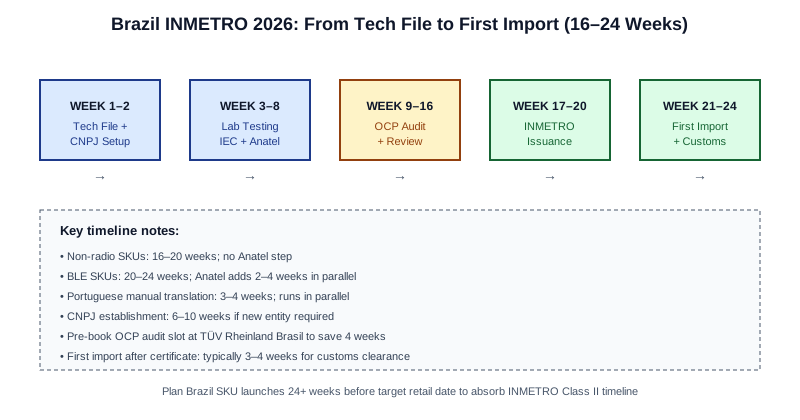
8. Beyond INMETRO: Other 2026 Brazil Requirements
Three additional compliance layers affect reading pens in Brazil:
LGPD (Lei Geral de Proteção de Dados). Reading pens with companion apps that process personal data of Brazilian children must comply with LGPD, which is broadly equivalent to GDPR. The ANPD (Autoridade Nacional de Proteção de Dados) has signaled 2026 enforcement priority on children's data, with stricter consent requirements for minors under 12.
CONARQ Plugs and Voltage. Brazil uses NBR 14136 plugs and 127V/220V at 60Hz. USB power adapters must be compatible, but reading pens themselves are typically powered by USB and are plug-agnostic.
Remade Logistica Reversa. Reading pen importers must register with a reverse logistics operator for end-of-life battery and electronics take-back, under the 2010 Solid Waste Policy (PNRS).
9. Cost Stack Summary for BLE-enabled SKUs
For a BLE-enabled reading pen entering Brazil in 2026, the total certification cost stack is:
| Cost line | Amount (USD) |
|---|---|
| INMETRO Class II lab testing | $1,150–$1,800 |
| Brazilian Portuguese manual + packaging | $270 |
| OCP factory audit | $770–$1,150 |
| Anatel radio certification | $320–$1,720 |
| CNPJ or IOR arrangement (one-off) | $1,400 |
| Annual ongoing | $330 |
| Total per SKU (one-off) | $3,910–$6,340 |
For an 8,000-unit annual shipment, the per-unit certification cost amortizes to $0.49–$0.79 per unit, which is manageable within the Brazil distributor margin structure.
10. Case Study: Multi-SKU Brazil Rollout
A representative 2026 multi-SKU Brazil rollout for our factory illustrates the practical cost structure for importers entering or expanding in Brazil. Consider a distributor that decides to launch six reading pen SKUs from our range — three non-BLE entry-tier (B1, B2, P2), one non-BLE premium (T2), and two BLE-enabled (Q6, KF1) — across the 2026 calendar year.
10.1 SKU Selection Logic
The selection prioritizes the highest-volume SKUs that share the most engineering and certification content. The Q6 BLE module, for example, is also used in KF1 with a similar antenna pattern, which allows the Anatel certification to be shared. Likewise, the IEC 62368-1 test report can be shared across all six SKUs because they use the same charger IC, same USB-C input, and same battery management topology.
| SKU | Brazil tier | INMETRO cert needed? | Anatel cert needed? | Shared content |
|---|---|---|---|---|
| B1 | Entry | Yes (Class II) | No | IEC 62368-1, Portuguese manual template |
| B2 | Entry | Yes (Class II) | No | Same as B1 |
| P2 | Entry | Yes (Class II) | No | Same as B1 |
| T2 | Premium | Yes (Class II) | No | Battery + enclosure variant |
| Q6 | BLE | Yes (Class II) | Yes | BLE module cert shared with KF1 |
| KF1 | BLE | Yes (Class II) | Yes | Same BLE module as Q6 |
The shared content strategy reduces the total test spend by roughly 35–40% versus certifying each SKU independently.
10.2 Cost Structure for the Six-SKU Rollout
| Cost line | Amount (BRL) | Per SKU equivalent |
|---|---|---|
| IEC 62368-1 base test (shared) | 22,000 | 3,667 |
| Battery IEC 62133-2 base (shared) | 16,000 | 2,667 |
| CISPR 32/35 EMC base (shared) | 18,000 | 3,000 |
| OCP factory audit (single visit, 6 SKUs) | 16,000 | 2,667 |
| Portuguese manual + packaging (6 SKUs) | 14,400 | 2,400 |
| INMETRO certificate issuance (6 SKUs) | 7,200 | 1,200 |
| Anatel module cert + 2 SKUs host integration | 28,000 | 14,000 (only Q6, KF1) |
| CNPJ/IOR one-off | 8,000 | 1,333 |
| Total rollout | 129,600 | 21,600 average |
The per-SKU cost averages BRL 21,600 (about USD 4,300) which is approximately 25–35% below the per-SKU cost of certifying each SKU independently. The savings come entirely from shared lab testing, shared factory audit, and shared Portuguese translation.
10.3 Timeline for the Six-SKU Rollout
| Quarter | Activity |
|---|---|
| Q1 2026 | Shared IEC + battery + EMC test cycle (8–10 weeks) |
| Q1 2026 | CNPJ establishment and OCP audit booking |
| Q2 2026 | OCP factory audit (single visit), Portuguese manual draft |
| Q2 2026 | Anatel module reference application for Q6 and KF1 |
| Q3 2026 | INMETRO certificate issuance (staggered, 6 SKUs over 4 weeks) |
| Q3 2026 | First import clearance for entry-tier (B1, B2, P2) |
| Q4 2026 | First import clearance for BLE (Q6, KF1) and T2 |
| Q4 2026 | Retail launch |
The total calendar time from kickoff to retail launch is 9–10 months, which is consistent with the 2026 Brazil market entry cycle for the typical importer.
10.4 What to Do Differently in 2027
Three 2027 refinements for Brazil-market importers to plan for:
- Consolidate BLE certification. As more BLE-enabled reading pen SKUs enter the Brazil market, the Anatel pre-certified module list will expand. By 2027, we expect 4–6 new pre-certified modules specifically tested with reading-pen antenna patterns. Planning the BLE portfolio around these modules will further compress host integration time.
- Negotiate multi-year OCP audit cycles. OCPs are increasingly willing to offer 3-year audit contracts for importers with stable SKU portfolios. A 3-year OCP audit contract for the B1, B2, F8, K7, KF1, L5, P2, Q6, Q8, T2, Y6 range saves approximately 20–25% versus year-by-year audit scheduling.
- Build the IOR early. Distributors who wait until their first shipment is ready before establishing CNPJ face 6–10 week delays. Establishing the IOR 6 months before first import saves one full quarter of timeline.
Related Reading
- NEWS-012 Mexico NOM-024 Reading Pen 2026
- BUYING-GUIDE: Import Reading Pens Brazil
- BUYING-GUIDE: Reading Pen Certification Transfer
- TECHNICAL: INMETRO Test Process
- PRODUCT: Brazil-Certified Models
- INDUSTRY: Latin America EdTech Market 2026