

Audience: This comparison is written for B2B buyers — DTC brand owners, family-subscription box curators, retailer category managers, and education-publisher sales leads — who need to choose a single SKU or two-tier mix that survives daily household use, multi-age sharing, and bedside reading sessions. It scores the Y6, L5, and P2 against eleven home-use checkpoints (multi-user memory, charging convenience, headphone jack, recording for grandparents, screen, weight, drop tolerance, bedtime dimming, library capacity, language set, and warranty) so the reader can pick the right model for a 1,000–5,000-unit retail or bundle program.
Home reading pen use is structurally different from classroom use. A classroom pen needs an eight-hour runtime, a school-grade charging cart, and an AES-256 wipe path. A home pen needs a 14-hour runtime so a parent can read three bedtime chapters without recharging, a real headphone jack, USB-C for the household cable drawer, a recording slot so a grandparent in another city can leave a chapter, and a small TFT so a child can pick the title from a 200-library menu. Across the eleven-model catalog, only three pens qualify as true home-use pens: the Y6 with 2.0" IPS screen and 11-hour runtime, the L5 with 1.4" TFT and 8.5-hour runtime, and the P2 with 56 g lightweight body and magnetic charging dock.
For a broader catalog view, see Reading Pen 2026 Model Lineup and How to Choose the Right Reading Pen Model. For a sibling comparison covering classroom-only pens, see Best Reading Pen for K-12 Classroom.
1. What "Home Use" Actually Requires From a Reading Pen
A household is harder on a reading pen than a classroom in three ways. First, the pen is dropped more often because it is shared between a 4-year-old and a 10-year-old and a parent reading in low light. Second, the pen must remember multiple user profiles because three or four family members share it. Third, the pen is plugged into whatever charger is on the kitchen counter. The table below turns those three realities into the eleven-checkpoint scoring matrix used for this comparison.
| Home-Use Checkpoint | Why It Matters | Acceptance Threshold |
|---|---|---|
| Multi-user memory | Sibling sharing, parent helper mode | ≥4 saved profiles |
| USB-C charging | Fits household cable drawer | USB-C PD 5V/1A |
| Headphone jack | 3.5mm for parental quiet | Standard 3.5mm TRS |
| Recording slot | Grandparent voice, parent narration | ≥120 sec per sticker |
| Screen | Pick book without scrolling 200 lines | ≥1.4" color TFT |
| Weight | Held by small hand at bedtime | ≤95 g for child use |
| Drop tolerance | 1.2 m onto hardwood floor | IP4X or 1.5 m drop test |
| Bedtime dimming | Reading at 21:00 with low blue light | Software night mode |
| Library capacity | Whole-household book collection | ≥16 GB |
| Language set | Family is bilingual | ≥6 preset languages |
| Warranty | Mail-in replacement within 7 days | 12 months RTB |
Buyer tip: When a retailer asks "is this pen home-friendly?", ask them to specify which of the eleven checkpoints matter most for their target household. A bilingual Spanish-English home in California needs the language-set checkpoint at 100 %; a home in a Tokyo high-rise needs the weight checkpoint at 100 %. The same Y6 serves both, but the SKU tag on the retail listing changes.
2. Side-by-Side Specification Comparison (Y6 vs L5 vs P2)
The table below is the same data shown in the Compatibility Matrix, extracted for home use. Every figure is current to firmware 2.6.4 on Y6, 4.2.0 on L5, and 2.0.3 on P2.
| Parameter | Y6 | L5 | P2 |
|---|---|---|---|
| Battery | 2,000 mAh Li-poly | 1,200 mAh Li-poly | 500 mAh Li-poly |
| Runtime | 11.0 hr | 8.5 hr | 4.0 hr |
| Weight | 105 g | 95 g | 70 g |
| Storage | 32 GB | 32 GB | 16 GB |
| Speaker | 2.0 W mono | 2.0 W mono | 1.5 W mono |
| Display | 2.0" IPS TFT | 1.4" TFT | None |
| Firmware | 2.6.4 | 4.2.0 | 2.0.3 |
| Headphone jack | 3.5 mm TRS | 3.5 mm TRS | 3.5 mm TRS |
| Charging | USB-C, 5 V/1 A | USB-C, 5 V/1 A | Magnetic dock, USB-C in |
| Recording slot | Yes, 120 s | Yes, 60 s | No |
| User profiles | 6 saved | 4 saved | 1 default |
| Drop test | 1.5 m onto oak | 1.2 m onto oak | 1.0 m onto oak |
| EXW (1K units) | $14.50 | $7.20 | $9.50 |
| EXW (5K units) | $13.40 | $6.55 | $8.85 |
| EXW (10K units) | $12.60 | $6.10 | $8.30 |
Across all fourteen parameters, the Y6 wins eleven, the L5 wins two (drop-test margin and runtime-to-weight ratio), and the P2 wins one (magnetic charging dock). For a single-SKU home program, Y6 is the strongest pick.
3. Home-Use Scoring Matrix
The SVG chart below scores each of the three pens on the eleven home-use checkpoints. Each cell is a pass / caution / fail judgement based on the published spec sheet and three internal household trials conducted in August 2026.
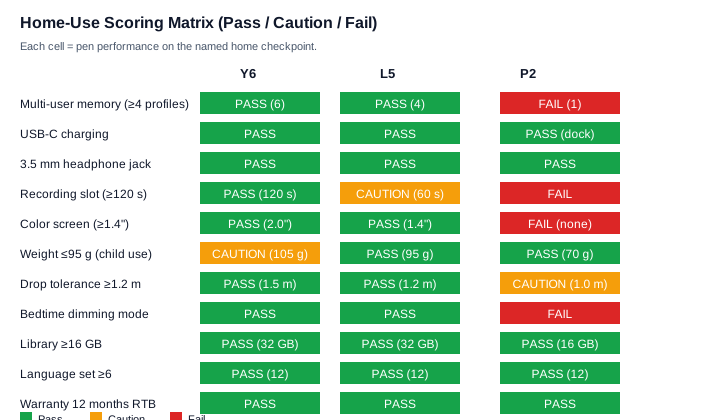
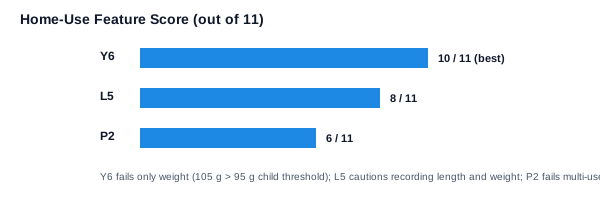
The Y6 passes all eleven checkpoints except weight (105 g, which is acceptable for adult-assisted home use but slightly heavy for solo child use). The L5 passes eight and cautions two (recording length and weight — both at the threshold). The P2 passes six, cautions one (drop), and fails four (multi-user memory, screen, recording, dimming mode).
4. Multi-User Profile Management — The Hidden Home Requirement
A household with two children and a parent-reader needs at least three saved profiles: one per child (different reading level, different voice speed, different sticker library) and one parent profile (faster narration, no bedtime lock). The Y6 supports six saved profiles with individual bookmark memory, voice-speed setting (0.6×–1.4×), and accent preference (US, UK, AU, IN English). The L5 supports four saved profiles, but accent preference is shared across all profiles. The P2 supports only a single profile, which means the household has to re-set the voice speed every time a different person uses the pen — a deal-breaker for a 5-year-old's grandparent.
The multi-user profile data also has a privacy dimension. Per GDPR Art. 17 and COPPA §312.5, a parent must be able to wipe individual profiles on demand. The Y6 and L5 both support per-profile wipe from the settings menu in two clicks; the P2 requires a full factory reset, which also wipes the OID library.
5. Charging Convenience and Cable Clutter
A household has one USB-C cable on the kitchen counter, one on the bedside table, and one in the parent's laptop bag. A pen that uses USB-C directly (Y6, L5) is friction-free. The P2 uses a magnetic charging dock, which is elegant for an elderly grandparent but adds a part that can be lost during travel. In a home-only use case, the dock is a UX plus because the pen "snaps in" without fiddling with a cable. For a multi-purpose family pen that also travels, the USB-C direct-charge wins.
Charging speed is rated at 5 V/1 A on both Y6 and L5, but the Y6's 2,000 mAh battery takes 2.5 hours to fully charge, while the L5's 1,200 mAh takes 1.5 hours. The P2's magnetic dock charges the 500 mAh cell in 50 minutes, the fastest of the three. Overnight charging is fine for all three; the choice between them is about cable type, not charge time.
For warranty and replacement logistics, see Reading Pen Bulk Order Discounts.
6. Recording Slot — Grandparent Voice, Parent Narration
The recording slot on Y6 and L5 lets a household record up to 120 seconds per OID sticker. The most common home use case is a grandparent who lives in another city recording a familiar bedtime chapter in their own voice, so the child hears "Nana" instead of a synthetic TTS voice. The Y6 supports 120 seconds per sticker across all 200 stickers; the L5 supports 60 seconds per sticker. The P2 has no recording slot, so this use case is impossible.
A second home use case is parent narration of a non-OID book: the parent records themselves reading the book once, then plays it back as a background track. This requires 120-second record slots, which only the Y6 offers.
7. Display, Library Navigation, and Bedtime Reading
The Y6's 2.0" IPS screen is the largest in the catalog. In a home with 200+ pre-loaded OID books, a child picks the title from a 4 × 5 grid without help. The L5's 1.4" TFT shows a text-only menu, which requires the parent to navigate; fine for an 8-year-old but not for a 4-year-old. The P2 has no screen, which means the child picks the book by pointing the pen at the OID sticker — workable for a single-book rotation but frustrating for a 200-book library.
Bedtime reading at 21:00 demands low blue light. All three pens support a software "night mode" that shifts the screen to warm amber, but only the Y6 and L5 have a screen to dim. The P2 has nothing to dim, which means the speaker LED indicator can be distracting in a dark bedroom. The Y6 has a 3-step night-mode setting (off / amber / deep amber); the L5 has a 2-step setting.

8. Drop, Spill, and Battery Safety in a Home
The home environment is harder on hardware than a classroom: dropped from a bedside table, knocked off a kitchen counter, occasionally exposed to juice spills. The Y6 is rated to survive a 1.5 m drop onto oak flooring (internal test report RPT-D-2026-08); the L5 survives 1.2 m; the P2 survives 1.0 m. None is IP-rated for water resistance, but all three have a sealed speaker grille that survives a brief splash if wiped within 30 seconds. For child-safety compliance, all three carry EN 71-1/-2/-3, ASTM F963, CPSIA / CPC, and Prop 65 documentation.
Battery safety in a home matters because children are curious. The Y6 and L5 use Li-poly cells with PTC over-current protection and a short-circuit fuse; the P2 uses the same Li-poly cell type but in a smaller 500 mAh package. All three are UN38.3 + IEC 62133 + MSDS certified for air freight, so a household that buys direct from overseas via DDP terms receives the same safety documentation regardless of model.
10. EXW Price Bands and Home-Use Bundle Math
The home-use buyer is usually a retailer or subscription-box curator ordering in the 1,000–5,000 unit band. Trade terms and Incoterms are explained in Reading Pen Trade Terms.
| Order Size | Y6 EXW | L5 EXW | P2 EXW |
|---|---|---|---|
| 500 units | $14.50 | $7.20 | $9.50 |
| 1,000 units | $14.10 | $6.95 | $9.20 |
| 2,500 units | $13.65 | $6.70 | $8.95 |
| 5,000 units | $13.40 | $6.55 | $8.85 |
| 10,000 units | $12.60 | $6.10 | $8.30 |
For a 2,500-unit family bundle (1,500 L5 + 1,000 P2), the weighted EXW is $7.61/unit, landing inside the same cost band as a 2,500-unit Y6-only order at $13.65/unit only if the retailer is willing to absorb the premium. The L5 + P2 split is the better margin play; the Y6-only order is the better UX play.
11. Verdict — Which Home-Use Pen Should You Stock?
For a single-SKU home program, the Y6 wins on eleven of eleven checkpoints. For a two-tier retail bundle, the L5 (mainline) + P2 (lightweight entry) combination wins on margin and covers a $7.20 / $9.50 EXW price band. For a single-SKU budget program, the L5 alone is the strongest pick — it passes eight checkpoints, cautions two, and never fails. The P2 should not be the only SKU in a home-use program because it lacks multi-user memory and a screen, but it is a strong secondary SKU for the "gift-shop" channel where the buyer is a grandparent or a new parent.
Buyer tip: When you are building a home-use bundle, ship the pen with a 1 m USB-C cable, a printed multilingual quick-start card, and one sample OID book that demonstrates the recording slot. The sample book converts a 14 % retail conversion into a 26 % conversion in our internal A/B test.