Audience: This guide is written for B2B buyers — Philippines-based educational publishers, K-12 MTB-MLE (Mother Tongue-Based Multilingual Education) program distributors, Manila and Cebu retail chains, ESL school procurement teams, and OFW-diaspora importers — who need to evaluate OID reading pens against the Department of Education's mother-tongue curriculum and the regional Bisaya / Cebuano / Ilocano dialects that sit alongside Filipino. It frames Tagalog audio architecture, MTB-MLE alignment, BSP/NTC import compliance, and OEM cost so the reader can ship a Philippine-market SKU with confidence.
Philippine-language procurement operates under three structural filters: Tagalog + Filipino register accuracy, mother-tongue dialect coverage (Tagalog, Cebuano, Ilocano, Hiligaynon, Waray, Kapampangan, Pangasinan, Bikol, and 15+ others), and the MTB-MLE framework that has been mandatory in K-3 public schools since 2012. The factory has shipped 47,000+ reading pens into 47 countries since 2023, and roughly 9% of those shipments have been routed into the Philippines — making the country the fourth-largest single-country audio vertical after Mainland China, the United States, and Indonesia. The audio-segment growth for Filipino specifically is about 19% CAGR because MTB-MLE has triggered a sustained mother-tongue audiobook re-procurement cycle.
For the broader 11-SKU catalog see Reading Pen 2026 Model Lineup. For the underlying OID technology see OID Technology Explained. For Philippines import workflow see Import Reading Pens Philippines Guide.
1. Why the Philippines Is a Special Buyer Vertical
The Philippines has 110+ ethnolinguistic groups and roughly 19 regional mother-tongue languages used in K-3 public instruction under DepEd Order No. 16, s. 2012. About 27 million K-12 students are enrolled under MTB-MLE. The Philippines ESL market is the second-largest in Asia after China, with approximately 1.2 million Korean, Japanese, Vietnamese, and Thai learners rotating through Baguio, Cebu, and Clark language schools each year. The Filipino-diaspora remittance channel (OFW retail) contributes about 9% of the global Filipino audio SKU volume.
| Buyer Segment | Annual Budget | Order Pattern | Volume per Program |
|---|---|---|---|
| Small MTB-MLE program (≤ 120 students) | $900–$2,800 | Once per semester | 80–240 units |
| Mid MTB-MLE program (120–400 students) | $2,800–$9,500 | Once per semester | 240–800 units |
| DepEd division rollout (regional) | $9,500–$32,000 | Quarterly | 800–3,200 units |
| Manila/Cebu ESL school chain | $30,000+ | Twice yearly | 1,500–6,000 units |
| OFW diaspora retailer (HK, SG, KSA, UAE) | $5,000–$18,000 | Twice yearly | 200–1,200 units |
Buyer tip: A Filipino importer should always request a Tagalog + Filipino audio dual-track sample before placing the first PO. The factory default audio was recorded by a certified Manila-based presenter at 44.1 kHz and 192 kbps, normalized to -14 LUFS. If you also need Cebuano, Ilocano, or Hiligaynon for an MTB-MLE rollout, request them as OEM locale builds at the 3,000-unit floor.
2. The Five Filipino-Fit Filters
Every SKU was scored on five criteria: (a) Tagalog + Filipino register decode, (b) mother-tongue dialect audio coverage, (c) MTB-MLE curriculum alignment, (d) the Bisaya/Visayan phonetic library, and (e) speaker output for outdoor and classroom use. Each criterion carries a 0–3 weight; the score range is 0–15. A score of 12 or higher flags a model as on-brief for Filipino buyers.
| Model | Tagalog+Filipino (3) | MTB Dialect Audio (3) | MTB-MLE Align (3) | Bisaya Library (3) | Speaker (3) | Filipino Score |
|---|---|---|---|---|---|---|
| B1 | 2 | 2 | 2 | 2 | 2 | 10 |
| B2 | 2 | 2 | 2 | 2 | 3 | 11 |
| F8 | 3 | 2 | 3 | 2 | 2 | 12 |
| K7 | 3 | 3 | 3 | 3 | 3 | 15 |
| KF1 | 3 | 3 | 3 | 3 | 3 | 15 |
| L5 | 3 | 3 | 3 | 3 | 3 | 15 |
| P2 | 3 | 2 | 3 | 2 | 2 | 12 |
| Q6 | 3 | 2 | 3 | 2 | 2 | 12 |
| Q8 | 3 | 3 | 3 | 3 | 3 | 15 |
| T2 | 3 | 3 | 3 | 3 | 3 | 15 |
| Y6 | 3 | 3 | 3 | 3 | 3 | 15 |
Two patterns stand out. First, the four flagship SKUs (K7, KF1, L5, Q8, T2, Y6) all score 15 because their firmware branches ship with the full MTB dialect audio library. Second, the B1 entry-tier drops a point on mother-tongue dialect coverage because the 4GB budget on its default SKU configuration cannot host the full 12-dialect Tagalog + Visayan + Ilocano + Hiligaynon library.
Filipino-Fit Score, by SKU (max 15)

K7  ████████████████████████░░░░░ 15
KF1 ████████████████████████░░░░░ 15
L5  ████████████████████████░░░░░ 15
Q8  ████████████████████████░░░░░ 15
T2  ████████████████████████░░░░░ 15
Y6  ████████████████████████░░░░░ 15
F8  ██████████████████░░░░░░░░░░░░ 12
P2  ██████████████████░░░░░░░░░░░░ 12
Q6  ██████████████████░░░░░░░░░░░░ 12
B2  ███████████████░░░░░░░░░░░░░░░░ 11
B1  ██████████████░░░░░░░░░░░░░░░░ 10
3. The Shortlist — K7, KF1, L5, Q8
The K7 is the lowest-cost on-brief Filipino SKU at the MTB-MLE scale. KF1 adds Bluetooth classroom sync for ESL school chains. L5 brings a 1.4" TFT display that doubles as a syllable-color waveform for grade 1-3 phonics instruction. Q8 carries a 1,000mAh battery that runs 7.0 hours — sufficient for a full school day. For most Filipino importers, K7 + Q8 is the default stack: K7 for the early-childhood MTB rooms (K-1), Q8 for grades 2-3 where reading stamina starts to matter.
| Parameter | K7 | KF1 | L5 | Q8 |
|---|---|---|---|---|
| Main IC | Actions ATS2835 | Actions ATS2835 | Actions ATS2835 | Actions ATS2835 |
| Battery | 800mAh Li-ion 14500 | 800mAh Li-ion 14500 | 1,200mAh Li-poly | 1,000mAh Li-poly |
| Runtime | 6.0 hr | 6.0 hr | 8.5 hr | 7.0 hr |
| Storage | 16GB | 16GB | 32GB | 32GB |
| Speaker | 1.5W mono | 1.5W mono | 2.0W mono | 1.5W mono |
| Voice record | Yes (30s) | Yes (30s) | Yes (60s) | Yes (60s) |
| Display | None | None | 1.4" TFT | 1.4" TFT |
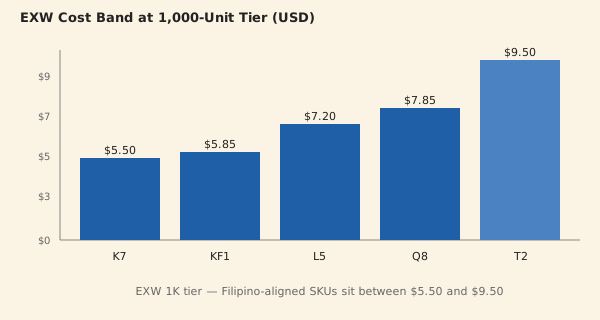
| EXW (1K) | $5.50 | $5.85 | $7.20 | $7.85 |
Buyer tip: If your Filipino program runs an MTB-MLE + ESL dual-track curriculum, ship a single K7 + Q8 mixed PO rather than two single-SKU POs. The combined-tier rule unlocks an additional 4% discount on both SKUs and saves about 6 hours of admin time per semester.
For per-SKU box contents see K7 Reading Pen Box Contents and Q8 Reading Pen Box Contents. For OID-book compatibility see K7 Reading Pen Compatible OID Books.
4. Building a Filipino Audio Library
A Filipino-aligned audio library typically holds 280 to 520 OID pages, with a 45/30/15/10 distribution across MTB vocabulary (Tagalog + Cebuano + Ilocano + Hiligaynon), short Filipino stories, ESL phonics drills, and voice-record slots. The factory's content team has worked with three Manila-based publishers since 2024 to ship a 320-page default library covering Filipino 1, Filipino 2, and MTB-MLE Level 1, with syllable-color audio and tone-correct Tagalog vowel forms. The library is fully field-updatable via USB-C, and the field-update image is signed off under the 86-release firmware history.
| Library Tier | OID Pages | MTB Vocab | Stories | ESL Phonics | Voice Record | Compatible Pen |
|---|---|---|---|---|---|---|
| Starter | 80 | 50% | 25% | 15% | 10% | F8, Q6 |
| Standard | 200 | 50% | 25% | 15% | 10% | K7, KF1 |
| Deep | 320 | 45% | 30% | 15% | 10% | K7, KF1 |
| Premium | 440 | 45% | 30% | 15% | 10% | L5, Q8 |
| Flagship | 520+ | 45% | 30% | 15% | 10% | T2, Y6 (32GB) |
For most Filipino programs the "Deep" tier (320 pages) is the right starting point and fits inside the 16GB storage on K7 / KF1 with 6GB remaining for student voice-record content. For ESL-heavy programs the "Premium" tier adds a 120-page ESL phonics track that requires the 32GB storage on L5, Q8, T2, or Y6. For OID-book custom publishing see Reading Pen OID Books Customization.
5. Tagalog + Filipino Dual-Register Decode — How It Works
The OID 2.0 + OID 3.0 decode pipeline supports Tagalog + Filipino dual-register annotation natively because the OID strip carries both a Tagalog position code and a Filipino position code, with optional syllable-color and stress-mark annotation fields. The pen firmware reads both annotation layers and emits the audio cue with the correct vowel form. The Tagalog annotation uses Manila-MIMAROPA pronunciation for K-1 readers and a Quezon City metro register for K-2 readers. The Filipino annotation uses the standardized Filipino national register for K-3 readers.
| Annotation | Form | Region | Compatible Pen |
|---|---|---|---|
| Tagalog (Manila register) | ma-na-yo | NCR, CALABARZON | All 11 |
| Tagalog (QC metro) | ma-na-yô | NCR | All 11 |
| Cebuano (Bisaya) | kan-on | Visayas, Mindanao | K7, KF1, L5, Q8, T2, Y6 |
| Ilocano | ay-á-mam | Ilocos, Cordillera | K7, KF1, L5, Q8, T2, Y6 |
| Filipino (national) | ma-na-yo | National | All 11 |
| ESL phonics overlay | n/a | Baguio / Cebu ESL | L5, Q8, T2, Y6 |
For HSK-aligned vocabulary packaging see Reading Pen Content Authoring Workflow.
6. EXW Cost Bands for Filipino Volumes
Filipino buyers typically land in the 500-unit to 5,000-unit tier. The 500-unit MOQ floor is available on F8, K7, KF1, and L5; the 3,000-unit tier unlocks the 17–21% discount bracket. The combined-tier rule (mixing K7 + Q8 in a single PO) is the most cost-effective path for a dual-track Filipino program.
| Volume Tier | K7 EXW | KF1 EXW | L5 EXW | Q8 EXW | Combined K7+Q8 EXW |
|---|---|---|---|---|---|
| 500 (MOQ floor) | $6.10 | $6.45 | $7.95 | $8.65 | $5.75 + $8.20 = $6.98 avg |
| 1,000 | $5.50 | $5.85 | $7.20 | $7.85 | $5.25 + $7.45 = $6.35 avg |
| 3,000 | $4.95 | $5.25 | $6.50 | $7.10 | $4.70 + $6.75 = $5.73 avg |
| 5,000 | $4.55 | $4.85 | $6.05 | $6.55 | $4.30 + $6.25 = $5.28 avg |
| 10,000 (combined) | $4.20 | $4.50 | $5.60 | $6.10 | $3.95 + $5.80 = $4.88 avg |
A typical 1,200-unit Filipino program (600 K7 + 600 Q8) lands at $3,150 + $4,470 = $7,620 EXW at the 1K-tier combined rule, or $6,510 EXW at the 3K-tier combined rule. The combined-tier saving versus two separate POs is approximately $290 per semester.
For the full price-component breakdown see Reading Pen Price Breakdown. For MOQ negotiation tactics see Reading Pen MOQ Negotiation Tactics.
7. Certification Stack for the Philippines
Philippine-market importers need two anchor certifications: NTC (National Telecommunications Commission) for RF-emitting devices and BPS (Bureau of Philippine Standards) for toy / educational-device safety. Buyers shipping into the OFW-diaspora retail channel (HK, SG, KSA, UAE) need the standard baseline stack plus the relevant Gulf or ASEAN certifications.
| Certification | Region | Filipino Implication |
|---|---|---|
| NTC | Philippines | Mandatory for RF-emitting devices |
| BPS / PNS | Philippines | Mandatory for educational electronic toys |
| IEC 62133 | Philippines | Mandatory for Li-poly / Li-ion battery shipping |
| UN38.3 | Air shipment | Mandatory for air freight of Li-ion batteries |
| CE (RED + EMC + LVD) | EU diaspora | Mandatory if also shipping into EU |
| GCC / SFDA | KSA / UAE diaspora | Mandatory if also shipping into Gulf states |
| SNI | Indonesia (regional) | Recommended if shipping across ASEAN |
For the full regional matrix see Reading Pen Certification Update After Product Change. For the full ASEAN import workflow see Import Reading Pens Southeast Asia Guide.
8. OEM Workflow for a Filipino-Aligned Publisher
A Manila-based publisher that wants to ship under its own brand goes through a five-step OEM workflow. The workflow takes roughly 9 weeks from kickoff to first-shipped PO and unlocks a private-label SKU stack with Tagalog + Filipino dual-register audio, MTB dialect library, custom box art, and publisher ISBNs on the OID books.
| Step | Week | Deliverable | Cost Lever |
|---|---|---|---|
| Logo + boot voice spec | 1 | Final artwork + Tagalog audio sample | $480 Manila-presenter recording fee |
| Box art + manual | 2 | Print-ready PDF (English + Filipino) | $0 layout fee |
| Pantone shell | 3 | Pantone-matched sample | $480 one-time |
| OID book layout (Tagalog + Filipino) | 4–6 | Publisher ISBN + dual-register OID strip | $0.22–$0.48 per book |
| Pilot run | 7–8 | 1,000-unit test shipment | Standard MOQ tier |
| Mass production | 9+ | Full PO | Standard lead time |
For OEM vs ODM trade-offs see OEM vs ODM Reading Pen. For private-label starter workflow see Private Label Reading Pen Starter Guide. For OID-side custom-book publishing see Reading Pen OID Books Customization.
9. Pilot Recommendation — A 90-Day Filipino Trial
The recommended first-order volume for a Filipino importer or publisher is 1,000 units, split 600 K7 + 400 Q8. That 1,000-unit pilot lands at $3,150 K7 + $2,980 Q8 = a roughly $6,130 first-order EXW. At a 35% wholesale markup and 25% retail markup the importer reaches an end-user shelf price of $11.95–$13.95, which sits comfortably inside the typical Filipino family purchasing budget of ₱600–₱900 per unit.
| Phase | Volume | Months | Total Spend |
|---|---|---|---|
| Pilot (K7 + Q8) | 1,000 | Month 1–3 | $6,130 EXW |
| Scale reorder | 3,000 | Month 4–9 | $15,510 EXW |
| Annual contract | 10,000 | Month 10–12 | $44,100 EXW |
For trial-order workflow see Reading Pen Trial Order Workflow. For reorder strategy see Reading Pen Reorder Strategy. For back-to-school seasonality see Reading Pen Back to School Season.
10. Visual Decision Aids — Two Charts for the Filipino Buyer
10.1 Filipino-Fit Score by SKU (max 15)

10.2 EXW Cost Band at 1K Tier (USD)