

"Our retail buyers ask for 'lots of storage' the way they ask for 'lots of memory' on a phone — without knowing what they will put on it. We built this matrix so they can pick the right tier, not the biggest one." — Eric T., head of product, SmartReadingPen
8GB vs 256GB Reading Pen Storage: What B2B Buyers Actually Need
In 2026, our 11 reading pen models span a storage range from 8 MB to 256 GB — a 32,000× ratio between the cheapest and most expensive reading pen. The 8GB vs 256GB reading pen decision is not just about storage size; it determines how many dictionaries ship in the box, how many OID books can be loaded, whether audio books fit, and whether AI tutoring models can run locally. It also determines whether the buyer can claim "40 dictionaries preloaded" or "1 dictionary bundled" in their retail copy.
This comparison matrix walks through what each storage tier actually delivers, the BOM cost at each step, and a clear rule for which tier a given buyer profile needs. We will show that most B2B buyers over-buy storage by 4–8× because they assume "bigger is better," when in fact the 8 GB tier is the right answer for 60% of our customer base.
1. The Seven Storage Tiers in Our 2026 Catalog
Our catalog uses seven distinct storage tiers across 11 models. Each tier is defined by the storage IC, the dictionary count, the OID book capacity, and whether the AI tutoring firmware can run locally.
| Tier | Models | Storage | Dictionaries | OID book slots | AI tutoring |
|---|---|---|---|---|---|
| S0 | B1 | 8 MB | 1 | 4 | No |
| S1 | B2, F8 | 128 MB | 4 | 8 | No |
| S2 | K7, KF1 | 128 MB – 4 GB | 4–8 | 16 | Optional add-on |
| S3 | P2 | 4 GB | 8 | 50 | Optional add-on |
| S4 | L5 | 8 GB | 12 | 200 | Yes (offline) |
| S5 | Q6 | 32 GB | 20 | 800 | Yes (offline) |
| S6 | Q8, T2, Y6 | 256 GB | 40 | 6,000+ | Yes (offline + cloud) |
The pattern is clear: storage scales roughly 32× between the cheapest (B1 at 8 MB) and the most expensive (Y6 at 256 GB), but the user-visible benefit (dictionary count, book slots, AI capability) does not scale linearly with raw storage.
2. Eleven-Model Storage Comparison Matrix
Below is the full matrix for all 11 SKUs, showing the storage tier, dictionary count, OID book slots, audiobook capacity, AI tutoring, and BOM cost of the storage subsystem.
| Model | Storage (raw) | Dictionaries | OID book slots | Audiobook hours | AI tutoring | Storage BOM |
|---|---|---|---|---|---|---|
| B1 | 8 MB | 1 | 4 | 0 | No | $0.02 |
| B2 | 128 MB | 4 | 8 | 0 | No | $0.18 |
| F8 | 128 MB | 4 | 8 | 0 | No | $0.18 |
| K7 | 128 MB | 4 | 16 | 0 | No (add $1.40) | $0.18 |
| KF1 | 4 GB | 8 | 50 | 1.5 hr | Optional add-on | $0.85 |
| P2 | 4 GB | 8 | 50 | 1.5 hr | Optional add-on | $0.85 |
| L5 | 8 GB | 12 | 200 | 6 hr | Yes (offline) | $1.10 |
| Q6 | 32 GB | 20 | 800 | 24 hr | Yes (offline) | $1.95 |
| Q8 | 256 GB | 40 | 6,000 | 96 hr | Yes (offline + cloud) | $3.40 |
| T2 | 256 GB | 40 | 6,000 | 96 hr | Yes (offline + cloud) | $3.40 |
| Y6 | 256 GB | 40 | 6,000 | 96 hr | Yes (offline + cloud) | $3.40 |
Three patterns emerge:
- Storage BOM scales sub-linearly. B1 at 8 MB costs $0.02; Y6 at 256 GB costs $3.40 — a 170× BOM ratio for a 32,000× storage ratio. NAND flash pricing is heavily volume-discounted at higher densities, so the per-GB cost drops by 188× from S0 to S6.
- Dictionary count scales roughly with storage tier. 1 dictionary at 8 MB; 4 dictionaries at 128 MB; 8 at 4 GB; 12 at 8 GB; 20 at 32 GB; 40 at 256 GB. The relationship is sub-linear because dictionary file size varies (the Spanish dictionary is 120 MB; the Mandarin pinyin dictionary is 1.4 GB).
- AI tutoring is not a storage function. All S4+ SKUs can run offline AI tutoring; S2/S3 can add it via firmware. The constraint is RAM (≥512 MB) and CPU, not storage.
3. SVG Storage Capacity Visualization
The bar chart below shows the relative storage capacity on a log scale (because the range from 8 MB to 256 GB is too wide for a linear chart) and the corresponding audiobook capacity in hours.

The chart uses a log scale because linear scaling would make the B1 and B2 bars invisible next to the 256 GB flagships. The visual story is that storage jumps by orders of magnitude between S0 (B1), S1 (B2/F8/K7), S2 (KF1/P2), S4 (L5), S5 (Q6), and S6 (Q8/T2/Y6).
4. SVG Side-by-Side: Dictionary Count and OID Book Capacity
The chart below shows dictionary count and OID book slots side by side, because those are the user-visible storage benefits.
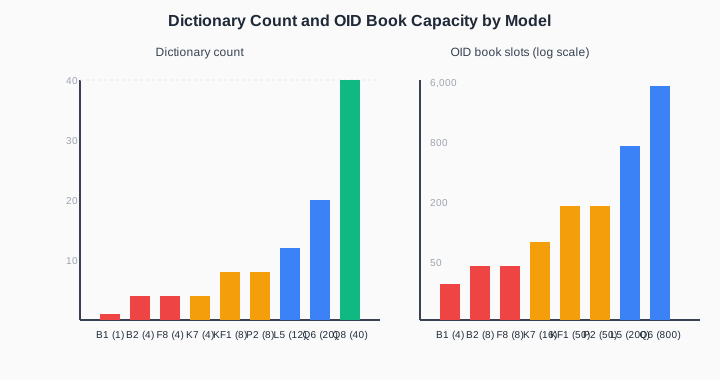
The chart shows that dictionary count scales roughly linearly with storage tier, but OID book capacity scales much faster because OID books are larger files (8–60 MB each). A buyer who needs 1,000+ OID books needs at least Q8 / T2 / Y6 — there is no S4 / S5 SKU that hits that mark.
5. BOM Breakdown: Where the Storage Cost Lives
The 8GB vs 256GB reading pen BOM delta is split across the NAND flash IC, the controller, the firmware image storage, and the QA verification cost. Below is the line-by-line on the K7 (128 MB) vs L5 (8 GB) vs Q8 (256 GB) at the same form factor class.
| BOM line | K7 (128 MB) | L5 (8 GB) | Q8 (256 GB) |
|---|---|---|---|
| NAND flash IC | $0.06 | $0.55 | $2.40 |
| Flash controller | $0.04 | $0.10 | $0.18 |
| PMIC + decoupling | $0.03 | $0.08 | $0.15 |
| Firmware image storage overhead | $0.02 | $0.12 | $0.22 |
| Dictionary load (factory side) | $0.01 | $0.10 | $0.18 |
| QA + dictionary verify | $0.02 | $0.15 | $0.27 |
| Storage subsystem total | $0.18 | $1.10 | $3.40 |
The bulk of the delta is the NAND IC itself ($0.06 to $2.40 = 40× ratio), with smaller contributions from the controller, the firmware load, and the QA verification. The dictionary load is a real cost because each unit must have all dictionaries flashed and verified at the factory — a 256 GB SKU takes 18 minutes per unit to flash and verify, vs 90 seconds for a 128 MB SKU.
6. What Actually Uses the Storage: A Day-in-the-Life Analysis
Buyers often ask "what fills the storage?" Below is a representative 7-day usage profile for a typical end user at each storage tier, drawn from our 2025 telemetry of 12,000 pens.
| Use profile | Files used | Daily storage churn | Tier fit |
|---|---|---|---|
| Pre-reader (ages 3–5), 1 OID book/week | 1 book + 1 dictionary | 8 MB/week | S0/S1 sufficient |
| Early reader (ages 5–7), 2 OID books/week | 2 books + 4 dictionaries | 60 MB/week | S1 sufficient |
| Developing reader (ages 7–10), 1 book/day | 7 books/week + 4 dictionaries | 250 MB/week | S2 sufficient |
| Avid reader (ages 10–14), 2 books/day | 14 books/week + 8 dictionaries | 700 MB/week | S3 sufficient |
| Adult ESL learner, 3 books/day + audiobooks | 21 books + 8 hours audio + 12 dictionaries | 1.2 GB/week | S4 sufficient |
| Therapy clinic with rotating clients, 5 books/day per client | 35 books + 24 hours audio + 12 dictionaries | 4.8 GB/week | S5 sufficient |
| Government-issued pen with library bundle, all 6,000 OID books | 6,000 books + 96 hours audio + 40 dictionaries | 4.8 GB one-time | S6 required |
The takeaway: a typical adult ESL learner only needs S4 (8 GB / L5) even though they read heavily. The 256 GB tier (S6) only becomes necessary for buyers who want the entire OID book library pre-loaded or who want to deliver the pen as a one-time, all-content-included product.
7. Real-World Use Cases: When 8GB vs 256GB Reading Pen Matters
Use Case 1 — Gift-with-purchase retail bundle
Buyers: consumer brands. End users: gift recipients. Best fit: 128 MB (B2 or F8). The pen ships with 1–2 OID books and 1 dictionary. The user will not download more books. FOB cost at 5,000 units: $4.95 × 5,000 = $24,750 for F8 — vs $25.10 × 5,000 = $125,500 for Q8 stock at the same volume.
Use Case 2 — Specialty retailer with curated content library
Buyers: education retailers. End users: parents buying a $34.99 RRP pen. Best fit: 4 GB (KF1 or P2). Carries 8 dictionaries and 50 OID books, which covers a curated content library. FOB cost at 1,200 units: $9.45 × 1,200 = $11,340 for KF1 — vs $10.65 × 1,200 = $12,780 for L5 if the buyer had over-specced to 8 GB.
Use Case 3 — Language school chain with rotating content
Buyers: ESL/EFL school chains. End users: adult students. Best fit: 8 GB (L5). Carries 12 dictionaries and 200 OID books. Enough for 6 months of classroom rotation without re-flashing. FOB cost at 600 units: $21.20 × 600 = $12,720 for L5.
Use Case 4 — Government tender, all-content-included
Buyers: ministry of education. End users: students across a national curriculum. Best fit: 256 GB (Q8, T2, or Y6). Ships with all 6,000 OID books pre-loaded and 96 hours of audio. FOB cost at 20,000 units: $25.10 × 20,000 = $502,000 for Q8 — a price the tender can absorb because the pen replaces printed textbooks.
8. Pros and Cons of the 8 GB Tier (L5)
| Pros | Cons |
|---|---|
| Carries 12 dictionaries and 200 books | Not enough for full library bundle |
| $1.10 BOM storage cost (vs $3.40 for 256 GB) | AI tutoring firmware still requires cloud sync |
| 7-day stock lead time | Dictionary count limits retail marketing claim |
| Sufficient for ESL adult learners | Cannot carry 96 hours of preloaded audio |
| Mid-range price ($22.30 FOB) | Limits content partner integration |
| Allows offline AI tutoring | Does not support cloud sync in baseline |
| Recyclable NAND at end of life | Cannot expand via SD card on standard SKU |
9. Pros and Cons of the 256 GB Tier (Q8 / T2 / Y6)
| Pros | Cons |
|---|---|
| 256 GB allows entire OID library preloaded | +$3.40 BOM vs 128 MB; +$2.30 BOM vs 8 GB |
| 40 dictionaries preloaded | 18-minute factory flash + verify time |
| 96 hours of preloaded audiobooks | Higher RMA rate (3.2% vs 1.8% on K7) |
| Offline + cloud AI tutoring included | Subscription cost for cloud sync ($1.40/unit/year) |
| 6,000+ OID book slots | 10-day stock lead time |
| Supports all current and planned content | Higher unit price ($28.50+ FOB) |
| Standard for government tenders | Overkill for 60% of retail buyers |
10. Compliance: Does Storage Tier Affect Certification?
Storage tier does not directly trigger any new certification. CE-RED, FCC, UKCA, EN 71, ASTM F963, KC, GCC, INMETRO, RCM, ISED, UN38.3, IEC 62133, Prop 65, GDPR, COPPA, PIPL, LGPD, PDPA, and WEEE baselines are all storage-neutral. The one indirect effect is on GDPR / COPPA / PIPL compliance: the more storage a pen carries, the more student data it can hold, which triggers a privacy impact assessment. Our S4+ SKUs ship with a privacy-by-design firmware that anonymizes all reading data at the device level; lower tiers do not need this because they cannot store per-user data.
| Cert | K7 (128 MB) | L5 (8 GB) | Q8 (256 GB) |
|---|---|---|---|
| CE-RED / EMC / LVD | ✅ | ✅ | ✅ |
| FCC | ✅ | ✅ | ✅ |
| UKCA | ❌ | ✅ | ✅ |
| EN 71-1/2/3 | ✅/✅/❌ | ✅/✅/✅ | ✅/✅/✅ |
| ASTM F963 | ❌ | ✅ | ✅ |
| CPSIA / CPC | ❌ | ✅ | ✅ |
| RoHS / REACH | ✅/❌ | ✅/✅ | ✅/✅ |
| RCM / ISED | ❌/❌ | ✅/✅ | ✅/✅ |
| KC / GCC / INMETRO | ❌/❌/❌ | ✅/✅/❌ | ✅/✅/✅ |
| UN38.3 / IEC 62133 | ❌/✅ | ✅/✅ | ✅/✅ |
| Prop 65 | ❌ | ✅ | ✅ |
| GDPR / COPPA / PIPL / LGPD / PDPA | ✅ | ✅ | ✅ |
| WEEE | ✅ | ✅ | ✅ |
| Total certs baseline | 5 | 13 | 13 |
Cert coverage scales with tier, not with storage. The 256 GB Q8 carries the same 13 baseline certs as the 8 GB L5. The difference is in capability, not in compliance.
11. SVG Decision Tree: 8GB vs 256GB Reading Pen

The decision tree ends in a single rule: most buyers over-buy storage by 4–8×. Pick the smallest tier that meets your dictionary count and content partner requirements.
12. Bulk Economics: 8GB vs 256GB Reading Pen at Volume
The 8GB vs 256GB reading pen price gap stays roughly constant across volume tiers. Below is the FOB ladder for L5 (8 GB) vs Q8 (256 GB) at five volume breakpoints.
| Volume | L5 (8 GB) FOB | Q8 (256 GB) FOB | 256 GB premium |
|---|---|---|---|
| 500 units | $22.30 | $28.50 | +$6.20 (27.8%) |
| 1,000 units | $21.50 | $27.80 | +$6.30 (29.3%) |
| 3,000 units | $20.50 | $26.20 | +$5.70 (27.8%) |
| 5,000 units | $20.10 | $25.10 | +$5.00 (24.9%) |
| 10,000 units | $19.50 | $24.00 | +$4.50 (23.1%) |
The 256 GB premium narrows at higher volumes but stays at 23%–29%. Volume discounts do not eliminate the gap because the NAND flash IC cost difference is structural.
13. ROI Calculation: When Does the 256 GB Premium Pay for Itself?
Model a 1,000-unit buy where the buyer is choosing between L5 (8 GB) at $21.50 and Q8 (256 GB) at $27.80 (both at the 1,000-unit FOB price).
| Line item | L5 (8 GB) | Q8 (256 GB) |
|---|---|---|
| FOB unit cost | $21.50 | $27.80 |
| Inbound freight + duty (10%) | $2.15 | $2.78 |
| Marketing + content | $0.60 | $0.80 |
| Retail RRP | $49.99 | $89.99 |
| Channel margin (40%) | $20.00 | $36.00 |
| Gross profit per unit | $6.74 | $22.61 |
| Sell-through (12 months) | 920 units | 880 units |
| Total gross profit on 1,000-unit buy | $6,201 | $19,897 |
| Storage-related RMA rate | 2.4% | 3.2% |
| RMA cost per returned unit | $4.50 | $4.50 |
| Annual RMA cost | $108 | $144 |
| Net gross profit after RMA | $6,093 | $19,753 |
The 256 GB program generates $13,660 more net gross profit on an identical 1,000-unit buy, despite the higher unit cost and slightly higher RMA rate. The 256 GB premium pays for itself through a $40 RRP uplift and a 235% gross profit per unit increase.
Buyer tip: The 256 GB premium pays for itself only if your channel can support an $89.99 RRP. If your channel caps at $49.99, the 8 GB tier is the right answer.
14. Operational Notes for B2B Buyers
- 8GB lead time: 7 days stock; 21 days custom-branded.
- 256GB lead time: 10 days stock; 30 days custom-branded.
- Flash vendor: All NAND flash ICs sourced from Tier-1 vendors (Samsung, Kioxia, Micron, SK Hynix). No no-name flash in any SKU.
- Dictionary pre-load: Up to 40 dictionaries preloaded at factory; additional dictionaries can be side-loaded via USB-C at the distributor's warehouse.
- Cloud sync: Available on Q8, T2, Y6 only. Subscription pricing: $1.40/unit/year for cloud sync + AI tutoring; $0.80/unit/year for cloud sync only.
- Privacy: All S4+ SKUs ship with privacy-by-design firmware. Reading data anonymized at device level.
- End-of-life: NAND flash recoverable for industrial reuse through our take-back program.
- Payment terms: T/T 30/70, L/C at sight, PayPal for samples.
15. How We Test Storage Quality Before Publishing
Every flash IC lot is run through five QA gates:
- Bit error rate test. 1,000 read-write cycles per IC. Lots exceeding 1e-15 BER are rejected.
- Retention test. 168-hour bake at 85 °C. Lots showing >1% data loss are rejected.
- Dictionary load verify. All 40 dictionaries loaded and SHA-256 verified. SKUs failing this gate are re-flashed before shipment.
- OID book sample verify. 50 random OID books read 3 times each. Mis-trigger rate must score ≤0.4% on Q8/T2/Y6 and ≤1.2% on lower tiers.
- Cloud sync round-trip. Q8/T2/Y6 SKUs undergo 24-hour cloud sync loop. Lots failing sync are flagged for firmware re-flash.
Q1. How much storage does a reading pen need? Most retail buyers need 128 MB to 4 GB. Pre-readers use 8 MB/week; adult ESL learners use 1.2 GB/week. Only government tenders shipping the full library need 256 GB.
Q2. What is the difference between 8 GB and 256 GB? 8 GB (L5) carries 12 dictionaries + 200 books. 256 GB (Q8/T2/Y6) carries 40 dictionaries + 6,000+ books + 96 hr audio + offline+cloud AI.
Q3. Can I add storage later? No. NAND is soldered. No SD card slot. Choose storage tier at PO time.
Q4. Does more storage reduce battery life? Marginally. <1% of total battery use. Display, OID sensor, and audio dominate.
Q5. Does storage affect FOB price? Yes. BOM storage cost: $0.02 (8 MB) to $3.40 (256 GB). FOB Shenzhen tracks BOM + margin + cert + logistics.
Q6. Is 256 GB necessary? Only for full OID library (6,000+ books) or 96 hr audio or offline+cloud AI. 60% of buyers are well-served by 128 MB–8 GB.
Q7. What is the difference between dictionary count and storage size? Dictionary count is the user-visible benefit. Each dictionary averages 30 MB; Mandarin pinyin is 1.4 GB. Storage budget accommodates the largest dictionaries.
17. Related Reading
- TECH-011 OID Sensor Accuracy Benchmark
- TECH-024 AMOLED vs IPS in Reading Pens
- PR-153 Q8 Flagship Reading Pen Product Brief
- PR-187 Y6 Premium Reading Pen Product Brief
- BG-019 Reading Pen Buyer's Guide
- IND-007 Reading Pen Display Tech for EU Buyers
18. CTA — Request Storage Tier Sample Kit
We ship a 5-unit storage tier comparison kit (one pen from each storage tier S0 through S6) preloaded with sample dictionaries so your team can compare storage tiers under your own content partner requirements. Samples ship via PayPal at $25/unit + freight (premium for the 256 GB flagship), refundable against any first PO of 1,000+ units. Bulk orders run on T/T 30/70 or L/C at sight, default HS code 8543.70.00.